
How tiny eye implants are opening new doors for those with vision loss
For patients with advanced vision loss, reading a sign or a book was once impossible. But now, a tiny implant placed inside the eye is allowing some people to regain functional sight, including the ability to magnify images up to twelve times.
Age-related macular degeneration, or AMD, is the leading cause of irreversible vision loss in older adults. An estimated 200 million people worldwide are affected by the disease (1). In its late-stage form, known as geographic atrophy, AMD progressively destroys the retina’s light-sensitive photoreceptors in the central region of the eye. These cells normally convert incoming light into electrical signals that travel through the optic nerve to the brain. As photoreceptors deteriorate, central vision fades, leaving patients unable to read, recognize faces, or see fine detail (2).
In recent years, scientists have started developing retinal implants aimed at restoring sight by replacing the function of damaged photoreceptors. One of the most advanced and successful of these technologies is the Photovoltaic Retina Implant Microarray, also known as PRIMA (2).
Developed by researchers at Stanford University, the PRIMA system consists of two main components. A small camera mounted on a pair of glasses captures visual information, converts it into infrared light in real time, and transmits it to a tiny wireless chip. This two-by-two millimeter chip, implanted beneath the retina in areas where photoreceptors have deteriorated, processes the light and conveys electrical signals to the brain. Because natural photoreceptors cannot detect infrared light, this prosthetic vision does not interfere with any remaining healthy, peripheral vision (2).
Clinical trial results for PRIMA have been promising. In a study published in The New England Journal of Medicine, 32 participants over the age of 60 with advanced geographic atrophy received the implant and followed up a year later. Of those patients, 27 regained the ability to read and 26 demonstrated clinically meaningful improvements in visual acuity, defined as gaining at least two additional lines on an eye chart (3). On average, participants improved by five lines, with one patient improving by twelve lines. When using digital features such as zoom and increased contrast, some patients achieved vision equivalent to approximately 20/42, allowing them to read books, food labels, and subway signs (2).
Safety outcomes were also examined: 19 participants experienced a total of 26 serious adverse events, including increased eye pressure, peripheral retinal tears, and bleeding beneath the retina. Most of these events occurred within the first two months of surgery, and nearly all (95%) complications resolved within two months of onset. Furthermore, the participants’ natural peripheral visual acuity remained the same after the implant, indicating that the device did not compromise remaining healthy vision (3).
Moving forward, researchers are working to improve the technology further. The current PRIMA system provides only black and white vision, but software updates are expected to enable full grayscale and color, which are essential for tasks like recognizing faces. Resolution is another area of development. The current chip contains 378 pixels, but next-generation versions may have up to 10,000 pixels per chip (2).
PRIMA is not necessarily a cure for blindness, but it serves as a viable alternative. As researchers continue to improve the device, retinal implants may become an increasingly useful tool in treating degenerative vision loss.
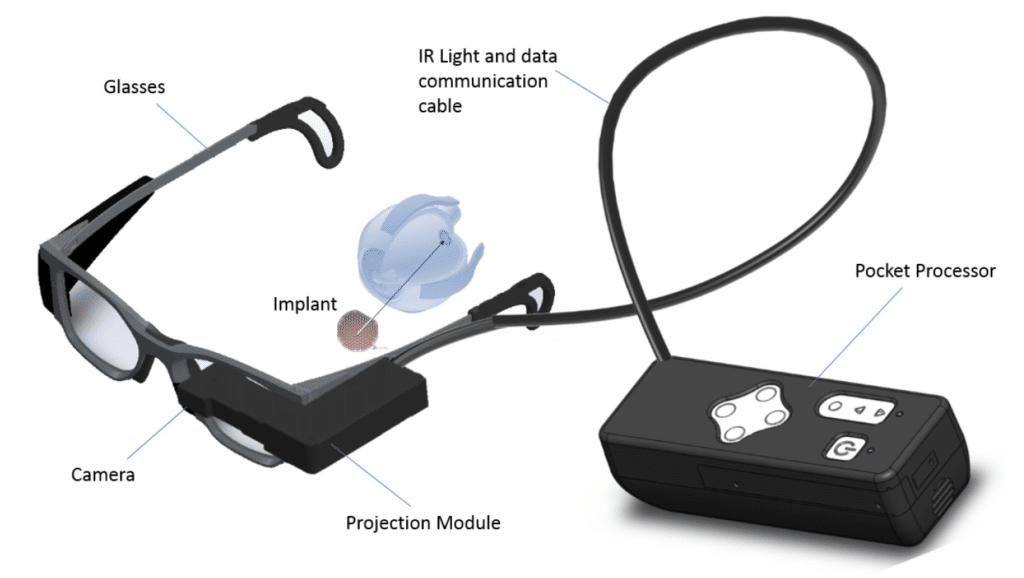
A visual representation of PRIMA (a)

Before and after effects of using PRIMA. Left: visual representation of the sight of an AMD patient. Right: What an AMD patient sees with PRIMA implanted (b)
References:
- Vyawahare, H. et al. (2022, Sep 26). Age-Related Macular Degeneration: Epidemiology, Pathophysiology, Diagnosis, and Treatment. Cureus. 14(9). doi.org/10.7759/cureus.29583
- Bai, N. (2025, Oct 20). Eye prosthesis is the first to restore sight lost to macular degeneration. Stanford Medicine. https://med.stanford.edu/news/all-news/2025/10/eye-prosthesis.html
- Holz, F. et al. (2025, Oct 20). Subretinal Photovoltaic Implant to Restore Vision in Geographic Atrophy Due to AMD. New England Journal of Medicine. 394(3). 232-242. doi.org/10.1056/NEJMoa2501396
Images:







Comments are closed.