
Pushing the Limits in the Pursuit of Efficiency
In the midst of the Space Race, just one year before the Saturn V rocket and its Rocketdyne F-1 engines shot astronauts to the moon, Rocketdyne was investigating an entirely different propulsion system. Stepping beyond the bounds of conventional liquid engines, which ignite two propellants to create thrust, the company sought after the extremely efficient yet complex tripropellant rocket (1). But why? What hurdles did Rocketdyne face in making this technology a reality? And what valuable insights did the program’s failure lend to the pursuit of spaceflight?
Specific impulse is the name of the game. This metric measures how much thrust a rocket engine can produce per unit of fuel—essentially an indicator of efficiency. Because fuel comprises 90% or more of a typical rocket’s weight, improving the specific impulse of engines is a priority for the entire industry; increased impulse enables weight reduction, more payload to orbit, and more mission possibilities (2). One of the most efficient chemical rocket types ever flown, the Space Shuttle’s blue-plumed RS-25 engine, had a specific impulse of ~452 seconds, whereas the Saturn V’s F-1 engine had only ~304 seconds of specific impulse (1). These engines are bipropellant engines: they mix and ignite liquid oxygen with a fuel (hydrogen and kerosene, respectively) to produce thrust. However, by introducing a third propellant, specific impulse can be catapulted to much higher values. With their tripropellant engine, Rocketdyne accomplished just that, achieving a stunning 542 seconds of specific impulse—a value that leaves every other chemical rocket in the dust (1,3). So why don’t we see Rocketdyne’s impressive technology in use?
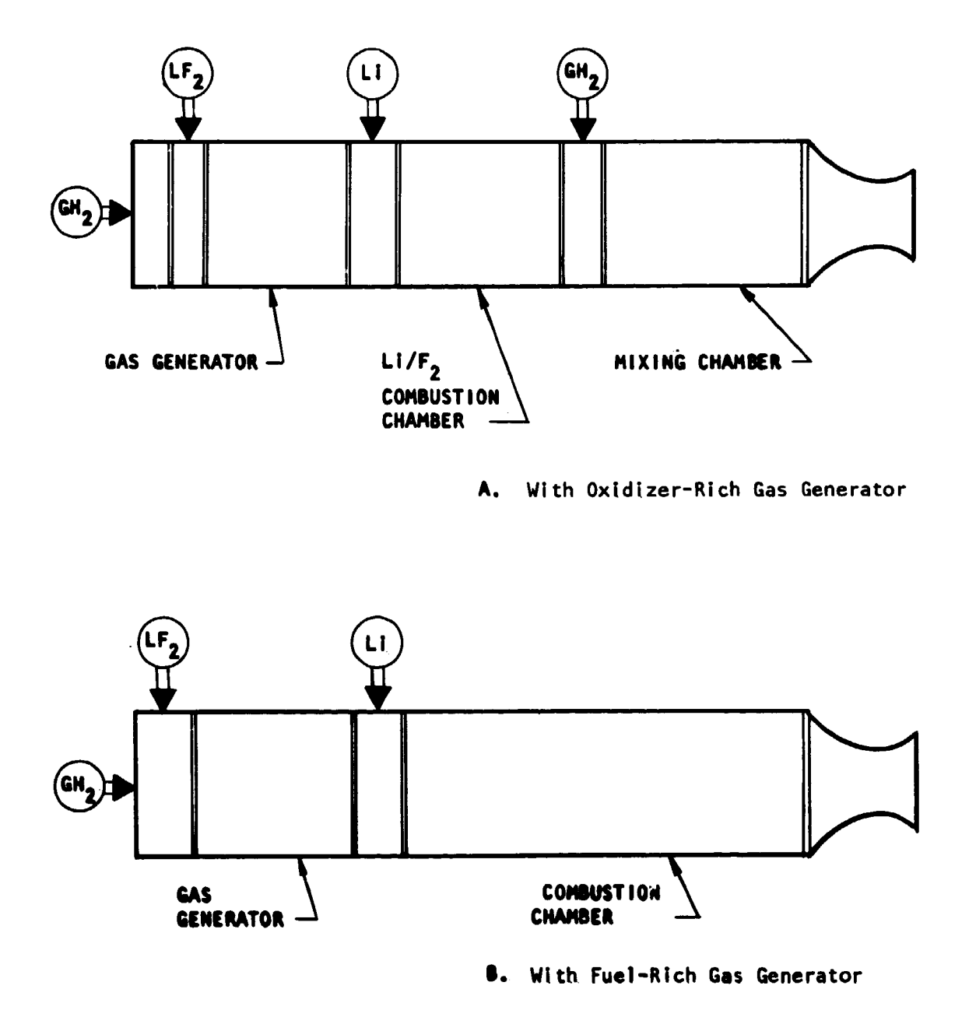
The main issue is the engine’s chemistry. Conventional engines use a combination of liquid oxygen and liquid hydrogen, kerosene, or methane. These elements burn in the combustion chamber. Through the rearrangement of oxygen, carbon, and hydrogen atoms into water and carbon dioxide, heat is produced, driving the gases out of the engine to create thrust (1).
But Rocketdyne had no interest in convention. In order to create the most energetic combustion reaction, engineers sought an element with even higher reactivity than hydrogen: lithium. Given its high energy per unit mass, this material would significantly bolster the engine’s power. However, lithium is solid at room temperature, so Rocketdyne chose to melt the lithium and inject it as liquid droplets into the engine’s combustion chamber (1,3). This decision invited more risks—namely, that liquid lithium ignites on contact with air and also corrodes the piping it travels through (1). Yet the tripropellant rocket team hoped to take their pursuit a step further.
Enter fluorine, which Rocketdyne used in place of oxygen. Oxygen is typically the enabler of combustion, since it seeks bonds with hydrogen and carbon atoms in order to release energy. Fluorine is the only element with an even higher “pull” towards forming bonds in this manner, so the Rocketdyne engineers used it for even more efficiency (3,4). As if lithium was not already reactive enough, fluorine reacts explosively with any material it contacts, and the tripropellant team was storing it in liquid form (1)!
Because lithium and fluorine reactions result in heavy, slow-moving exhaust products, the engineers reintroduced hydrogen as a light third propellant to improve efficiency. Thus, the most volatile engine in history was born. This liquid-fueled rocket did not need a way to ignite—its propellants were so reactive that they set alight on contact. Furthermore, the engine had to be purged of air before each test run to prevent the liquid lithium from exploding (1). Lastly, a complex ignition sequence was needed to pre-heat the engine so that the lithium-fluorine reaction could proceed at a high rate (1, 3).
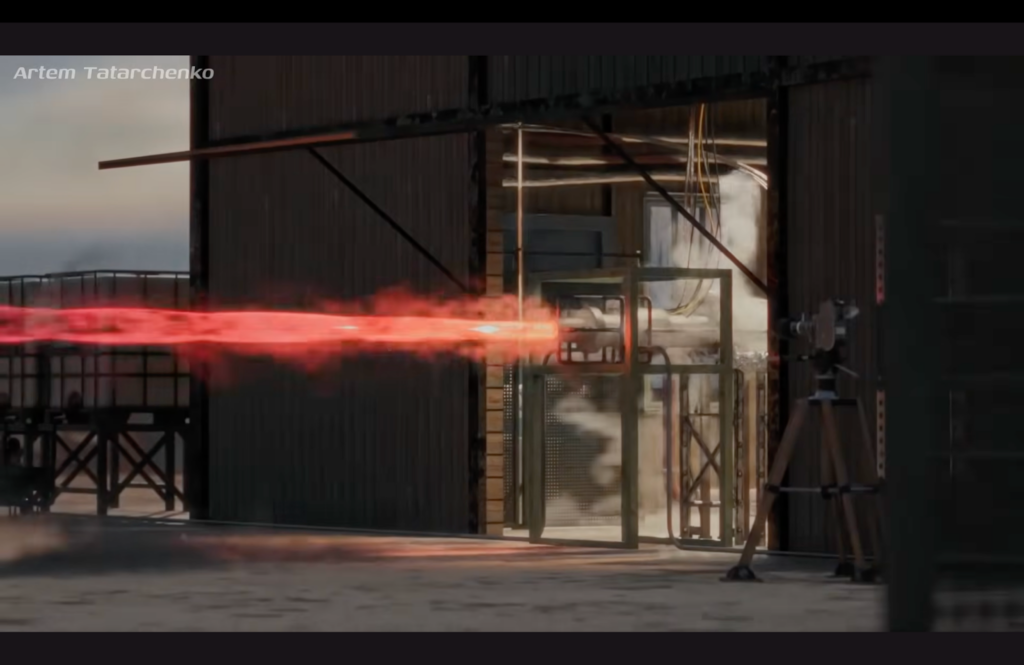
Rocketdyne had achieved the impossible, and it stayed impossible. The engine reached 542 seconds of specific impulse, but it only ever fired in ten-second intervals. The complexities of managing molten lithium with corrosive liquid fluorine and supercooled liquid hydrogen were too great to manage. Here, the limits of chemistry had come face-to-face with the limits of human engineering and safety. No spacecraft could equip such an engine, and nobody would approve an engine that could poison both crew and environment with its gaseous byproducts (1). The engine never flew, nor did it approach practical feasibility. It sat on the test stand and was disassembled. The next year, astronauts traveled to the Moon and back on the simple oxygen-kerosene engine.
So what, then, was the point of such a study? Why stretch safety and feasibility so far in the name of specific impulse? Was it worth it at all?
Of course. Science and engineering fundamentally require the pushing of limits. You cannot know a task is impossible until you confirm that it is not. That mentality brought humanity to the Moon and back and delivered us the technologies of the modern world. Failure is inevitable in the process. But failure informs us as much as success. There’s a reason we only use bipropellant rockets. Sometimes testing does not give us something new, but instead sends us back to what we already have and that, too, is science.
Images
- https://ntrs.nasa.gov/api/citations/19700018655/downloads/19700018655.pdf
- https://www.youtube.com/watch?v=KX-0Xw6kkrc
Sources
- Alexander the ok. (2025, February 24). The Best Performing (and most dangerous) Chemical Rocket Ever Tested: Rocketdyne Tripropellant. YouTube. https://www.youtube.com/watch?v=KX-0Xw6kkrc
- StarTalk. (2021, February 9). Neil deGrasse Tyson Explains the Rocket Equation. YouTube. https://www.youtube.com/watch?v=-73MZsj8bVI&t=145s
- Arbit H.A., Clapp S.D., Nagai C.K. (1970, May). Lithium-Fluorine-Hydrogen Propellant Investigation (Report No. NASA-CR-72695). National Aeronautics and Space Administration. https://ntrs.nasa.gov/api/citations/19700018655/downloads/19700018655.pdf
- Jaccaud M., Faron R., Devilliers D. et al. (2020, March 23). Fluorine. In Ullmann’s Encyclopedia of Industrial Chemistry. Weinheim: Wiley-VCH. https://doi.org/10.1002/14356007.a11_293.pub2








Comments are closed.