
AlphaFold’s breakthrough in predicting protein structures
What if we could understand the building blocks of life and the meaning behind the twists and turns of every protein in our body? AlphaFold is an artificial intelligence (AI) system created by DeepMind focused on solving scientific problems through the use of AI. DeepMind noticed the struggles the structural biology world had dealt with for many years, causing them to take initiative and make advancements in the problem (1). It uses machine learning to predict 3D protein structures (2). Because of its accuracy and speed, AlphaFold has allowed scientists to study protein structures in far greater detail at an unprecedented rate. This technological breakthrough has led to the discovery of numerous new drugs and materials, along with helping those studying protein structure to gain a more complete understanding. AlphaFold has accelerated advances in biology by accomplishing what would take scientists thousands of years to do (3).
Proteins are chains of amino acids folded into 3D shapes. The structure of proteins determines their function. However, determining their structure is a complicated task. Even small rearrangements in their structure can create an entirely unique protein and function. Of the approximately 250 million known proteins, scientists have only figured out a small percentage of their structures. This percentage keeps getting smaller each year, as scientists cannot keep pace with the rate of newly discovered proteins. Given the billions of proteins across living organisms, as well as the time-consuming and expensive nature of traditional methods, scientists have searched for an effective solution for many years.
Throughout the 1950s and 1960s, scientists used experimental techniques, such as x-ray crystallography and nuclear magnetic resonance to determine protein structures. At the start of the 21st century, cryogenic electron microscopy (cryo-EM) gained popularity. Despite the effectiveness of these past methodologies, many struggled with the volume they had to handle. That is where AlphaFold differs (4).
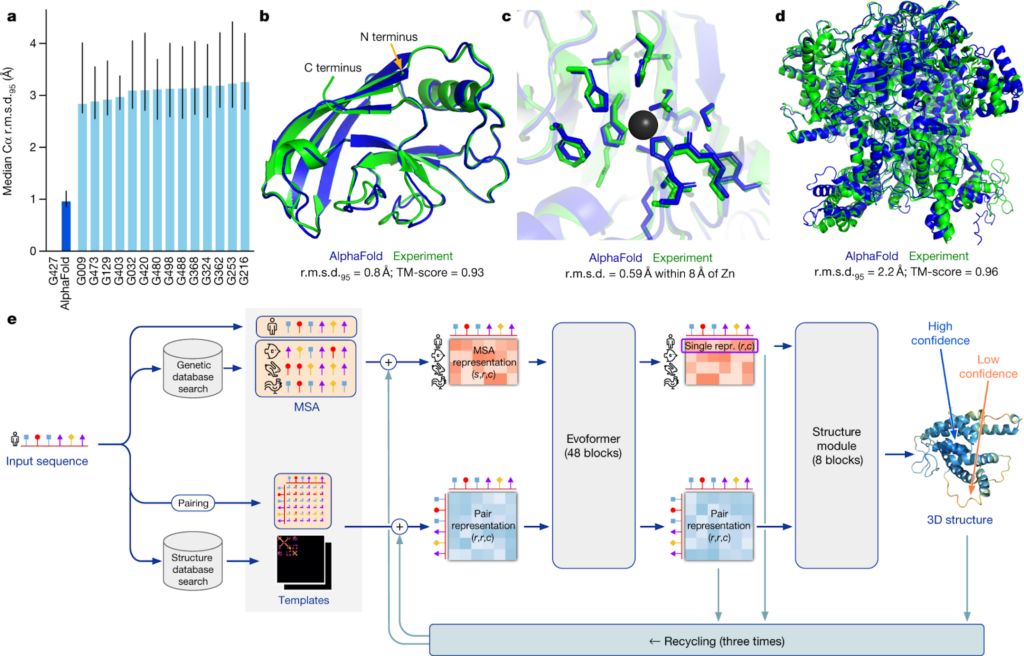
AlphaFold works by scanning an unknown amino acid sequence and matching it to previously known structures stored in a large database. The AI then predicts which amino acids will remain in the structure through changes over time. From this, the distances between each amino acid are found, along with a repetitive process to determine which way they fold. Each cycle clarifies earlier predictions. Next, AI uses transformers (neural networks) to focus on key components of the structure. Finally, the process is repeated until AlphaFold reaches a final structure (5).
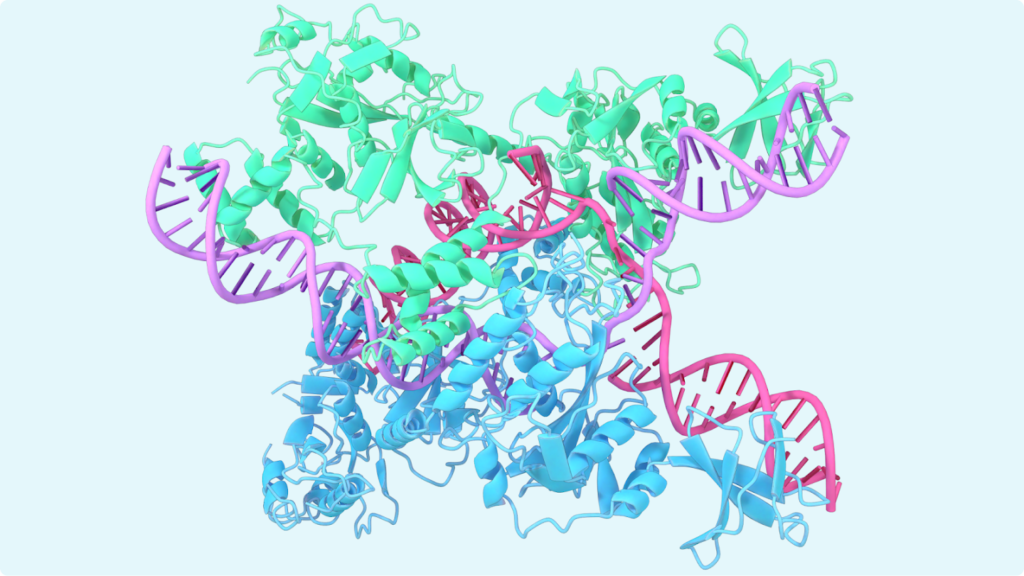
While AlphaFold is a revolutionary breakthrough in protein structure prediction, it has both strengths and limitations. This system is highly effective at predicting structures of single proteins, protein complexes, and protein multimers. However, AlphaFold struggles to handle many variables beyond structure, such as multiple folds, single-point mutations, and dynamic changes. Additionally, AlphaFold cannot accurately model protein interactions with RNA or DNA, binding with small or charged molecules, or changes made to the protein after it is made (6).
Despite these limitations, AlphaFold’s invention has transformed countless scientific fields. With improvements in technology made every day, it shows great promise to impact how we view life at the molecular level. Despite that, AlphaFold still faces numerous technological constraints that need to be addressed before further reliance. With more time and research spent to understand protein structures and to develop AlphaFold, it has the potential to revolutionize biology and medicine through faster research speeds, allowing us to study new areas previously inaccessible.
Sources:
- (n, d). “Our mission is to build AI responsibly to benefit humanity.” DeepMind. https://deepmind.google/about
- (n, d). What is AlphaFold?. EMBL-EBI. https://www.ebi.ac.uk/training/online/courses/alphafold/an-introductory-guide-to-its-strengths-and-limitations/what-is-alphafold/
- (n, d). DeepMind AlphaFold: Revolutionizing Protein Folding Predictions. GAIN Theraputics. https://gaintherapeutics.com/perspectives/deepmind-alphafold-protein-folding-structure-prediction-everything-we-know-till-now/
- (n ,d). What are proteins and how do we know their structures?. EMBL-EBI. https://www.ebi.ac.uk/training/online/courses/alphafold/an-introductory-guide-to-its-strengths-and-limitations/what-are-proteins-and-how-do-we-know-their-structures/
- Jarnestad, J. (n, d). How does AlphaFold2 work?. The Royal Swedish Academy of Sciences. https://www.nobelprize.org/uploads/2024/11/fig2_ke_en_24-5.pdf
- (n, d). Strengths and limitations of AlphaFold 2. EMBL-EBI. https://www.ebi.ac.uk/training/online/courses/alphafold/an-introductory-guide-to-its-strengths-and-limitations/strengths-and-limitations-of-alphafold/
Images:




Comments are closed.