
The legacy of the XB-70 experimental bomber
In search of a replacement to the aging B-52 Stratofortress strategic bomber, the U.S. Air Force sought for a high-speed, high-altitude alternative to carry out strategic bombing missions—and more notably, nuclear strikes (1). In the 1950s when the XB-70 Valkyrie was first conceptualized, its planned maximum speed of Mach 3 (three times the speed of sound) with an altitude of up to 73,000 feet meant that it would be untouchable to the SA-1 Guild, the Soviet Union’s first Surface-to-Air missile (2). Before the first XB-70 prototype was even built, the military demands shifted away from the strengths the bomber provided. The Soviet intercontinental ballistic missile R-7 Semyorka saw its first successful test on August 21, 1957, becoming the world’s first operational intercontinental ballistic missile, or ICBM (3). The United States soon followed with the development of its own Atlas ICBMs in the late 1950s (4).
The final nail in the coffin for the XB-70’s military aspirations came on May 1st, 1960. On the eve of the Paris Summit planned between Eisenhower and Khrushchev to soothe tensions, a U-2 spy plane piloted by Gary Powers was shot down over the Ural Mountains during a reconnaissance flight over Soviet territory (5). Despite being not nearly as fast as the Valkyrie’s planned top speed of Mach 3, the U-2 shared a similar maximum altitude of around 70,000 feet. This incident, coupled with the rapid rise of the faster and cheaper ICBMs, led the USAF to cancel the B-70 bomber program (6).
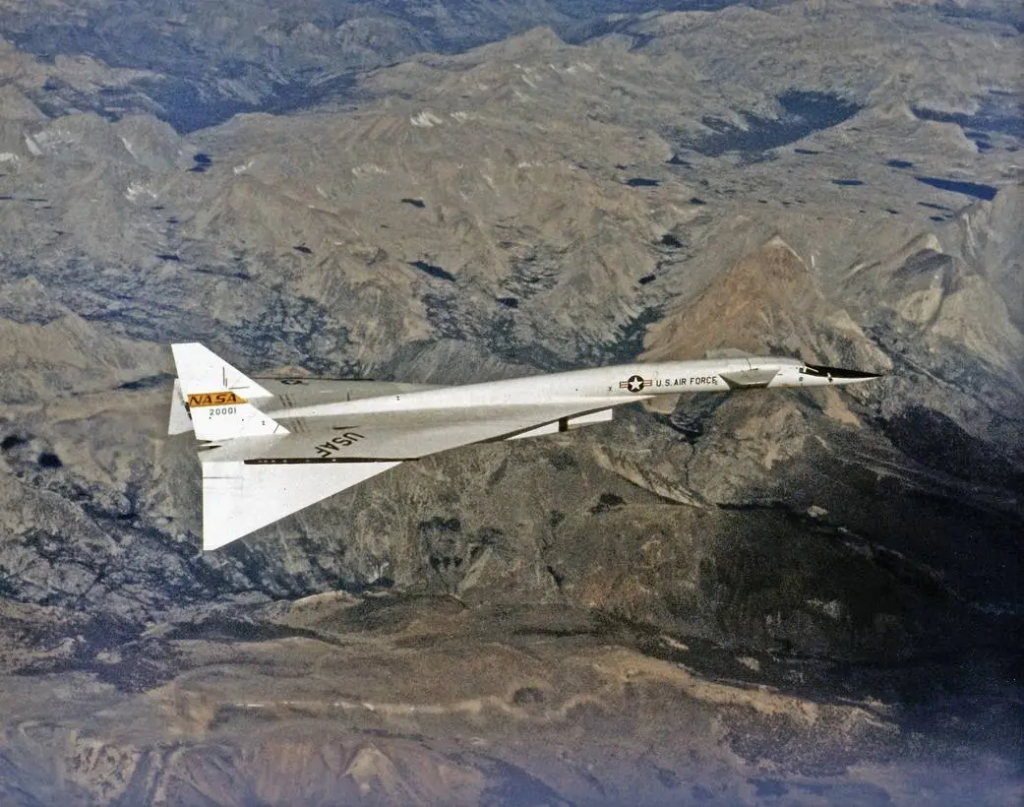
Despite these setbacks, the Valkyrie’s story didn’t end here. Coincidentally, interest in Supersonic Transport (SSTs) grew as well, following the boom of jet travel (7). Similar to projected designs in both size and construction, the XB-70 in construction by North American Aviation was soon repurposed by NASA to become a testbed for supersonic transport (6).Six General Electric YJ93 afterburning engines powered the XB-70, each producing upwards of 30,000 lbs of thrust that propelled it to a top recorded speed of Mach 3.1 (1).
The design allowed the jet to manipulate the air from shockwaves generated by supersonic flight at the front of the aircraft to the intakes and undersides, creating greater pressure underneath the aircraft. As the lower pressure air over the top of the aircraft tries to stabilize with the bottom, higher-pressure airflow, the XB-70 is able to ride its own supersonic shockwaves in what’s called “compression lift” (8). Its wingtips were hinged, allowing it to sit flat during takeoff, landing, and slow-speed flight for more lift or pivoting downwards in supersonic flight to reduce drag and create more yaw control (6).
The first XB-70 made its first flight on September 21, 1964. The early data it provided immediately highlighted the issues of supersonic transport, such as noise, control surface design, flight data, etc. (6). The early promise of the first prototype further encouraged NASA to procure the second XB-70 testbed, which included design modifications from telemetry given by the first prototype and avionics updates. Combined, the two prototypes conducted 129 total flights between 1964 to 1969 (1).
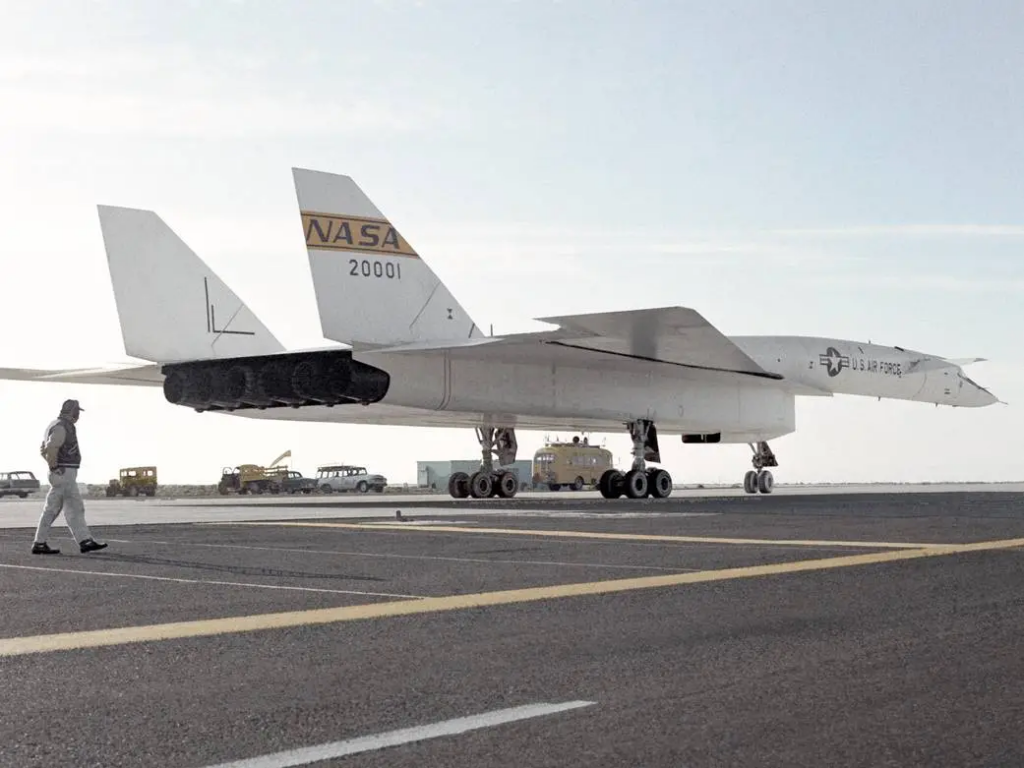
Unfortunately, the test programs never reached their full potential. NASA had planned more high speed research flights with the second, more advanced XB-70. However, on June 8 of 1966–a little over a year since its first flight, the second XB-70 crashed after a mid-air collision with an observing NASA F-104N (6). Joe Walker, the F-104N pilot, and Major Carl Cross, co-pilot of the XB-70, died from the incident. Though more test flights occurred with the remaining first prototype, eventually in 1969, the program was overshadowed by the YF-12C, which could log more Mach 3+ hours in a single flight than the total Mach 3+ flight time of both XB-70s combined (6).
Bibliography
- North American XB-70 Valkyrie. (n.d.). National Museum of the United States Air ForceTM. https://www.nationalmuseum.af.mil/Visit/Museum-Exhibits/Fact-Sheets/Display/Article/195767/north-american-xb-70-valkyrie/
- Fought, S. O. (1999, July 26). Rocket and missile system | Definition, Types, & Facts. Encyclopedia Britannica. https://www.britannica.com/technology/rocket-and-missile-system/Tactical-guided-missiles#ref520945
- Logsdon, J. M. (2015). R-7 | missile and launch vehicle | Britannica. In Encyclopædia Britannica. https://www.britannica.com/technology/R-7
- The Atlas Missile (U.S. National Park Service). (n.d.). Www.nps.gov. https://www.nps.gov/articles/atlas-icbm.htm
- Office of the Historian. (2019). U-2 Overflights and the Capture of Francis Gary Powers, 1960. State.gov. https://history.state.gov/milestones/1953-1960/u2-incident
- XB-70 Valkyrie – NASA. (2014, February 28). https://www.nasa.gov/aeronautics/xb-70-valkyrie/
- National Air and Space Museum. (2024). The Jet Age. Airandspace.si.edu. https://airandspace.si.edu/explore/stories/jet-age
- Boom Supersonic. (2021, September 7). Boom – FlyBy – From Bomber to Supersonic Testbed: Explore the XB-70 Valkyrie with the National Museum of the U.S. Air Force. Boom. https://boomsupersonic.com/flyby/xb70-from-bomber-to-supersonic-testbed
Images







Comments are closed.