
A deployment system inspired by ancient origami techniques
I’m sure you remember cleanup day at bivouac, when everyone wrestled with their gear and tried to cram sleeping bags back into the ridiculously small sacks they came in. It’s a simple problem, but it mirrors a challenge space engineers deal with on a much larger scale. Rockets offer very limited room, and the space equipment is only getting larger. To solve this problem, NASA has turned to origami-inspired designs. Folding patterns let massive structures launch compactly and then unfold perfectly once they reach space.
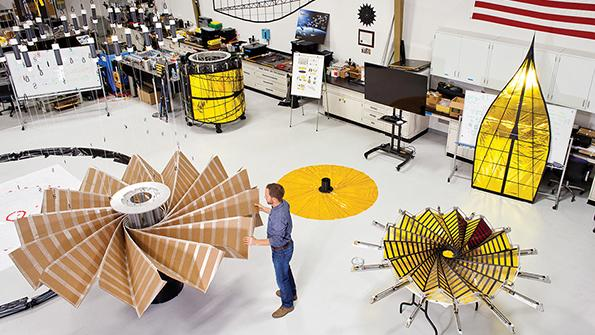
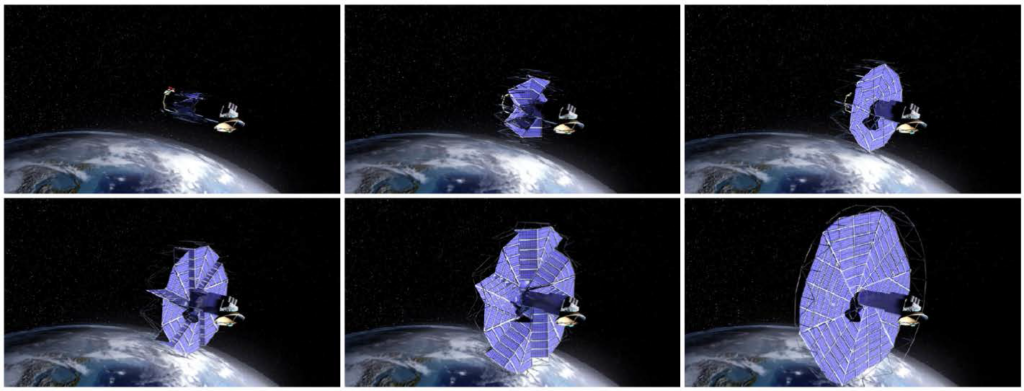
Space is unforgiving when it comes to size and weight. Every extra kilogram costs millions, and every extra inch has to fit inside a rocket with fixed dimensions. Traditional mechanical designs, such as hinges or motors, can only shrink things so far before they become too heavy or too complicated to trust. Origami solves this problem by letting a structure collapse along repeatable folds, which, by contrast, use the material’s own geometry to move. Therefore, fewer parts can break, and there is far less risk during deployment. Using this method, engineers can take something massive, like a solar array the size of several basketball courts, and fold it into a compact shape that fits neatly inside the rocket (1).
Once the spacecraft reaches orbit, those same folds let the structure expand with a pretty simple deployment system. Instead of relying on dozens of joints that could jam, the material just follows the geometry it was designed with. These folding techniques are especially important for components that need to be large to work well. For example, solar arrays need a huge surface area to collect sunlight, or high-gain antennas that require wide dishes for strong signals (2). One of the most common patterns engineers use is the Miura fold, a zig-zag layout that allows a large sheet to collapse into a small rectangle and then unfold in a single, smooth motion (3).
But origami doesn’t only work for flat surfaces like solar panels. Some antennas and scientific instruments use three-dimensional folding patterns, which let scientists pack down spacecraft pieces like a spring, and then they pop into shape when they’re in space. NASA has even tested structures made from flexible composites that “remember” an unfolded form. They’re folded on the ground and stored inside the rocket. Then, they are triggered to expand once they reach orbit. It’s a relatively simple idea, but solves a huge engineering problem: how to launch something big without actually launching something big (4).
These designs have already influenced real missions. One notable example is Starshade, a giant flower-shaped screen designed to block light from stars so telescopes can photograph distant planets. This system depends entirely on origami geometry (5).
The idea of using origami in space engineering may seem complex, but is actually relatively simple. It lets us take the big or delicate structures and shrink them into something a rocket can actually carry. Once in orbit, they unfold into the tools that make science exploration possible. This approach has expanded what engineers can build, allowing missions to be larger, lighter, and more ambitious than ever before.
Bibliography
- Nishiyama, Y. (2012). Miura folding: Applying origami to space exploration. International Journal of Pure and Applied Mathematics, 79(2), 269–279. https://www.ijpam.eu/contents/2012-79-2/8/8.pdf
- Origami-based Deployable Fiber Reinforced Composites | T2 Portal. (n.d.). Technology.nasa.gov. https://technology.nasa.gov/patent/LAR-TOPS-372
- “Communicating from Space: Gaining a Grip on Antennas.” Www.esa.int, www.esa.int/Science_Exploration/Space_Science/Rosetta/Communicating_from_space_gaining_a_grip_on_antennas2.
- Capturing the art and science of NASA’s origami starshade. (2023). Photography. https://www.nationalgeographic.com/photography/article/art-science-nasa-starshade-origami-behind-the-cover-february?loggedin=true&rnd=1769089888339
- An engineer uses an ancient art to solve a very modern problem. (2022, July 18). Stanford University School of Engineering; Stanford University. https://engineering.stanford.edu/news/engineer-uses-ancient-art-solve-very-modern-problem
Images








Comments are closed.