
What is it and how does it work?
When most people hear the word “vaccine,” they think of routine childhood shots for the flu that help stop an infection before it starts. Moderna’s experimental cancer vaccine, however, works entirely differently—it’s a therapeutic vaccine designed to treat patients who already have cancer and prevent it from ever coming back (1).

The treatment, known as mRNA-4157 or V940, uses the same messenger RNA (mRNA) technology that became famous during the COVID-19 pandemic (1). Each person’s cancer has a distinct genetic fingerprint. To build the vaccine, doctors surgically biopsy a patient’s tumor and sequence its DNA (2). Then, algorithms analyze the tissue to identify up to 34 unique mutated proteins called neoantigens. Neoantigens are found exclusively on those cancer cells and nowhere else in the body, so they signal to the immune system exactly where to target and destroy those cells (1). Moderna synthesizes a custom mRNA strip that instructs the body’s immune system to attack unique cancer mutations (3).
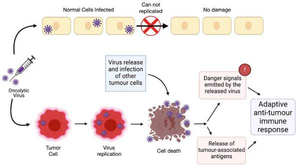
Once injected, the mRNA instructs the patient’s muscle cells to locate these harmless tumor fragments (3). This reaction prompts the immune system to instruct specific white blood cells to patrol the bloodstream and hunt down any surviving cancer cells (3). In Phase 2 of testing, mRNA-4157 was able to reduce the risk of recurrence of cancer or death by 44% (4).

Image Citations:
- https://www.technologynetworks.com/cancer-research/articles/what-are-neoantigens-372277
- https://www.whatisbiotechnology.org/
Bibliography:
- Moderna. (2026). Moderna. https://www.modernatx.com/research/product-pipeline
- Shafique, M., Chaman Lal, K., & Ahmed, M. F. (2025). Personalized cancer vaccines: promise, challenges, and the path forward. Annals of Medicine & Surgery, 87(12), 7864–7865. https://doi.org/10.1097/ms9.0000000000003991
- One Medicine for One Patient. (2023). Moderna. https://www.modernatx.com/media-center/all-media/blogs/one-medicine-for-one-patient
- Weber, J. S., Carlino, M. S., Khattak, A., et al. (2024). Individualised neoantigen therapy mRNA-4157 (V940) plus pembrolizumab versus pembrolizumab monotherapy in resected melanoma (KEYNOTE-942): a randomised, phase 2b study. The Lancet, 403(10427), 632–644. https://doi.org/10.1016/s0140-6736(23)02268-7





Comments are closed.