
A hybrid of bacteria holds the ability to break down ocean plastics
Living in a world made of trash may seem like fantastical dystopian fiction, but it could be a future quietly approaching in plain sight. Unless humanity intervenes.
The Great Pacific Garbage Patch is a floating mass of nearly 80,000 tons of garbage that spans an area roughly the size of Alaska (1, 2). But even more than that, there are roughly 11 million tons of plastic that enter rivers, seas, and oceans across the world each year (1,3).
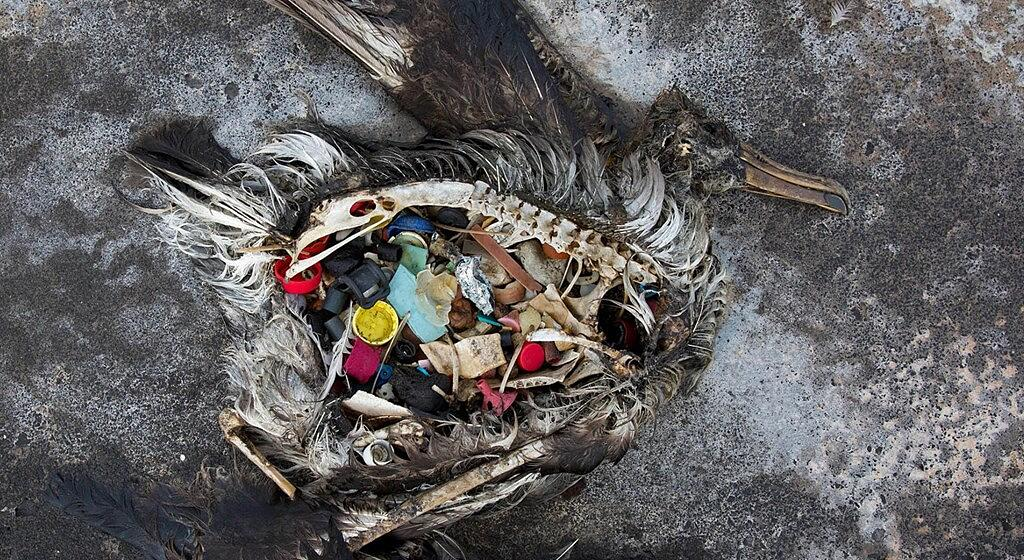
The majority of this waste comes from plastic items such as waste from the fishing industry, disposable bottles, cutlery, and cups, all made of a plastic called polyethylene terephthalate, or PET (3). PET takes around 450 years to decompose fully, while also breaking down into smaller pieces of plastic known as microplastics (3). These plastics cause extreme damage to the environment and marine life through physical damage and chemical harm (3). The physical forms of plastics end up harming animals and damaging flora (Figure 1), while many plastics leach microplastics and harmful chemicals that poison the ecosystem.
Since plastics make up 80% of all marine debris, handling the worst and most common marine pollutant is a paramount step toward improving the state of the world’s ecosystems (1). Luckily, a seemingly magical solution to this growing problem was discovered in 2021. The miracle treatment: a plastic-eating bacteria that can thrive in the ocean.
In 2023, a group of scientists proved the potential of a “mutant”, or chimera, bacteria capable of breaking down and metabolizing PET plastics. This “mutant” is a combination of two bacteria: Vibrio natriegens and Ideonella sakaiensis (4). Vibrio natriegens, or Vn, is famous in molecular biology for its unmatched reproduction speed and ability to adopt and carry out additions to its genetic information, all while being non-pathogenic, so it will not harm the ecosystem in which it is utilized (5). Several other hosts can be modified to break down PET, but Vn is special because it thrives in saltwater rather than being inhibited by it (4). However, on its own, Vn is not able to do anything about plastic.
Through studies on PET’s potential for biodegradation, a new species of bacteria was discovered in 2016 in waterways exposed to PET from bottle-recycling plants: Ideonella sakaiensis, or Is (6). Due to Is’s exposure to PET, the bacterium has adapted the ability to synthesize enzymes capable of decomposing PET through hydrolysis while providing itself with the basic materials needed for survival (6). However, in its basic state, it would not be a viable option to use at larger scales in sensitive ocean ecosystems, as it dwells in fresh water and would be killed by the salinity of ocean water (6).
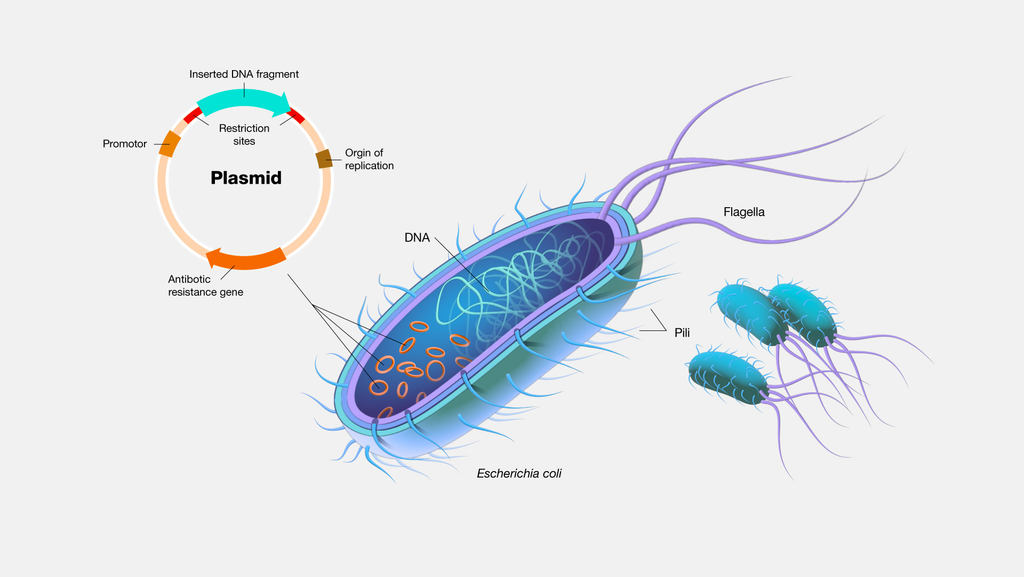
So, to combine the mass reproduction and ability to thrive in ocean water of Vibrio natriegens and the plastic-eating ability of Ideonella sakaiensis, scientists extracted, synthesized, and then injected the DNA sequences for the enzymes needed for the process of breaking down PET (4). By using plasmids (Figure 2) which are loops of DNA commonly used in genomics, scientists can input the DNA they want into the target cells and have that DNA expressed, without needing to alter the host’s genome as the plasmids stay separate from the main DNA (7).
Finally, Vn was the first host to break down PET in salt water (7). However, there are many limitations to this scenario. This study mainly focused on proving its efficacy and new methodology, so the conditions required–30°C water, PET in the form of microplastic on the scale of several hundred micrometers, extra solutions to sustain the bacteria, and more–are not possible for simply releasing a population of the modified bacteria into the ocean or even for dealing with large trash (4). Nonetheless, this study brought scientists closer to repairing the earth’s oceans– a problem that does not need just one miracle solution, but a combination of many smaller solutions. Among other new breakthroughs using nature’s adaptability to deal with trash, the use of modified Vn has helped address the significant and specific issue of microplastics, and has opened the door to more research on Vn as a host, as well as other methods of removing microplastics in the ocean.
Bibliography:
- Nogueira, T. (2021, February 9). 14 Types of plastic in the ocean | know the story. Be The Story. https://www.be-the-story.com/en/plastic/14-types-of-plastic-in-the-ocean/
- S Census Bureau. (2010). State area measurements and internal point coordinates. The United States Census Bureau. https://www.census.gov/geographies/reference-files/2010/geo/state-area.html
- Surfers Against Sewage. (2025). Plastic pollution: Facts & figures. Surfers Against Sewage. Surfers Against Sewage. https://www.sas.org.uk/plastic-pollution/plastic-pollution-facts-figures/
- Li, T., Menegatti, S., & Crook, N. (2023). Breakdown of polyethylene therepthalate microplastics under saltwater conditions using engineered Vibrio natriegens. Aiche Journal, 69(12). https://doi.org/10.1002/aic.18228
- UXu, J., Yang, S., & Yang, L. (2021). Vibrio natriegens as a host for rapid biotechnology. Trends in Biotechnology, 40(4). https://doi.org/10.1016/j.tibtech.2021.10.007
- Yoshida, S., Hiraga, K., Takehana, T., Taniguchi, I., Yamaji, H., Maeda, Y., Toyohara, K., Miyamoto, K., Kimura, Y., & Oda, K. (2016). A bacterium that degrades and assimilates poly(ethylene terephthalate). Science, 351(6278), 1196–1199. https://doi.org/10.1126/science.aad6359
- National Science Foundation. (2023, October 26). Genetically modified bacteria break down plastics in saltwater. NSF – National Science Foundation. https://www.nsf.gov/news/genetically-modified-bacteria-break-down-plastics-saltwater
Image Citations:

Comments are closed.