
Phones and other applications of flexible screens
Have you ever wondered why we left the flexible portability of a flip phone in the past? Recently, with the introduction of various bendable and flexible displays, the trend of creating conforming phones has been flooding the market. Bendable and folding displays have uses beyond just giving us more screen real estate when we scroll Instagram Reels, and only recently have displays, such as OLED, reached the point of widespread usage, changing TVs to medical equipment.
Traditionally, screens on electronic devices have been Liquid Crystal Displays (LCD). These are made up of an outer hard shell and inner soft piece. LCD screens absorb and re-emit light that is on an LED panel, producing the images we see on our TVs (1). This technology has been dominant in older televisions, phones, and screens, but recently OLED has been on the rise. The colorful specks that we see are on a surface called a substrate. On an LCD screen these are typically solid sheets of glass, and while flexible LCD screens do exist, the majority are very rigid and will shatter when they are bent (2).
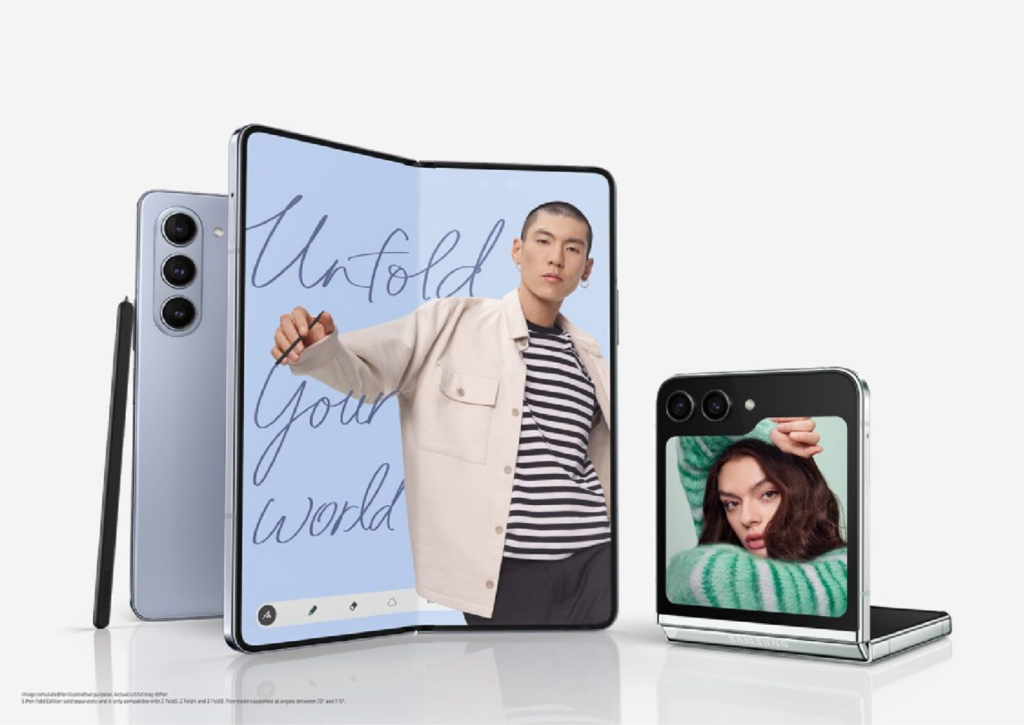
Samsung Galaxy Z-Flip and Z-Fold
Now, OLED screens have come to dominate not only general usage in technology but also the foldable market (3). These displays do not have LED backlights; instead, they are made up of a pattern of pixels which actually display the colors themselves. These displays can create better color saturation, have higher refresh rates and deeper blacks for color accuracy(1). OLED screens are made up of 4 layers: the substrate, which can be a plastic such as Polyimide to remain flexible; the TFT layer, which acts as the power grid for the display,;the OLED layer, where light actually emits,;and the cover layer, which can either be plastic or ultrathin glass which is still bendable (2).
Companies such as Samsung, Google, and even Apple have recently been creating mobile phones that implement the technology of these bending screens. The innovations can be implemented in various ways, most commonly in these phones a screen which can bend tightly into a U-shape is created using a hinge (3). This creates a “crease” that must be able to withstand thousands of folds to simulate daily use without ever degrading or damaging image quality. The estimated lifespans of a foldable are a good estimate of the quality of the product (1). Other commonly used flexible displays are: conformable, which can’t be unbent but hold a specific shape well; rollable, which can be used such as on a wristband; and stretchable, which can compress and stretch to change the screen realestate (3).
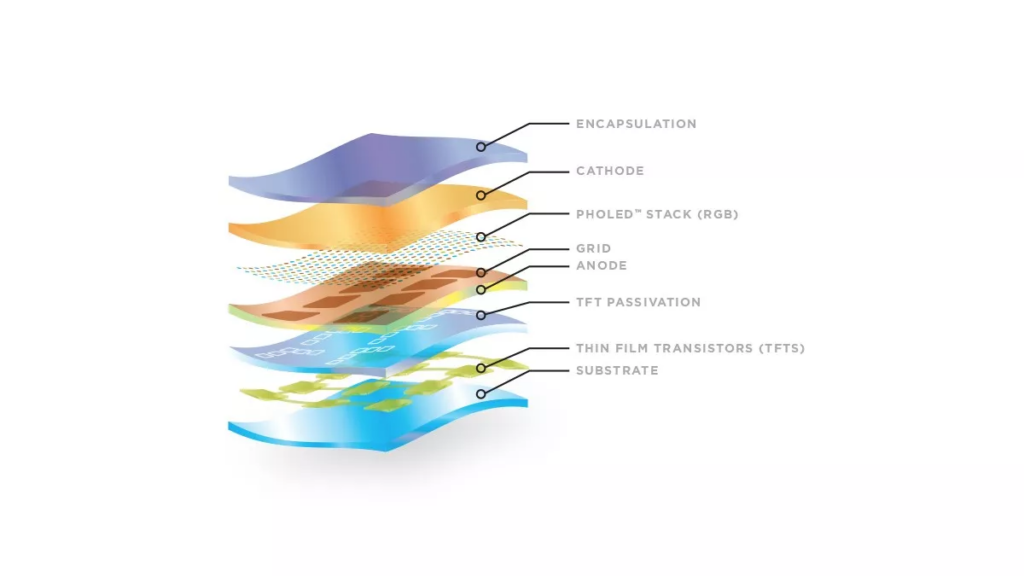
Layers of an OLED screen
Only about 1% of sold smartphones are actually foldable (3). The majority of which can fold out to become a larger tablet or into a small compact shape much like a flip phone. This doesn’t mean that flexible screens are useless however, and many devices that need specific shapes such as medical patches can use the free-form screens to be customized to fit exact needs (3). So, while we aren’t returning to the age of the flip phone any time soon, flexible screens are still a promising technology that is slowly making their way into our daily lives.
- Halliday, F. (2020, December 16). How do foldable screens work? Medium; 2Fold. https://medium.com/think-foldable/how-do-foldable-screens-work-bee2a2c283b9
- How do folding screens actually work? (2023, September 7). Android Authority. https://www.androidauthority.com/how-do-folding-screens-actually-work-3164822/
- Chavarria, J. (2024, August 14). Curve Your Enthusiasm: The Rise of Flexible Displays. IEEE Transmitter. https://transmitter.ieee.org/curve-your-enthusiasm-the-rise-of-flexible-displays/





Comments are closed.