
Examining the risk microplastics pose to human health
The next time you open a plastic bottle of water, know that some of what you’re drinking isn’t just water—in fact, that same unknown substance may go directly towards vital organs. Every time you breathe, drink, or eat, microplastics enter your body. In the past, it has been widely understood that the kidney and lungs contain microplastics (1). However, the brain does too—and not in small quantities. According to a study in New Mexico, the brain contains seven to thirty times more microplastics than the kidney and lungs respectivley, accounting for 0.5% of the overall weight in brain tissue (2). This means a gram of your brain tissue has more plastic than items classified as plastic products. This discovery has prompted additional questions related to what microplastics in the brain actually do and what risk they pose to our health.
Our brains all have a defensive layer called the blood barrier that prevents most bacteria, viruses, and other foreign particles from entering the brain; however, this does not seem to stop microplastics due to their minuscule size, specifically under 200 nanometers or 500 times thinner than a strand of human hair (3).
Once the microplastics are within the human brain, they tend to interfere with glial fibrillary acidic protein (GFAP), the supporting protiens for brain cells called astrocytes. Astrocytes mainly help maintain tissue structure, hold the blood barrier together physically, and maintain neurotransmitters. Unfortunately, microplastics cause the reduction of GFAP. Loss of GFAP has resulted in depression and Alzheimer’s disease (4). For this reason, researchers are seriously considering the possibility that microplastics are the main cause of these brain-damaging viruses.
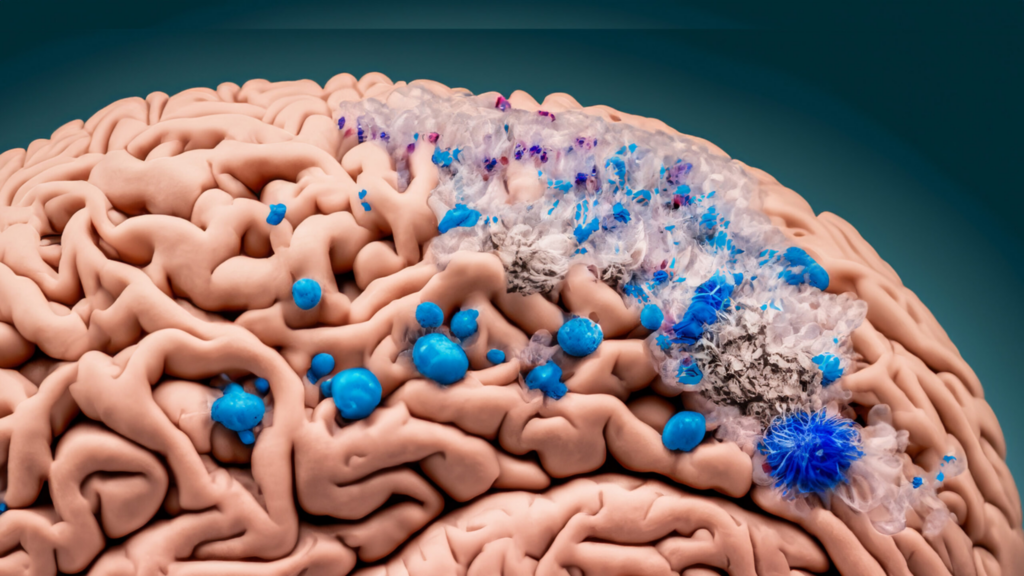
Brain samples of those diagnosed with dementia have up to ten times more microplastics than those without the disease (3). Many of these microplastics end up stuck to the walls of blood vessels or within immune cells. Furthermore, plastic samples within brains from 2016 to 2024 rose over 50% (2). According to a study at the University of Rhode Island, microplastics were detected in the human brain just three weeks after drinking water (5).
The brain isn’t the only seriously affected organ. In 2024, a study observed 257 patients facing blocked arteries and found that microplastics were directly in their arterial plaque, facing increasing rates of heart attack and stroke, in contrast to those who didn’t have as many brain-residing microplastics (6).
So, where is all this plastic coming from? The answer is practically everywhere. Plastic tea bags release millions of nanoparticles in each cup. Processed food can have thirty times the microplastics per gram compared to their unprocessed counterparts, and bottled water, which people believe is of better quality than tap water, has over twenty-two times as many microplastics as tap water (9). Moreover, less than 10% of these plastic products are recycled (7). Even worse, global plastic production is projected to triple by 2060 (8).
Because the 19 million tons of plastic emitted into our environment take years to break down, humans aren’t directly going to stop plastic effects at the current moment (9). However, there is still hope. The brain removes microplastics over time—meaning older people do not necessarily have more microplastics than their younger counterparts. As a result, the amount of microplastics is primarily determined by the choices we make now. Decisions like switching from bottled to tap water, cutting back on processed foods, and using non-plastic tea bags can help reduce the amount of microplastics we intake. None of this has any guarantee of making a significant impact, but each of them help us take one step toward a world devoid of plastic’s negative effects.
Sources:
- Nihart, A.J., Garcia, M.A., El Hayek, E. et al. “Bioaccumulation of microplastics in decedent human brains.” Nat Med 31, (2025). https://doi.org/10.1038/s41591-024-03453-1
- Haederle, M. (2025, February 28). “UNM researchers find alarmingly high levels of microplastics in human brains – and concentrations are growing over time”. University of New Mexico Health Sciences. https://hsc.unm.edu/news/2025/02/unm-researchers-find-alarmingly-high-levels-of-microplastics-in-human-brains.html
- Campen, M., Nihart, A., Garcia, M., Liu, R.,…El Hayek, E. (2024). “Bioaccumulation of Microplastics in Decedent Human Brains Assessed by Pyrolysis Gas Chromatography-Mass Spectrometry”. National Institutes of Health. https://pmc.ncbi.nlm.nih.gov/articles/PMC11100893/
- Yang, Z., & Wang, K. (2015, June 1). “Glial fibrillary acidic protein: From intermediate filament assembly and gliosis to neurobiomarker.” Trends in Neurosciences. https://pmc.ncbi.nlm.nih.gov/articles/PMC4559283/
- Ross, J. (2023, August 4). “A new study investigates the impact of microplastics in the brain.” University of Rhode Island Ryan Institute for Neuroscience. https://ryaninstitute.uri.edu/microplastics/
- Marfella, R., Prattichizzo, F., Sardu, C.,… Paolisso, G. (2024). “Microplastics and nanoplastics in atheromas and cardiovascular events.” New England Journal of Medicine. https://www.nejm.org/doi/full/10.1056/NEJMoa2309822
- Edirisingha, I., Undugoda, L., Manage, P., Lankasena, N., Patabendige, C., Nugara, R., Macreadie, P., & Bhadury, P. (2025). “Microplastics in agroecosystems: Sources of food crop contamination, detection challenges, and sustainable remediation strategies.” Food and Bioproducts Processing. https://www.sciencedirect.com/science/article/abs/pii/S2212429225021066
- U.S. Environmental Protection Agency & U.S. Department of Health and Human Services. (2026, April 2). EPA, “Plastics – fueling oil demand, climate change and pollution”. EPA. https://www.un.org/en/climatechange/science/climate-issues/plastics
- Cleveland Clinic. (2024, February 15). “Atherosclerosis”. Cleveland Clinic. https://my.clevelandclinic.org/health/diseases/16753-atherosclerosis-arterial-disease






Comments are closed.