
NASA’s Ignition event outlines new space initiatives
With the recent launch of NASA’s Artemis II lunar mission, human space exploration is on the rise again. Beyond returning humans to the Moon, NASA recently announced in its March 24 “Ignition” even the agency-wide initiative to advance space capabilities.
During the event, NASA Administrator Jared Isaacman said, “NASA is committed to achieving the near‑impossible once again, to return to the Moon before the end of President Trump’s term, build a Moon base, establish an enduring presence, and do the other things needed to ensure American leadership in space” (1). Ignition focused on addressing President Donald Trump’s Executive Order, “Ensuring American Space Superiority” (2). Line 2.d.ii of the order seeks to progress space capabilities by “enabling near-term utilization of space nuclear power by deploying nuclear reactors on the Moon and in orbit, including a lunar surface reactor ready for launch by 2030” (3).
NASA plans to launch Space Reactor-1 (SR-1) Freedom, the first nuclear-powered planetary spacecraft, to Mars by the end of 2028, to test and demonstrate nuclear electric propulsion (NEP), using nuclear energy to power a rocket’s movements, in deep space, paving the way for future nuclear-powered long-duration missions (1). Nearly all current space missions use chemical rockets, which take vast amounts of fuel and are pretty slow. Instead, NEP would enable much higher speeds and far less fuel than standard rockets, which will be necessary for future exploration of the outer solar system and human space settlements.
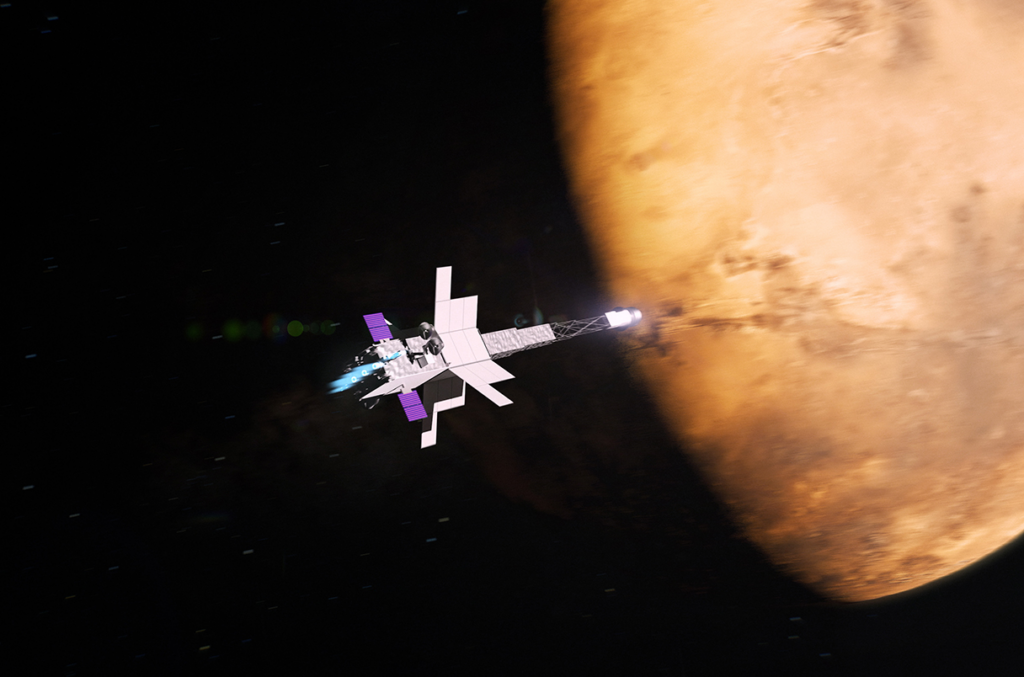
In a NEP system, a nuclear fission reactor generates heat, which is converted into electricity by a gas turbine. The electricity ionizes a gas propellant into plasma that shoots out of the rocket thrusters. This process would use only tens of kilograms of uranium-235 as fuel and thousands of kilograms of propellant, a fraction of what our current rockets use. Furthermore, onboard-generated electricity could power the spacecraft’s systems without relying on solar panels, which suffer from inconsistent sunlight in outer space (4).
SR-1 Freedom currently will use a 20-kW reactor, power too weak to achieve the speed improvements that NEP could offer in the future. It would take SR-1 Freedom around a year to reach Mars, whereas current rockets take around nine months (2, 4). In the future, megawatt-size reactors could travel the distance in as little as 2 to 3 months (4).
Building this new rocket before the Mars launch window in December 2028 is ambitious (4). The current timeline calls for significant designs to be complete by June 2026, allowing for the start of hardware development. Final assembly and testing would take place between January and October 2028 in preparation for the launch in December (2). Engineers and scientists interviewed in a Science article said it would typically take 3 to 5 years to build a mission like SR-1 Freedom. In a crunched timeframe like SR-1 Freedom, it is likely that NASA will have to make compromises, including in testing (4). To build the rocket this quickly, NASA is collaborating with the U.S. Department of Energy for the nuclear fuel, using a nuclear reactor that Isaacman described as “mostly built,” and repurposing the Power and Propulsion Element from Gateway, the now-canceled NASA lunar-orbit space station program. Although these elements all work on their own, integrating them will pose another challenge (4).
A NEP system also carries the political baggage of any nuclear project, which is clouded in fear caused by high-profile incidents and radioactive waste. A nuclear-powered machine flying over people’s heads is bound to make some nervous. However, NEP systems are generally not a big safety concern. They do not produce enough thrust for a blastoff; instead, they slowly build up speed over time, so they are only turned on after entering space, far away from Earth’s orbit (4).
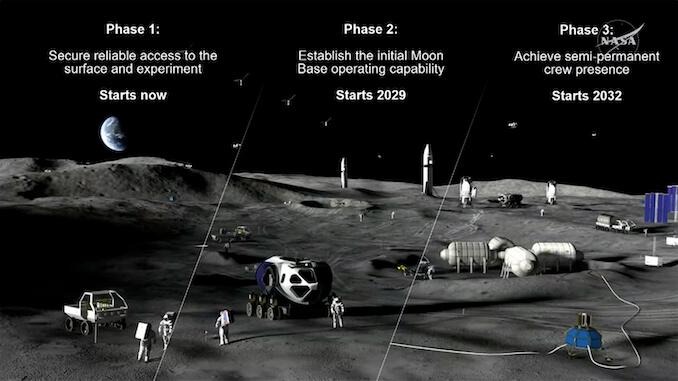
The Ignition event also outlined a three-phased plan to establish a base on the Moon, which will build upon the SR-1 Freedom. The three stages will gradually transport materials and equipment across numerous launches, eventually constructing a habitable base on the lunar surface. Nuclear power will be an important source of energy on the Moon during the 2-week-long lunar nights. The Lunar Reactor-1 is planned for 2030, which will support the third phase’s goal of a 4-crew, 28-day lunar mission and the future establishment of a permanent human settlement on the Moon (2).
While it is too soon to determine whether NASA, which frequently experiences project delays, will be able to pull off such an ambitious new plan, the technology it is seeking to test will have big implications for future space research and exploration.
Works Cited
- Low, Lauren E. “NASA Unveils Initiatives to Achieve America’s National Space Policy – NASA.” NASA, March 24, 2026. https://www.nasa.gov/news-release/nasa-unveils-initiatives-to-achieve-americas-national-space-policy/.
- Nuclear News. “NASA Announces Plan for Space Nuclear Propulsion By 2028.” American Nuclear Society, March 25, 2026. https://www.ans.org/news/article-7879/nasa-announces-plan-for-space-nuclear-propulsion-by-2028/.
- Trump, Donald J. “Ensuring American Space Superiority.” The White House, December 18, 2025. https://www.whitehouse.gov/presidential-actions/2025/12/ensuring-american-space-superiority/.
- Richter, Hannah. “History and Mystery Surround NASA’s 2028 Nuclear Mars Mission.” Science, April 3, 2026. https://doi.org/10.1126/science.z12vria.
Images









Comments are closed.