
A new era for software development
For many years, the “Hello World” program has been a rite of passage for all programmers—that is, the first demonstration that one has learned how to communicate with a computer. Building software required memorizing syntax, grinding through simple projects, and fixing bugs for hours. However, these skill barriers are now disappearing.
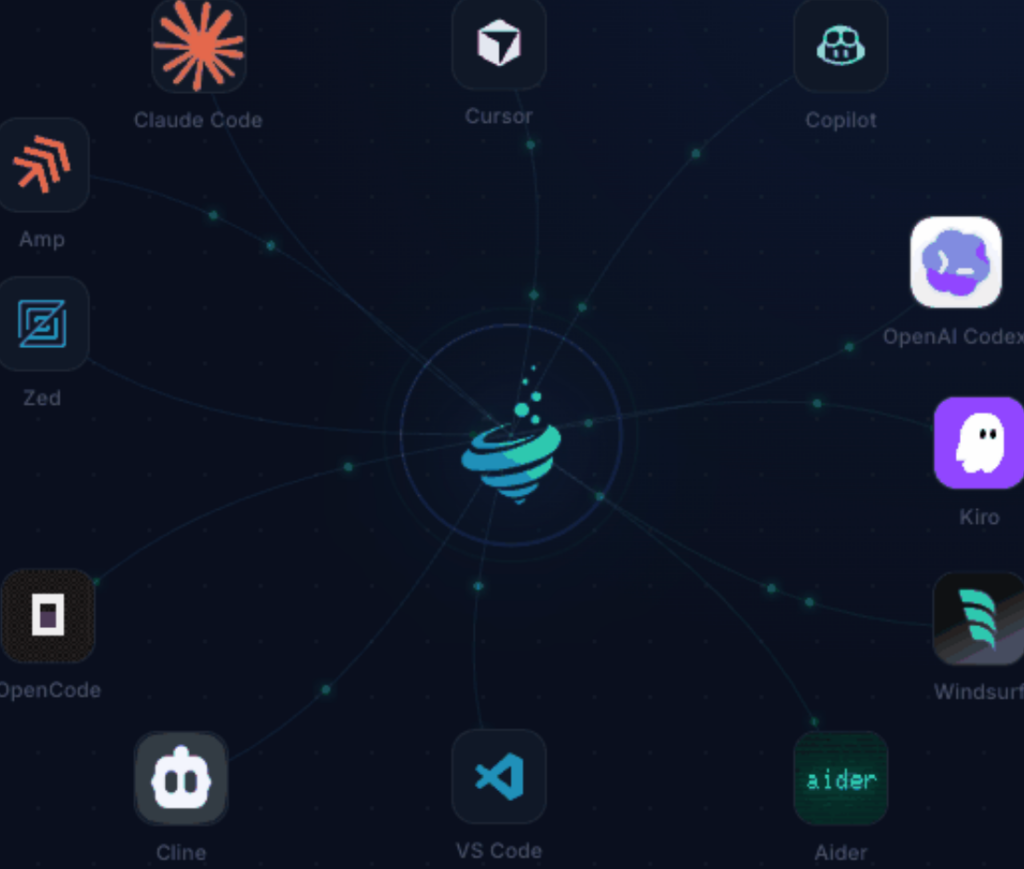
The change lies in the development of agentic artificial intelligence. As opposed to traditional or generative AI, agentic AI can be semi-autonomous or fully-autonomous and works in conjunction with other software to complete tasks (1). Instead of simply offering instructions on how to correct a particular bug, an AI agent can open the code, identify the error, implement the solution, run tests to verify the fix, and repeat itself until it gets a desirable outcome (1).
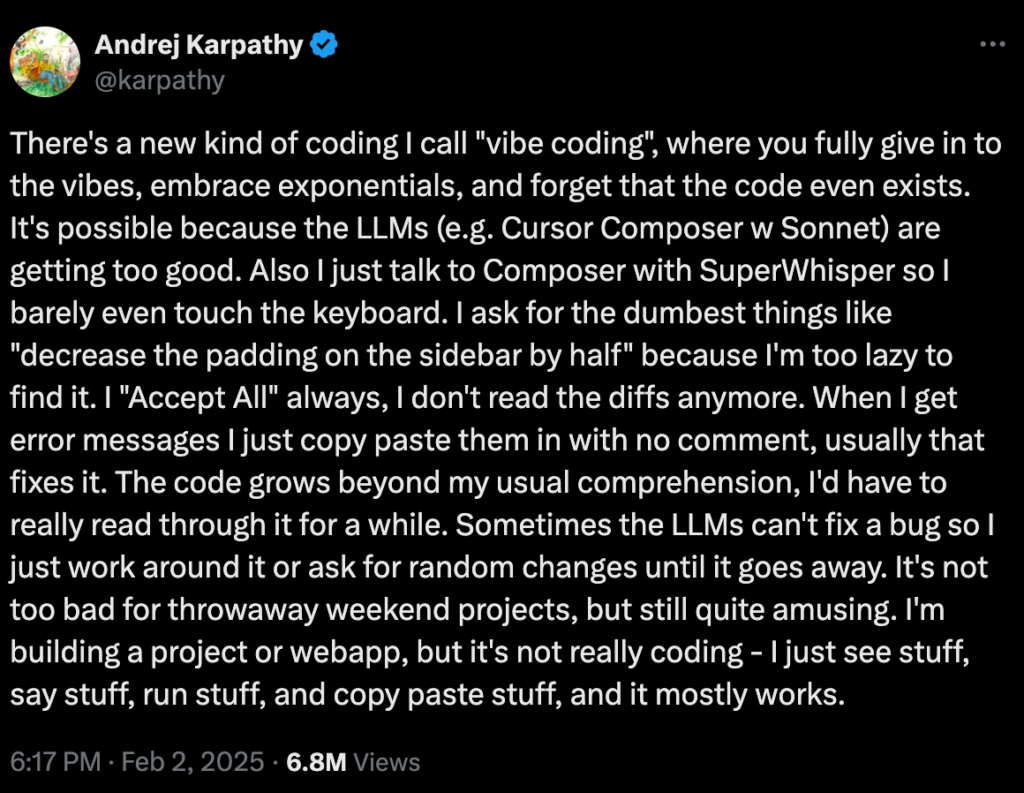
In February 2025, Andrej Karpathy, co-founder of OpenAI and former AI lead at Tesla, published a post on X coining the term “vibe coding.” He described a workflow in which developers fully surrender to the AI agent—accepting all code changes without reviewing differences, pasting error messages directly back into the AI model, and forgetting the code “even exists.” This post generated over 6.8 million views and sparked widespread debate throughout the developer community. The Collins English Dictionary even named it the Word of the Year 2025 (3).
Adoption of AI agents and vibe coding has been swift. A JetBrains survey of 24,534 developers across 194 countries found that 85% regularly use AI coding tools, with 62% relying on at least one AI coding assistant or agent (4). Y Combinator reported that 25% of companies in its Winter 2025 cohort had codebases that were 95% or more AI-generated (5).
The security implications of this shift, however, have been significant. Research across multiple frontier models found that over 80% of functionally correct agent-generated code contains exploitable vulnerabilities (6). Research across Fortune 15 enterprises indicates that AI-assisted developers update their code three to four times the rate of their peers but introduce security findings at ten times the rate. Veracode tested over 100 large language models on security-sensitive coding tasks and found that 45% of AI-generated code introduced significant security threats. In addition, approximately 20% of AI-generated code samples reference packages – bundles of code that can be downloaded – that do not exist; this is a hallucination pattern that attackers exploit through “slopsquatting.” In this process, hackers register the hallucinated package names as malicious libraries containing viruses before developers install them (4).
Agentic coding is not inherently flawed. The skillset it requires is just different from what came before. The programmers who will thrive are not necessarily the ones who write the cleanest code from scratch, but the ones who can evaluate what an agent produces, catch what it misses, and understand the system well enough to know when something has gone wrong. The barrier to building software has never been lower, but the responsibility of releasing it safely has not changed at all.
Sources:
- Stackpole, B. (2026, Feb 18). Agentic AI, explained, MIT Sloan. https://mitsloan.mit.edu/ideas-made-to-matter/agentic-ai-explained
- Karpathy, A. (2025, Feb 2). There’s a new kind of coding…, X. https://x.com/karpathy/status/1886192184808149383
- Garnsworthy, J. (2025, Nov 6). What does vibe coding mean? The AI term crowned Collins Word of The Year, The Independent. https://www.independent.co.uk/news/uk/home-news/vibe-coding-meaning-collins-dictionary-word-2025-b2859721.html
- Cloud Security Alliance. (2026, Apr 4). Vibe Coding’s Security Debt: The AI-Generated CVE Surge, Cloud Security Alliance. https://labs.cloudsecurityalliance.org/research/csa-research-note-ai-generated-code-vulnerability-surge-2026/
- Mehta, I. (2025, Mar 6). A quarter of startups YC’s current cohort have codebases that are almost entirely AI-generated, TechCrunch https://techcrunch.com/2025/03/06/a-quarter-of-startups-in-ycs-current-cohort-have-codebases-that-are-almost-entirely-ai-generated/
- Zhao, S., et. al (2025, Dec 2). Is Vibe Coding Safe? Benchmarking Vulnerability of Agent-Generated Code in Real-World Tasks, ArXiv. https://arxiv.org/abs/2512.03262
Images:








Comments are closed.