

Where does the line between conspiracy and history lie with cloud seeding?
On clear days when planes fly overhead, a soft white trail—something that appears as a cloud—follows closely behind each wing. Could it be just water, maybe jettisoned fuel, or, as popular modern conspiracy suggests, is it a chemtrail?
Chemtrails are to be condensation and ice crystals forming on the impurities expelled from engine exhaust (1). However, the chemtrail rabbit hole goes much farther into the depths of conspiracy.

The idea of controlling the weather originates from military research efforts in the late 20th century. The research focused on developing environmental weapons in a race against the Soviet Union and for use in the Vietnam War in the mid-20th century (2). Although the use of such techniques became banned in war, peaceful research and development of weather-controlling technology continued (2). Similar to many other scientific discoveries related to war, such as the development of nuclear energy, innovation continued post-war and led to the possibility of controlling precipitation to directly supply water to dry areas through rain or improve snowpacks in mountains to support the water supply of surrounding communities (3).
On the other hand, conspiracy theories take these developments in another direction. They describe this technology being implemented into everyday flights disguised as contrails (water vapor behind planes) and used for unknown and possibly ill-driven purposes (4). Some ways chemtrails have been theorized to be used include hiding and controlling global warming, secret mind control/psychological manipulation, and biological or chemical warfare (4).
The short answer to this is that, like many other conspiracy theories, this conspiracy holds little solid reasoning behind it. In full, the experimental science of cloud seeding was a real research endeavor that does use chemicals to initiate small weather events. Cloud seeding increases precipitation by dispersing silver iodide (AgI) crystals in clouds to add more nucleation points–places where condensation begins–for water droplets and ice crystals to form (3, 6). However, this process is highly dependent on atmospheric moisture, and it is not significantly harmful to the environment (6). While there are few downsides aside from resource expenditure, it is only applicable to specific situations where there is already enough water in the air (6). It is also not a foolproof solution capable of bringing water to any arid place through the skies. This, alongside a lack of extensive research, makes cloud seeding an endeavor not worth the investment of time, money, and resources despite potential benefits (5,6).
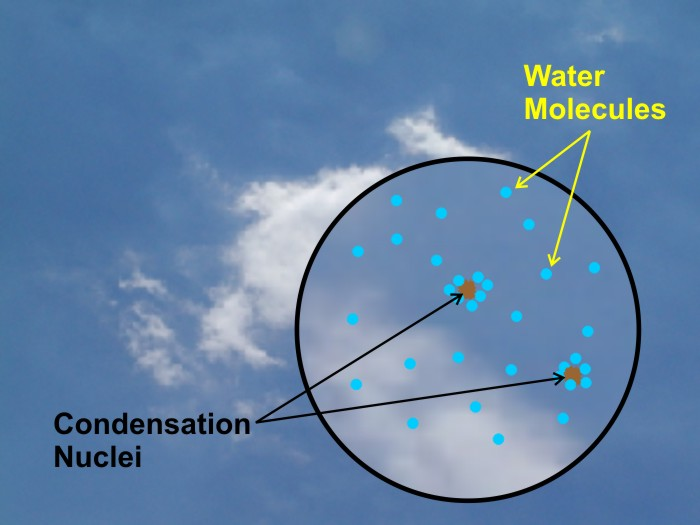
For some time, humankind has had its fingertips on the idea of taking over the weather, but contrary to conspiracy theories about secret government control through the skies, this technology has been left mostly experimental, with little prospect for progression and application.
Bibliography:
- United States Environmental Protection Agency. (2006). Aircraft contrails factsheet. In FAA.Gov.
- Ponte, L. (1976, April 17). War of the weathers. The New York Times. https://www.nytimes.com/1976/04/17/archives/war-of-the-weathers.html
- McDonough, F. (n.d.). What is cloud seeding? Desert Research Institute. Retrieved October 14, 2026, from https://www.dri.edu/cloud-seeding-program/what-is-cloud-seeding/
- Fraser, S. (2009). Phantom menace? Are conspirators using aircraft to pollute the sky? Current Science, 94(14), 8–9. ProQuest. https://www.proquest.com/docview/195877531
- SCHLATTER, T. (2001, March 9). Chemtrails. Web.Archive.Org. https://web.archive.org/web/20010309094441/http://www.weatherwise.org/qr/qry.chemtrail.html
- Office, A. (2024). Cloud seeding technology: Assessing effectiveness and other challenges. Gao.Gov. https://www.gao.gov/products/gao-25-107328
- Manton, M. J., & Warren, L. (2011). A confirmatory snowfall enhancement project in the Snowy Mountains of Australia. Part II: Primary and associated analyses. Journal of Applied Meteorology and Climatology, 50(7), 1448–1458. https://doi.org/10.1175/2011jamc2660.1
Image Citations:


Comments are closed.