

Rethinking our relationship with screen time
Imagine a world where there is an open phone policy. Students are able to take out phones whenever, wherever they want. Sounds too good to be true, but is it sustainable?
Teachers say the phone ban promotes more conversation and focus during the school day. But how does screen time actually affect the brain, and is excessive screen time really as bad as it seems? Research says it is. In this article, three major factors linked to prolonged screen time will be discussed: changes in the brain, poorer sleep quality, and worsened mental health.

First, it is helpful to define excessive screen time. According to Legner, the recommended screen time for adolescents is less than two hours a day, not counting homework. However, the average screen time for 15 to 17-year-olds is an overwhelming 7.5 hours, triple the recommended amount and ultimately equal to the average night of rejuvenating sleep (1). Additionally, a large CDC sample shows that 50.4% of U.S. teenagers spend more than 4 hours on screens outside of schoolwork (2).
From obsession to addiction, there are a substantial number of words describing the relationship between phones and adolescents. But what makes a random YouTube short so enticing?
Screen time can be addictive because it delivers intermittent rewards. Take social media, for example: the constant urge for more likes on a new post, or, once you’ve received enough likes, wanting to create another video for more likes, all contribute to excessive social media use. Eventually, it becomes a cycle of positive reinforcement—on a good day, we post for more likes; on a bad day, we also post for more likes (3). Pediatrician Michael Rich from Harvard Medical School compares the addictiveness of screens to a slot machine in a casino (4). The way social media platforms are designed causes addiction because they are built on something called a variable reward. The constant urge to scroll one last time to find something better is what keeps people going (4).

What makes teenagers especially vulnerable to developing unhealthy screen time use is the lack of executive functioning skills (6). The prefrontal cortex is the last to develop, making it harder for adolescents to stop scrolling because mature decision-making skills may not be developed yet. Not only does social media create reliance and addiction, but it also causes social hurdles, including not wanting to communicate with friends.
Evidence shows that screen time affects the day after you use your phone, not just the day of. This is due to the blue light emitted from the screen, which is said to alter melatonin production, which helps control the sleep-wake cycle, causing brain fog (4,7). This can reduce attention during the day and may lead to difficulty comprehending material during class. Surprisingly, a study from Durham University suggests brain shrinkage from excessive screen time, particularly in the ventral striatum, which processes rewards and motivation (7,8). This is extremely alarming because the brains of adolescents are still developing. In a study conducted with surveys among teens, 25.9% of the teens with more than 4 hours of screen time had depressive symptoms, and 27.1% reported anxiety symptoms (2).
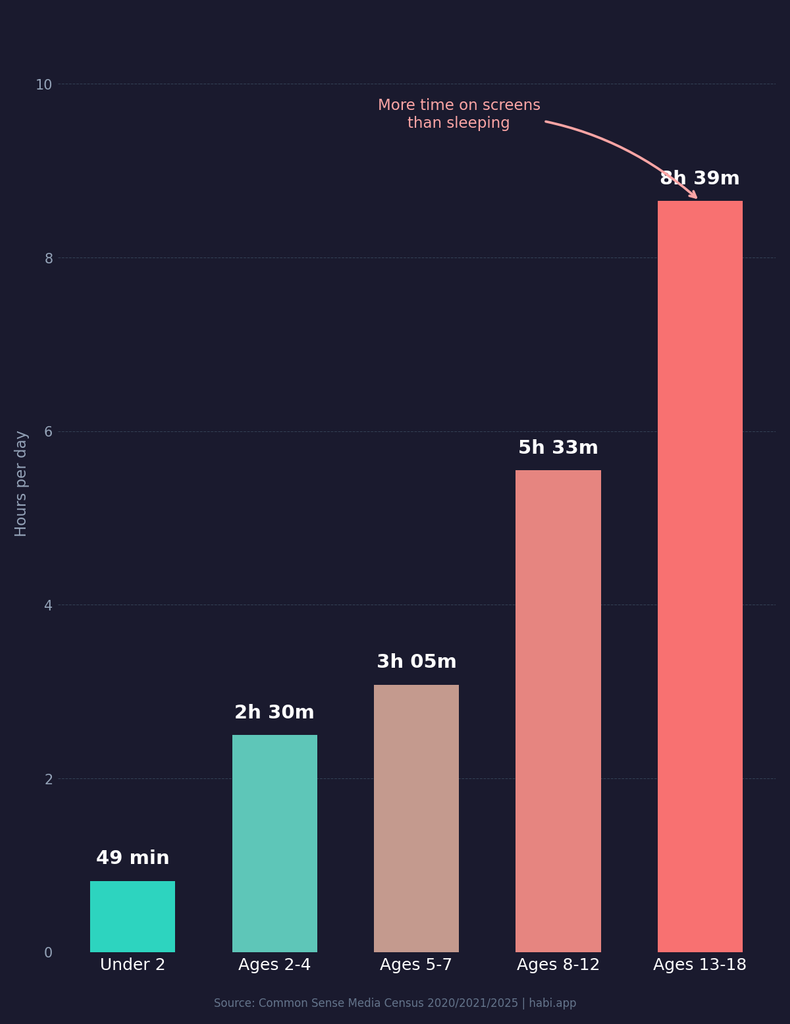
In conclusion, excessive screen time demonstrates a connection with symptoms including anxiety and depression in the brain; however, it does not prove screen time causes these symptoms. Dr. Rich argues, “It’s not how long we’re using screens that really matters; it’s how we’re using them and what’s happening in our brains in response,” (4). Even so, in a world where the phone ban does not exist, we still need to develop a better relationship with screens.
Bibliography
- Legner, L. (2021, December 6). Kids’ screen time: How much is too much? OSF HealthCare Blog. https://www.osfhealthcare.org/blog/kids-screen-time-how-much-is-too-much
- Zablotsky, B., Ng, A. E., Black, L. I., Haile, G., Bose, J., Jones, J. R., & Blumberg, S. J. (2025). Associations between screen time use and health outcomes among US teenagers. Preventing Chronic Disease, 22. https://doi.org/10.5888/pcd22.240537
- Hutton, J. S., Jessica Taylor Piotrowski, Bagot, K., Blumberg, F., Turhan Canli, Chein, J., Christakis, D. A., Grafman, J., Griffin, J. A., Hummer, T., Kuss, D. J., Lerner, M., Marcovitch, S., Paulus, M. P., Perlman, G., Romeo, R., Thomason, M. E., Turel, O., Weinstein, A.Potenza, M. N. (2024). Digital Media and Developing Brains: Concerns and Opportunities. Current Addiction Reports, 11(2). https://doi.org/10.1007/s40429-024-00545-3
- Harvard Medical School. (2019). Screen time and the brain. Hms.Harvard.Edu. https://hms.harvard.edu/news-events/publications-archive/brain/screen-time-brain
- National Institute of Mental Health. (2023). The teen brain: 7 Things to know. National Institute of Mental Health. https://www.nimh.nih.gov/health/publications/the-teen-brain-7-things-to-know
- Cleveland Clinic. (2022, May 7). Melatonin: What it is & function. Cleveland Clinic. https://my.clevelandclinic.org/health/articles/23411-melatonin
- Wadsley, M., & Ihssen, N. (2023). A systematic review of structural and functional MRI studies investigating social networking site use. Brain Sciences, 13(5), 787. PubMed Central. https://doi.org/10.3390/brainsci13050787
- Ventral striatum – an overview | ScienceDirect topics. (n.d.). Www.Sciencedirect.Com. Retrieved September 30, 2026, from https://www.sciencedirect.com/topics/neuroscience/ventral-striatum





Comments are closed.