
The split-brain experiments led to discoveries about how the human mind functions.
Are you a left-brain or right-brain dominant person? Read to the end to find out! All jokes aside, this is not a Buzzfeed quiz. Though it may answer which side of your brain is dominant, this article is all about split-brain patients and what that means for you and me.
What is the idea of split-brain? It can be thought of as the brain being a split thing, divided into left and right. Left-brain and right-brain, sounds familiar, right?
The notion of being left or right brain dominant shows up as early as the 1970’s, and is still widely accepted today (1). Which one are you? In truth, it doesn’t actually matter. While side dominance can show in visual and motion control, a study from 2013 at the University of Utah revealed that brain activity was similar on both sides regardless of personality (2).
It is, however, useful to know what each side of your brain is responsible for. Both hemispheres have motor control and sensory input inverse to the side they are on (3). In other words, the right hemisphere is connected to the left side of the body, and vice versa for the left hemisphere. However, the two sides are not the same. The left hemisphere generally controls math, comprehension, speech, and writing abilities, while the right hemisphere controls spatial ability, creativity, artistic and musical skills (3). From this, you can start to see where the “brain dominance” myth came from. But the myth is more of a figure of speech that represents someone’s skills rather than a scientific rule.
Even though the two hemispheres of the brain have such separate functions, they are not entirely split. The two hemispheres are nearly entirely separated, with nerve fibers called commissures that connect corresponding parts of the brain and enable communication and coordination (4). The main part of these connections is the corpus callosum (5). Since the two hemispheres only communicate through a few channels, what happens when they are separated?
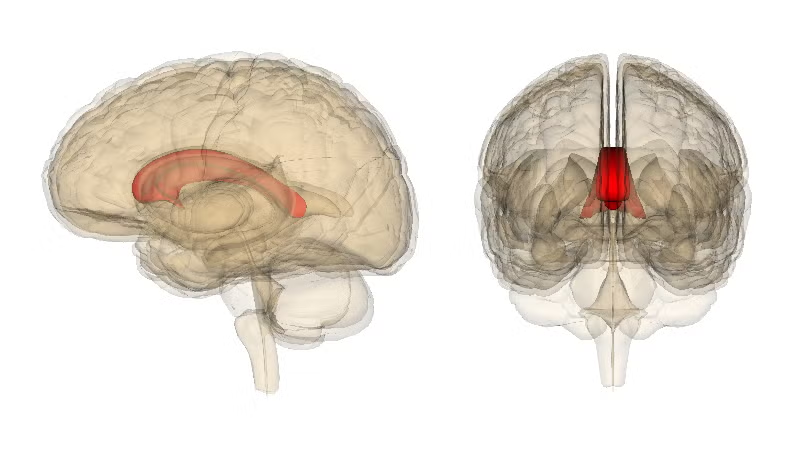
Since its discovery dating back to the 1700’s or earlier, scientists have wondered the same thing (6). Yet, some of the most revealing research done on the differences between the two hemispheres connected by the corpus callosum was not performed until the 1950s and 1960s by Roger Sperry and his colleagues (6,7).
Sperry started his research aiming to find the function of the corpus callosum. Split-brain patients seemed to have minimal symptoms, yet Sperry believed that it had a large impact. He designed tests to determine the exact effect of a severed corpus callosum (7). These experiments were before any regulation on using animals in research (8).
Sperry started by examining split-brain cats and monkeys, where he surgically severed their corpus callosum. He showed each eye a different image, and the animals memorized both scenarios separately. This experiment proved to him that split-brain animals had two separate brains, each capable of accomplishing tasks on their own (7).
This seemed to be a benefit of a severed corpus callosum, but Sperry wondered if there were drawbacks to the procedure (7). He moved on to human patients who had previously had their corpus callosum cut for external reasons, such as treatment for severe epilepsy.
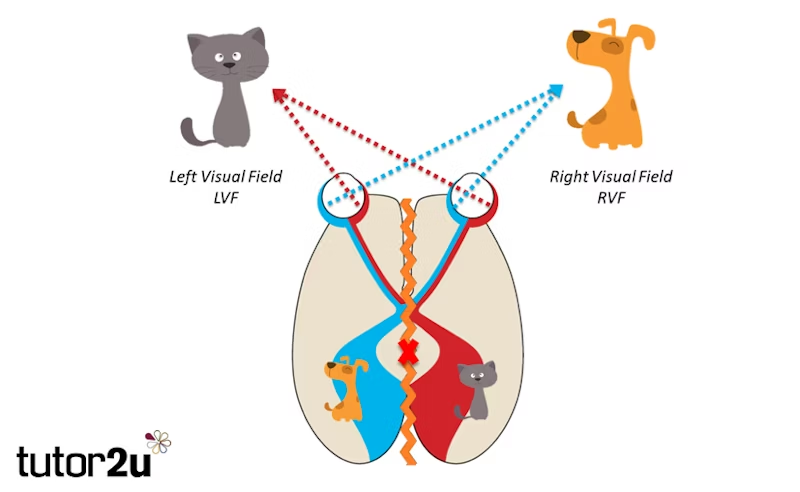
Across several tests that started with isolating each eye, Sperry examined how each hemisphere was able to respond and act to visual information (7).
In the first test, images were shown to the left and right eyes one at a time. When shown to the right eye, the patient could dictate what they saw. When shown to the left, they would say they didn’t remember it, while being able to draw the word. At this step, Sperry concluded that the left hemisphere could recognize language and speak, while the right could not (7).
In the next test, the participants’ left hands were in a box with various unknown tools. When a description of a tool was shown to the left eye, the left hand was able to pick up the tool, but was unable to name it. When seeing it with their right eye, they expressed that they didn’t know why they were holding it. This led Sperry to conclude that the right hemisphere could read and understand words to some extent, but had no way of verbalizing those feelings (7).
In his last experiments with humans, Sperry showed patients different objects in each eye. He then asked them to draw what they saw with their left hand with their eyes closed. They all drew what they saw with their left eye, while verbally describing what they saw with their right eye (7).
For example, the right hemisphere sees a cat, so it draws the cat with the left hand. The left hemisphere, however, sees a dog and just talks as if it were drawing the dog. This supported Sperry’s hypothesis that the hemispheres act as individual brains when separated (7).
In the end, Sperry concluded that even though a split-brain patient appears not disabled, a severed corpus callosum severely compromises the function of the brain (7).
Now we know that when split, the two halves of the brain in your head act independently. They can each see differently, move differently, and think differently, all while still functioning fine and having no clue the other is there. Even when the corpus callosum is intact, and the hemispheres can communicate, they still function differently than when separate: differently.
The procedure isn’t what makes the hemispheres separate. They always have been, but they just decided to collaborate. So, which one is really you? Sure, the one that talks to your family, shakes people’s hands, and sees through your right eye is the one that sounds and feels like you, but there is still the mute twin trapped next to it.
Which one are you? Both. “You is two,” says science animation YouTuber CGP Grey (9). You are two hemispheres, two brains, two intelligences, and maybe two consciousnesses. There is even evidence that says 1, 2, or something in between conscious agents in the brain work together to see, smell, taste, hear, and feel the world around us to make us who we are (10).
Bibliography
- Shmerling, R. (2022, March 24). Right brain/left brain, right? Harvard Health Blog; Harvard Health Publishing. https://www.health.harvard.edu/blog/right-brainleft-brain-right-2017082512222
- Nielsen, J. A., Zielinski, B. A., Ferguson, M. A., Lainhart, J. E., & Anderson, J. S. (2013). An Evaluation of the Left-Brain vs. Right-Brain Hypothesis with Resting State Functional Connectivity Magnetic Resonance Imaging. PLoS ONE, 8(8). https://doi.org/10.1371/journal.pone.0071275
- Hines, T. (2018). Anatomy of the human brain. Mayfield Clinic. https://mayfieldclinic.com/pe-anatbrain.htm
- Ricard, F. (2010). Le système neurovégétatif cervicocrânien et ses pathologies. Traité de Médecine Ostéopathique Du Crâne et de l’Articulation Temporomandibulaire, 413–438. https://doi.org/10.1016/b978-2-8101-0123-8.00013-9
- Wikipedia Contributors. (2024, September 9). Split-brain. Wikipedia; Wikimedia Foundation.
- Vaddiparti, A., Huang, R., Blihar, D., Du Plessis, M., Montalbano, M. J., Tubbs, R. S., & Loukas, M. (2021). The Evolution of Corpus Callosotomy for Epilepsy Management. World Neurosurgery, 145, 455–461. https://doi.org/10.1016/j.wneu.2020.08.178
- Lienhard, D. (2017, December 27). Roger Sperry’s Split Brain Experiments (1959–1968) | The Embryo Project Encyclopedia. Embryo.asu.edu. https://embryo.asu.edu/pages/roger-sperrys-split-brain-experiments-1959-1968-0
- Regulation of Animal Research. (2004). Nih.gov; National Academies Press (US). https://www.ncbi.nlm.nih.gov/books/NBK24650/
- CGP Grey. (2016). You Are Two [YouTube Video]. In YouTube. https://www.youtube.com/watch?v=wfYbgdo8e-8
- de Haan, E. H. F., Corballis, P. M., Hillyard, S. A., Marzi, C. A., Seth, A., Lamme, V. A. F., Volz, L., Fabri, M., Schechter, E., Bayne, T., Corballis, M., & Pinto, Y. (2020). Split-Brain: What We Know Now and Why This is Important for Understanding Consciousness. Neuropsychology Review, 30(2), 224–233. https://doi.org/10.1007/s11065-020-09439-3
Images



Comments are closed.