
Recent studies have raised concerns on the reliability of TikTok users’ advice on gout
Are you someone who seeks convenience and quick answers? If so, then you have also probably used a social media platform such as TikTok to quickly find solutions for everyday issues. TikTok hosts a variety of content, and its familiar search bar makes it second nature for users to seek for answers in the form of short, 30 second videos. However, in their haste, many people forget to ask an essential question: where is this information coming from?
Recently, researchers have raised concerns about the reliability of information on TikTok, particularly in relation to gout. Gout is a specific form of arthritis, a condition that causes swelling around joints. The disease is most commonly caused by a surplus of uric acid (1). Uric acid is generated by the body when purines—a compound found in food and within tissue—are broken down. Both abnormally high and low levels of uric acid in the blood can lead to illness; gout is often the result of excess uric acid (2). While these basic facts could be found on TikTok, the platform’s greatest risk is the misinformation surrounding the treatment of gout.
In a recent study conducted in New Zealand analyzed the information shared by TikTok creators about ways to treat gout. The study screened 116 TikTok videos and then sorted them based on the type of video, the advice provided, and the tone of the video (3). After analyzing the videos, the researchers identified patterns in the data. Of the 52 videos describing gout’s risk factors, 90% of the videos mentioned diet and lifestyle as a leading factor. Similarly, approximately 79% of the videos focused on dietary advice. This included claims that cutting back on salt, alcohol, and red meat would decrease gout incidents, as well as holistic nutrition advice on reducing gout (3). In general, there was often an overemphasize in the media of dietary issues seen as the main cause and the main way of treating gout. This pattern was similarly reflected in a 2016 study, which concluded that newspapers portray gout as a “self-inflicted” condition and overemphasize dietary solutions rather than medication (4). The study’s claim also applies to the gout advice found on TikTok. In comparison to the many videos suggesting a change in diet, only seven of the videos mentioned medication as a treatment option and only two of those videos recommended urate-lowering therapy (ULT) (3). ULT is a treatment that targets excessive urates, which cause gout flare ups. While a change in diet can fall under this umbrella, more effective ULT treatments include xanthine oxidase inhibitors (XOIs), uricosuric agents, and the use of anti-inflammatory prophylaxis (5).
While all these treatments are different, they target urates more directly and efficiently than diet changes. Although a change in diet can be helpful for someone initially diagnosed with gout, as the condition progresses, pharmacologic treatments will be more effective treatment. This information was absent from TikTok content, meaning that the platform lacks critical facts about the condition.
TikTok can be a great place to find inspiration and entertainment; however it is not a scientific database and therefore should not be treated as such. The studies showed that though Tiktok’s information wasn’t necessarily false, it lacked important information on different treatment methods. So, the next time you have a health-related question, skip a TikTok scroll and stick to a quick web search instead.
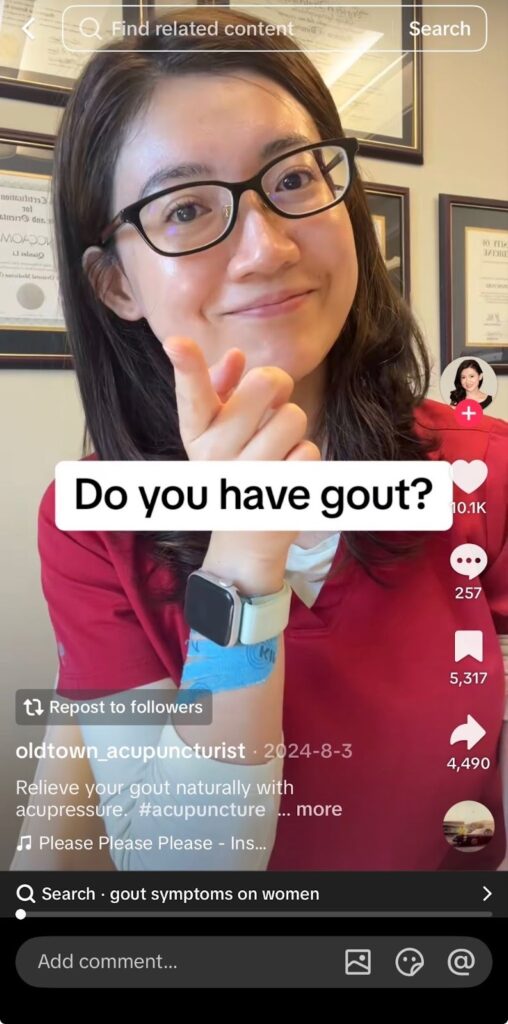
A Tiktok video about gout.
Bibliography
- Gout. (2007). In World of Health. Gale. https://link.gale.com/apps/doc/CV2191500540/SCIC?u=mlin_m_bucking&sid=bookmark-SCIC&xid=1845f5f3
- MedlinePlus. “Uric Acid – Blood : MedlinePlus Medical Encyclopedia.” Medlineplus.gov, 2017, medlineplus.gov/ency/article/003476.htm
- Ofanoa, Samuela, et al. “Gout, TikTok and Misleading Information: A Content Analysis.” Rheumatology Advances in Practice, vol. 9, no. 4, 2025, doi.org/10.1093/rap/rkaf126, https://doi.org/10.1093/rap/rkaf126 Accessed 12 Dec. 2025
- Duyck, S. D., Petrie, K. J., & Dalbeth, N. (2016). “You don’t have to be a drinker to get gout, but it helps”: a content analysis of the depiction of gout in popular newspapers. Arthritis Care & Research, 68(11), 1721-1725.
- Nebraska, Jennifer A. Tilleman, RPh, PharmD, FASCP Assistant Professor of Pharmacy Practice Edward M. DeSimone II, RPh, PhD, FAPhA Professor of Pharmacy Sciences Richard McAuliffe, 2017 PharmD Candidate Creighton University School of Pharmacy and Health Professions Omaha. “Urate-Lowering Therapy for the Prevention and Treatment of Gout Flare.” Www.uspharmacist.com, 17 Mar. 2017, www.uspharmacist.com/article/uratelowering-therapy-for-the-prevention-and-treatment-of-gout-flare.
Images:




Comments are closed.