
The flexibility of time explained by Einstein’s theory of special relativity
In October of 1971, scientists from the U.S. Naval Observatory and physics professor J.C. Hafele placed several highly precise atomic clocks on two commercial airplanes and sent them around the world twice. One plane flew eastward, in the same direction that the Earth rotates, while the other flew westward, against the Earth’s rotation. Before the flights, the in-flight clocks were synchronized with the ones on the ground. When the planes landed and the clocks were compared again, scientists discovered that the clocks no longer matched. The clocks on the plane that flew eastward were about 59 nanoseconds behind the clocks on the ground, while on the westward flight, the clocks were about 273 nanoseconds ahead (1).
The test, called the Hafele-Keating experiment, was designed to measure the effects predicted by Einstein’s theory of special relativity, which states that observers in different frames of reference experience time differently. The differences between the clocks were consistent with the predictions calculated from the theory, and the experiment became one of many confirmations that time itself is relative (1).
To understand Einstein’s theory, it helps to explore how scientists originally thought about motion. In classical physics developed by Isaac Newton, it was assumed that time and space were absolute, that is, they were experienced the same everywhere in the universe. This idea remained widely accepted until the discovery of electromagnetic waves in the mid-19th century. Scientists learned that electromagnetic waves (such as light waves) always travel at the same speed in a vacuum: the speed of light (c). Newtonian physics claimed that when observing the motion of an object, the observer’s own motion affects how the object’s speed is perceived. Moving opposite an object’s motion makes its velocity appear greater, while moving in the same direction will make it appear slower (2). However, light did not behave this way, and experiments in the early 20th century showed that no matter the magnitude or direction of an observer’s velocity, they always measured the same speed of light (3). This result could not be explained by classical physics.
Albert Einstein resolved this conflict with his theory of special relativity. He accepted what previous experiments had demonstrated: the speed of light is the same for all observers, regardless of their motion. For this to be possible, Einstein concluded that space and time themselves could not be absolute. Instead, they must change depending on the observer (3).
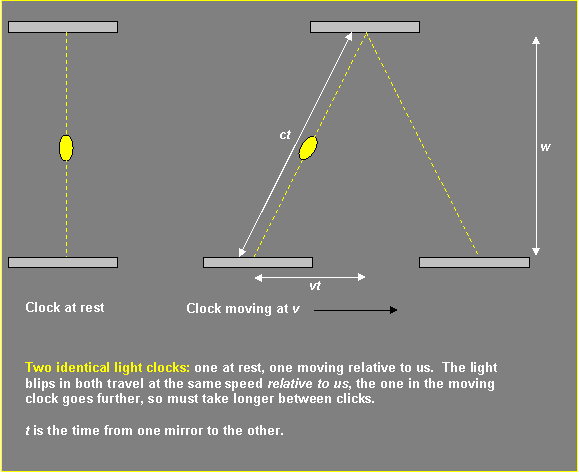
A thought experiment known as a photon clock helps clarify this idea (4). Imagine a simple clock consisting of two mirrors facing each other, with a beam of light bouncing back and forth between them. Each time the light hits a mirror, the clock records one “tick.” If the clock is stationary, the light travels straight up and down between the mirrors, and the time between ticks is consistent with all stationary observers. Now imagine that this photon clock is placed on a spaceship moving very fast across space. From the perspective of someone on the spaceship, the light still moves straight up and down between the mirrors, and the clock ticks normally. However, from the perspective of a stationary observer watching the spaceship pass by, the light follows a longer, diagonal path as the clock moves forward with the ship. Because light must always travel at the same speed, it takes longer, from the stationary observer perspective, for the clock to complete each tick. To someone in the spaceship, time appears unchanged, while to an outside observer, time aboard the spaceship passes more slowly. Einstein referred to this phenomenon as time dilation (3).
Time dilation occurs in two main ways. The first is due to velocity, as shown by the photon clock. The faster an object moves, the slower time passes for it compared to a stationary observer. This effect becomes noticeable only at speeds comparable to the speed of light. The second cause of time dilation is gravity, as described by Einstein’s theory of general relativity. The stronger the gravitational field, the slower time passes. Objects closer to massive bodies, such as planets or stars, experience time more slowly relative to objects farther away (4).
Time dilation isn’t just theoretical, Einstein’s calculations have practical applications in our world today. For example, GPS satellites experience both velocity-based and gravitational time dilation; to account for the difference in the passing of time, the clocks are corrected daily (4). Another example is that astronauts age slightly slower when in space than on Earth, though differences are minuscule with current space-travel technologies in use (3).
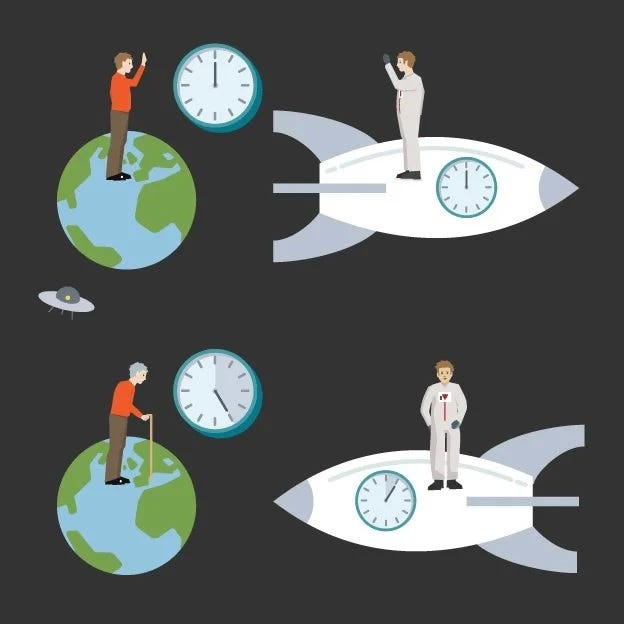
In theory, if a spaceship could travel close to the speed of light, the effects of time dilation could be dramatic. Hundreds of years could pass on Earth while astronauts only experience decades of travel. While time dilation can feel almost incomprehensible, experiments such as the Hafele-Keating experiment and real-life applications like GPS tracking show that it is not just theoretical. It is a real feature of how the universe works and will likely play a significant role in the future of space travel.
Bibliography
- Hafele, J. C. (1971). Performance and results of portable clocks in aircraft (Report, pp. 260–288). U.S. Naval Observatory. https://www.masterclock.com/cmss_files/attachmentlibrary/Archived-papers/Performance-and-Results-of-Portable-Clocks-in-Aircraft-1971.pdf
- FloatHeadPhysics. (2023, October 12). I never understood why speed of light is a constant (c)… until now! [Video]. YouTube. https://www.youtube.com/watch?v=Zkv8sW6y3sY
- Klonusk. (2024). Einstein’s Special Relativity Theory | Does time really slow down? [Video]. YouTube. https://www.youtube.com/watch?v=5BBHEZFearI
- Time dilation. (n.d.). In Wikipedia. Retrieved January 17, 2026, from https://en.wikipedia.org/wiki/Time_dilation
Images





Comments are closed.