
Why is there snow in Hawaii? How is it being affected by climate change?
When you picture Hawaii, you probably imagine white sandy beaches, postcard-worthy sunsets, and dark green mountains rolling over islands. Right now, Hawaii seems like an excellent alternative to the bare trees and freezing temperatures in Massachusetts. However, Hawaii only gets a fresh blanket of snow every year at its highest elevations. During the cool season from October to April, volcanoes Mauna Kea (13,308 ft) and Mauna Loa (13,679 ft) receive varying degrees of snowfall with severe wind gusts and blizzard conditions (1). The snow and its conditions are often associated with Kona lows: subtropical cyclones in the North Central Pacific during the cool season. Kona, which means leeward in Hawaiian, describes the winds that blow from southwest over the “Kona” side of the islands. This phenomenon produces varying weather patterns, including high winds, flash floods, heavy rains, and thunderstorms (2). The air, full of moisture due to the tropical climate, flows up the mountains and precipitates as rain or snow (3).
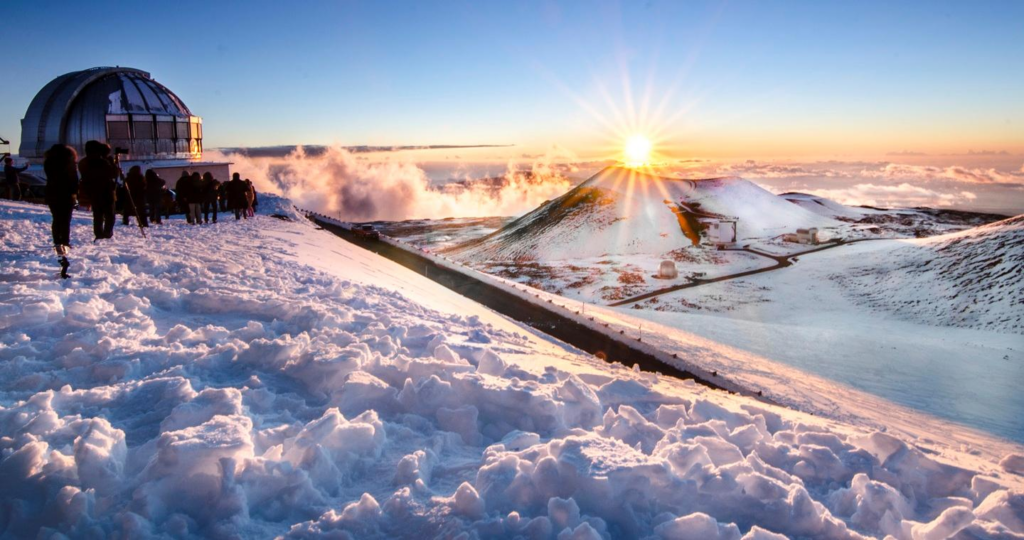
To further study the island’s snowfall, climate modelers at the University of Hawaii at Manoa used satellite images to quantify snow distribution patterns. Using this data, they created a regional climate model to simulate present snowfalls and predict future snowfall properties. They used satellite imagery from 2000 to 2015 to create a daily snow index, which represents the amount of snow cover there is on any given day. By using this data to corroborate their models and factor in different climate change scenarios, researchers were able to run simulations that predicted the snowfall throughout the 21st century. With a moderate level of climate change, they hypothesized that there would be virtually no snow coverage by the end of the century. With these projections, researchers highlight the significant local impacts of climate change that threaten the existence of snow on Hawaii’s mountains. The adaptation of satellite data and climate modeling offers valuable tools to monitor these local effects as well as the effectiveness of conservation efforts and environmental policies (4).
Bibliography
- Lyman Museum and Mission House. (n.d.). Snow in Hawai’i. Retrieved January 21, 2026, from
- https://lymanmuseum.org/exhibits/archive-special-exhibits/snow-in-hawaii/
- Morrison, I., & Businger, S. (n.d.). SYNOPTIC STRUCTURE AND EVOLUTION OF A KONA LOW. Retrieved January 21, 2026, from https://www.soest.hawaii.edu/MET/Faculty/businger/poster/KonaLow/
- Cassidy, E. (2023, December 6). A Dusting of Snow on Hawaii’s Tallest Peaks. Retrieved January 21, 2026, from https://science.nasa.gov/earth/earth-observatory/a-dusting-of-snow-on-hawaiis-tallest-peaks-152170/
- University of Hawaii at Manoa. (n.d.). Snow in Hawaiʻi: What does the future hold? Retrieved January 21, 2026, from https://www.soest.hawaii.edu/soestwp/announce/press-releases/snow-in-hawai%CA%BBi-what-does-the-future-hold-2/





Comments are closed.