
Adding dopamine receptors to the brain might cure this neurodegenerative disease
Parkinson’s Disease has been plaguing our ever-growing senior population for over two centuries. From drinking five cups of coffee a day to dietary supplements composed of lipids from cow brains, the road to a cure has been tumultuous (1). However, with new technology, scientists might be on the edge of a cure. New research suggests that we can treat Parkinson’s disease by adding specialized precursor cells that will develop into dopamine neurons in the brain (2).

Parkinson’s Disease is a neurodegenerative disorder most common in adults over 60, occurring when the cells in the area of the brain called the substantia nigra die rapidly. The nerve cells in the substantia nigra are responsible for creating dopamine, a chemical known for making your brain feel “happy.” However, the dopamine created in these nerve cells has another important job: it acts as a neurotransmitter that modulates motor control.When these nerve cells die, there is not enough dopamine produced to ensure smooth movement. This causes the tremors, stiffness, and cognitive decline often associated with Parkinson’s (5).
Parkinson’s is extremely hard to diagnose before tremors and shakiness show up. Usually, by the time the physical symptoms show up, irreversible brain damage has occurred, making it difficult to treat. Attempting to diagnose Parkinson’s before these notable symptoms appear is challenging: it relies on testing for important biomarkers, most notably alpha synuclein in the brain, or more obscure symptoms, namely loss of smell, sleep disorders, or chronic diarrhea (6). Additionally, because Parkinson’s Disease is a neurodegenerative disorder, it is incredibly complicated. Parkinson’s Disease is not just a dopamine deficiency; it affects many different parts of the brain, and the cognitive decline associated with the disease makes it difficult to treat. Altogether, the progressive nature of Parkinson’s disease and its complicated diagnosis process make treatment difficult and costly.
The cost of neurodegenerative diseases on our ever-aging population is huge; millions, even billions of dollars are spent every year in search of a cure. It is more important now than ever to invest in them as well, because as life expectancy increases, the risk of brain disease increases as well. With each new therapy comes hope as well as fear, as with every great medical breakthrough. iPSC therapy is the future of regenerative medicine, and though it has potential risks, its benefits could be enormous, making it a potentially revolutionary therapy.
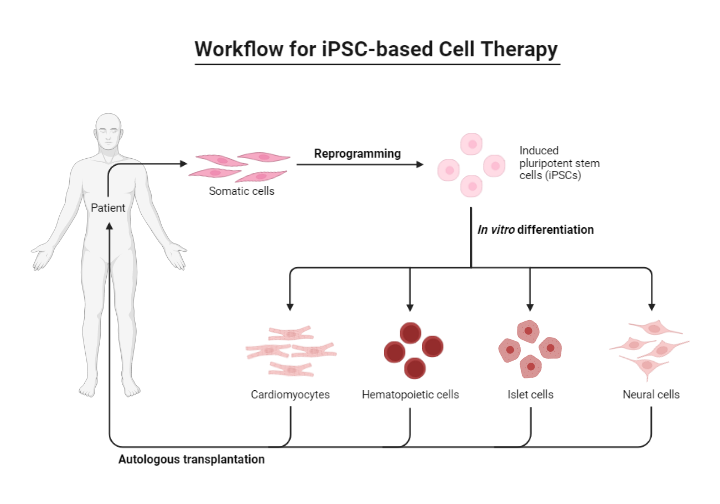
iPSC stands for induced pluripotent stem cells, which are new types of stem cells that are just being created. These stem cells are made by reprogramming the genome of an adult somatic cell to the pluripotent state, which is when a cell is unspecialized, or does not have a specific function. By reprogramming these cells, scientists can essentially create new tissues and organs. The programmability of these cells has also created a lot of worldwide attention, as it has the potential to treat neurodegenerative diseases like Parkinson’s and Alzheimer’s (7). These iPSC cells are being reprogrammed into dopamine-releasing neurons to treat Parkinson’s disease (3).
Studies have shown that iPSC therapy is very effective in the short term, especially at increasing mobility. However, the potential long-term side effects are risky (3). A main threat is immune rejection; there is a chance that the immune system does not accept the iPSC cells. Rejection occurs when the immune system sees an implant as foreign and attempts to attack it. When immune rejection occurs in the brain, serious side effects occur, like inflammation and potential loss or damage of brain tissue. These side effects could offset all the progress the therapy has already made, and set back patients further. The concern of immune rejection serves as a warning sign that the therapy may be ineffective in the future, showing how with every new therapy comes a risk of failure.
Bibliography
- Goetz, C. (2011, September 1). The History of Parkinson’s Disease: Early Clinical Descriptions and Neurological Therapies, National Library of Medicine. https://pmc.ncbi.nlm.nih.gov/articles/PMC3234454/#:~:text=Parkinson%27s%20disease%20was%20first%20medically,Parkinson%20captured%20the%20clinical%20picture:
- Woo Chang, J. (2025, December 11). Phase 1/2a clinical trial of hESC-derived dopamine progenitors in Parkinson’s disease, Cell. https://www.cell.com/cell/fulltext/S0092-8674(25)01041-4#:~:text=References-,Highlights,in%20the%20high%2Ddose%20group.
- Sawamoto, M. (2025, April 16). Phase I/II trial of iPS-cell-derived dopaminergic cells for Parkinson’s disease, nature. https://www.nature.com/articles/s41586-025-08700-0
- Parkinson’s Disease Risk Factors and Causes, Johns Hopkins Medicine. https://www.hopkinsmedicine.org/health/conditions-and-diseases/parkinsons-disease/parkinsons-disease-risk-factors-and-causes
- What is Parkinson’s?, Parkinson’s Foundation. https://www.parkinson.org/understanding-parkinsons/what-is-parkinsons#:~:text=Parkinson%27s%20disease%20%28PD%29%20is%20a%20progressive%20brain,impairments%20Symptoms%20generally%20develop%20slowly%20over%20years.
- Parkinson’s Disease: Challenges, Progress, and Promise, National Institute of Neurological Disorders and Stroke. https://www.ninds.nih.gov/current-research/focus-disorders/parkinsons-disease-research/parkinsons-disease-challenges-progress-and-promise#:~:text=In%20addition%20to%20new%20therapeutic,the%20onset%20of%20motor%20impairments.
- Sharkis, S. (20212, March 28). Pluripotent Stem Cell–Based Cancer Therapy: Promise and Challenges, National Library of Medicine. https://pmc.ncbi.nlm.nih.gov/articles/PMC3397797/
Images:
(a): https://www.biorender.com/template/workflow-for-ipsc-based-cell-therapy(b): https://www.atrainceu.com/content/2-pathophysiology-parkinson%E2%80%99s-disease




Comments are closed.