
Katherine Johnson: The Untold Story of the Woman Who Brought Man to Space
The 1969 moon landing was “One small step for a man, one giant leap for mankind,” as famously stated by American astronaut Neil Armstrong (1). But while Apollo 11 may have put the first man on the moon, the woman who got him there is often overlooked. Katherine Johnson was remarkable in countless ways. Her most notable work as a “human computer” at the National Advisory Committee for Aeronautics (NACA), later NASA, was crucial to early U.S. spaceflight (2). She was first hired by the NACA, when they began hiring African American women mathematicians to perform tedious calculations during World War II. Even before her time at NACA/NASA, Johnson was already breaking down barriers. As a child prodigy, she began high school at only 10 years old and attended graduate school at a time when many African Americans only went to school through the eighth grade (5). She became a pioneer for women of color and a crucial mathematician for the success of historic NASA missions.
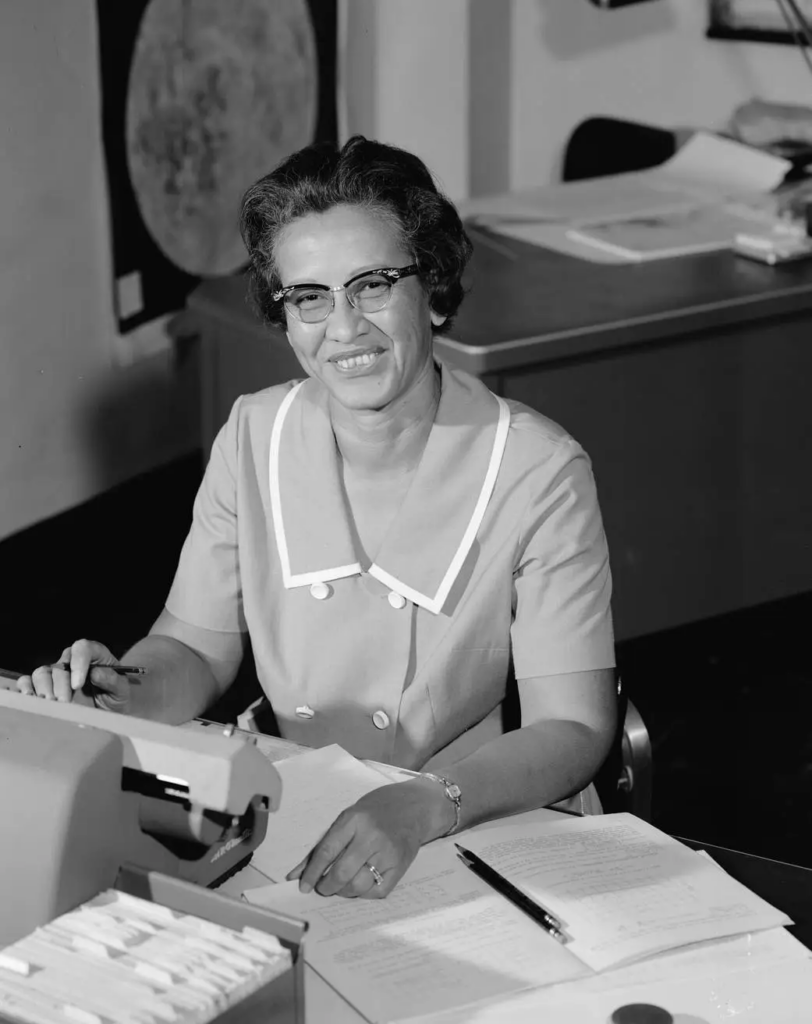
Long before Johnson calculated trajectories for NASA, she was already charting her own in her hometown of White Sulphur Springs, West Virginia. Her father, determined for his daughter to succeed, drove 120 miles to West Virginia State College (WVSU) so Johnson could attend high school and continue her education. At eighteen years old, she graduated from WVSU with high honors and entered the workforce as a public school teacher at black-only schools. Soon after, she was selected as the sole woman of three African American students integrated into the WVSU graduate studies program in 1939 (6). While she ultimately stepped away from the program to raise her children, in 1952 she heard of a job opening at the all-African American West Area Computing section at the NACA Langley Laboratory (3). Her dedication to mathematics led her and her husband to pursue the opportunity and move their family from West Virginia to Virginia. There, she spent the next four years analyzing flight test data and running investigations on plane crashes (3).
In 1958, the time when NACA transferred operations to NASA, very little was known about space. As a result, Johnson had to pioneer new mathematical methods to calculate rocket trajectories. She later said she went back to the basics of geometry and built her own textbook from there (6). In 1960, Johnson became the first woman in the Flight Research Division credited as an author on a research report. Alongside engineer Ted Skopinski, she coauthored Determination of Azimuth Angle at Burnout for Placing a Satellite Over a Selected Earth Position, which presents equations describing orbital spaceflight and spacecraft’s position relative to Earth’s surface (3). Later, in 1961, she conducted trajectory analysis on Alan Shepard’s Freedom 7 mission, making him the first American in space. Initially, other mathematicians attempted to calculate when the spacecraft should start so it would land in a certain place, but Johnson insisted: “Let me do it. You tell me when you want it and where you want it to land, and I’ll do it backwards and tell you when to take off.” (6)
By 1962, John Glenn was set to orbit the Earth, and NASA had introduced actual technological computers. Friendship 7’s orbital flight was complex, as it required the construction of a new communications network across the world linking the stations to control the spacecraft’s trajectory. Initially, John Glenn and the other astronauts of Friendship 7 did not feel comfortable leaving their lives in the hands of a technological computer program. Glenn demanded NASA to have Johnson to check the computer’s work, stating “if she says they’re good, then I’m ready to go” (3). Johnson checked the trajectory calculations by hand and confirmed the accuracy of the flight program. Additionally, her later work at NASA was vital to Project Apollo, the formation of the Space Shuttle, the Earth Resources Technology Satellite program, and she authored twenty-six research reports before her retirement in 1986 (3).
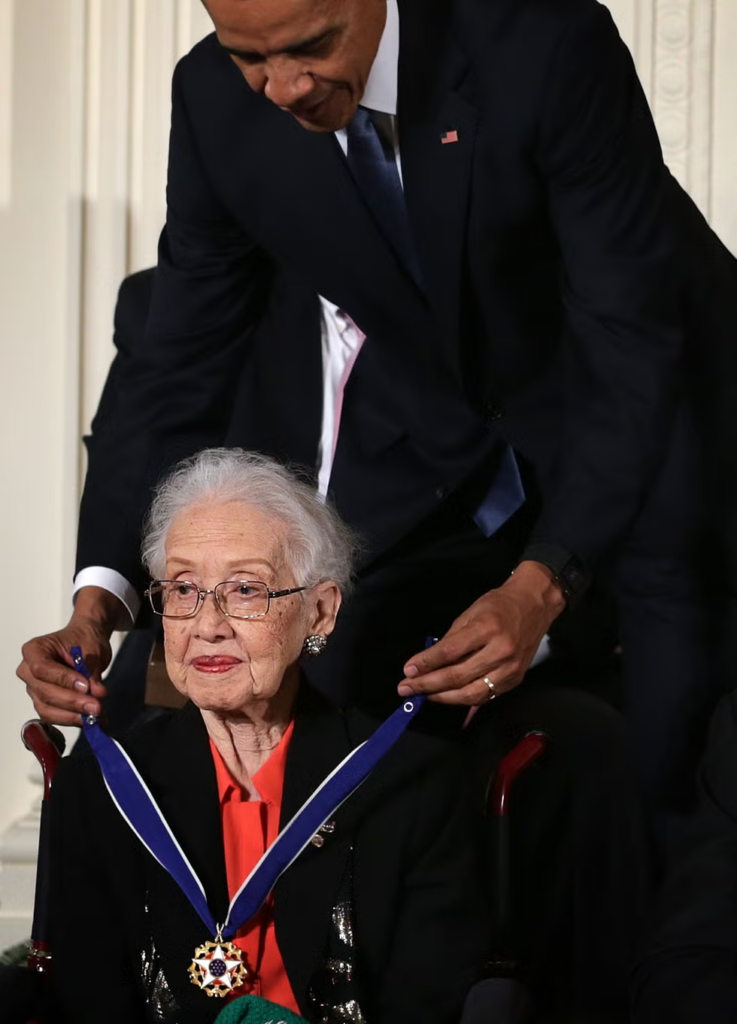
Katherine Johnson established vital foundations in aerospace mathematics. While her work contributed to the success of many early U.S. space missions, her achievements were rarely recognized at the time. In recent years, however, she has gained more exposure. In 2015, she was awarded America’s highest civilian honor, the Presidential Medal of Freedom, by Former President Barack Obama. A 2016 film titled ‘Hidden Figures’ also details her experiences along with two other African American women working at NASA, Mary Jackson and Dorothy Vaughn (7). Man took one small step, but it is Katherine Johnson’s leaps that have carried and will continue to carry mankind forward.
Bibliography:
- Armstrong, N. (1969, July 20). Apollo 11 Mission Commentary. NASA.
- Friendship 7 – Home. (2026). Nasa.gov. https://www.nasa.gov/history/friendship7/
- Katherine Johnson Biography – NASA. (2016, November 23). NASA. https://www.nasa.gov/centers-and-facilities/langley/katherine-johnson-biography/
- Mercury-Redstone 3: Freedom 7 – NASA. (2023, March 7). NASA. https://www.nasa.gov/mission/mercury-redstone-3-freedom-7/
- Katherine Johnson: The Girl Who Loved to Count – NASA. (2015, November 24). NASA. https://www.nasa.gov/centers-and-facilities/langley/katherine-johnson-the-girl-who-loved-to-count/
- She Was a Computer When Computers Wore Skirts – NASA. (2008, August 26). NASA. https://www.nasa.gov/centers-and-facilities/langley/she-was-a-computer-when-computers-wore-skirts/
- Figures, H. (2019). Hidden Figures. Hidden Figures. https://www.hiddenfigures.com/
Images:
- Katherine Johnson: A Lifetime of STEM – NASA. (2020, February 24). NASA. https://www.nasa.gov/learning-resources/katherine-johnson-a-lifetime-of-stem/
- Katherine Johnson Recalls Meeting President Obama in Her Posthumous Memoir, My Remarkable Journey. (2021, May 24). Oprah Daily. https://www.oprahdaily.com/entertainment/books/a36178863/katherine-johnson-memoir-my-remarkable-journey-president-obama/


Comments are closed.