
The brilliant programer that sent humanity to the moon
18 million people tuned in with excitement to watch the Artemis 2 launch on April 1st, 2026, whose crew would become both the fastest people in history and the humans who traveled furthest from Earth (1). The trajectory of these brave astronauts was hard to calculate, even with modern computers. However, the Apollo missions 57 years ago had to follow a similarly complex trajectory that included landing on the Moon (2). That trajectory had to be calculated on paper, compiled on paper, and imputed into the Apollo Guidance Computer, which had only 4KB of memory, 4,000,000 times less than the personal phones Artemis 2 crew members used to take personal photos (3)(4). Someone had to make all of this code. That someone was Margaret Hamilton, a brilliant mathematician and computer scientist who pioneered software engineering itself.
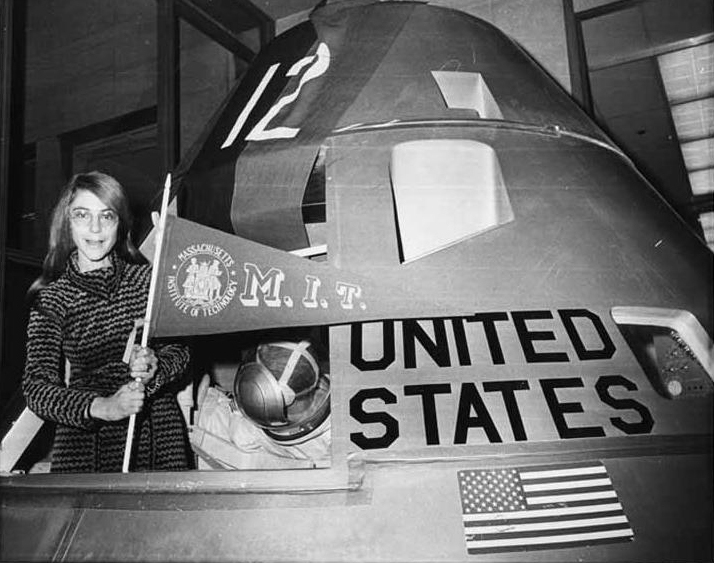
Margaret Hamilton’s story starts in 1936, when she was born on August 17th in Paoli, Indiana (5). She later moved with her family to Michigan, and after graduating from Hancock High School in 1954, Hamilton went on to study math at the University of Michigan (5). She then transferred to Earlham College, where she earned a Bachelor’s Degree in Mathematics and a minor in philosophy (5). At the time, women were generally discouraged from taking on difficult technical jobs.
Despite this, Hamilton soon earned a position at MIT, where she created weather prediction software for professor Edward N. Lorentz (5). From 1961-63, she also worked with the US SAGE air defense computer at MIT’s Lincoln Laboratories, headquartered in Lexington, Massachusetts (5). The plan was to help fund her husband’s education at Harvard Law School while gaining experience herself and preparing for a graduate degree in mathematics (6). However, before she could receive her degree, the department she led (the Software Engineering Division of the MIT Instrumentation Laboratory) was contracted by NASA to program the Apollo missions’ software (7).
In 1965, Hamilton was put in charge of onboard flight software for both the Lunar Excursion Module (LEM) and the Command/Service Module (CSM) (6). The CSM was the rocket that would take the astronauts from the Earth to the Moon, and the LEM was the Apollo missions’ lunar lander, the vehicle that would land astronauts on the moon. Hamilton and her team of 400 soon began working on one of the most impressive feats in aerospace history just two and half miles down the Charles River from BB&N.
The main difficulty with the code was that it had to be flawless; the smallest mistake 238,855 miles away on the Moon would cost the astronauts their lives. To make things even more difficult, Hamilton and her team were working on the bleeding edge of computer programming, having to perform at the highest level while coding the world’s first portable computer. They also had to invent brand new software concepts, such as the very word ‘software engineering’, which Hamilton coined in 1963-65 (6).
As with all engineering, more complexity creates a higher risk of errors. To mitigate this issue, Hamilton made this program the first asynchronous software, allowing the program to prioritize essential tasks like navigation ahead of others (8). Additionally, she and her team developed an error detection and prevention system for the program that after noticing an error/bug, restarted from a “safe place” automatically (8). When that did not work, Hamilton made the program show the astronauts on board a loud priority alert that showed the astronauts the error (8). Not only was Hamilton’s team’s code used for the CSM and the LEM, named Colossus and Luminary respectively, but it was also used for every moon-bound Apollo mission (Apollo 8-17) (6).
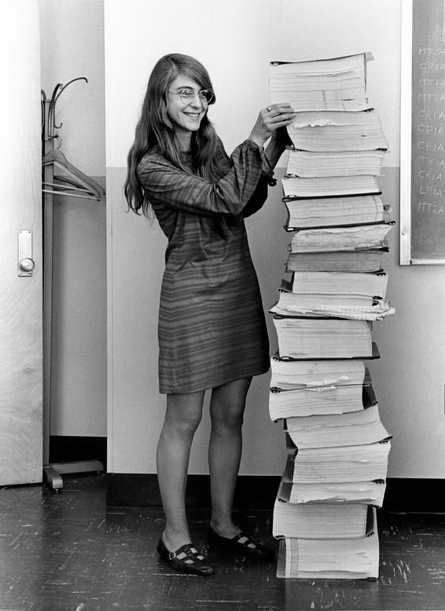
By 1970, Margaret Hamilton had left NASA and founded several software companies of her own, including Hamilton Technologies. Soon after, using lessons learned from the Apollo missions in reliability, she created the Universal Systems Language (USL) (7). Instead of doing repetitive real-time testing to detect errors like most languages, USL revolutionized programming by preventing issues ahead of time, never allowing them into the system in the first place (7). In 2016, Margaret Hamilton received the Presidential Medal of Freedom from Barack Obama for her pioneering contributions to software engineering and her work in general.
Without Margaret Hamilton, the Apollo missions would simply have been impossible, and as Barack Obama said; “Luckily for us, Margaret never stopped pioneering… Her software architecture echoes in countless technologies today, and her example speaks of the American spirit of discovery that exists in every little girl and little boy who know that somehow, to look beyond the heavens is to look deep within ourselves — and to figure out just what is possible” (9). Today, Margaret Hamilton lives in Cambridge, Massachusetts with her husband, Dan Lickly, and continues to serve as CEO of Hamilton Technologies.
Sources:
- Berger, Eric (2026, April 2). Artemis II Is Unlikely to Be the Cultural Touchstone Apollo 8 Was, and That’s OK, Ars Technica arstechnica.com/space/2026/04/artemis-ii-is-unlikely-to-be-the-cultural-touchstone-apollo-8-was-and-thats-ok/.
- (2016, June 9). Lunar Mission Flight Path | National Air and Space Museum, Smithsonian Air and Space Museum airandspace.si.edu/multimedia-gallery/image/5317hjpg.
- Hollingham, Richard (2019, July 5). Apollo in 50 Numbers: The Technology, BBC www.bbc.com/future/article/20190704-apollo-in-50-numbers-the-technology
- (2026, April 5). IPhone 17 Series: Features, Design, Specs, and More, T-Mobile www.t-mobile.com/dialed-in/devices/iphone-17-series.
- Fellow (2017). Margaret Hamilton, Computer History Magazine computerhistory.org/profile/margaret-hamilton/.
- Staff, WIRED (2015 October 13), Her Code Got Humans on the Moon—and Invented Software Itself, WIRED www.wired.com/2015/10/margaret-hamilton-nasa-apollo/
- Weinstock, Maia (2026 August 17), Scene at MIT: Margaret Hamilton’s Apollo Code, MIT News | Massachusetts Institute of Technology news.mit.edu/2016/scene-at-mit-margaret-hamilton-apollo-code-0817.
- Weinstock, Maia (17 August 2026), Margaret Hamilton – NASA Science, NASA science.nasa.gov/people/margaret-hamilton/.
- Office of the Press Secretary (2016 November 22), Remarks by the President at Presentation of the Presidential Medal of Freedom, obamawhitehouse.archives.gov/the-press-office/2016/11/22/remarks-president-presentation-presidential-medal-freedom.
Images:
- Weinstock, Maia (2026 August 17), Scene at MIT: Margaret Hamilton’s Apollo Code, MIT News | Massachusetts Institute of Technology news.mit.edu/2016/scene-at-mit-margaret-hamilton-apollo-code-0817.
- Weinstock, Maia (17 August 2026), Margaret Hamilton – NASA Science, NASA science.nasa.gov/people/margaret-hamilton/.

Comments are closed.