
How the discovery of PCR paved the way for revolutionary breakthroughs in medical research
Identified in 1869, DNA is essential for creating defining features in different species (1), (2). All living organisms contain DNA—and a surprisingly large amount of it. In fact, if you fully unravelled all the DNA in your body, it would stretch over 37 billion kilometers in length. Putting that in perspective, that would be more than eight times the distance between the Sun and Neptune (3). Given how much DNA we have naturally, DNA replication may seem unnecessary. However, replicating DNA is necessary for producing large amounts of specific DNA sequences for analyzing, testing, and creating medical treatments. The Polymerase Chain Reaction (PCR) is a DNA replication process used to accurately replicate strands, and the technique has been applied across multiple fields of scientific research.
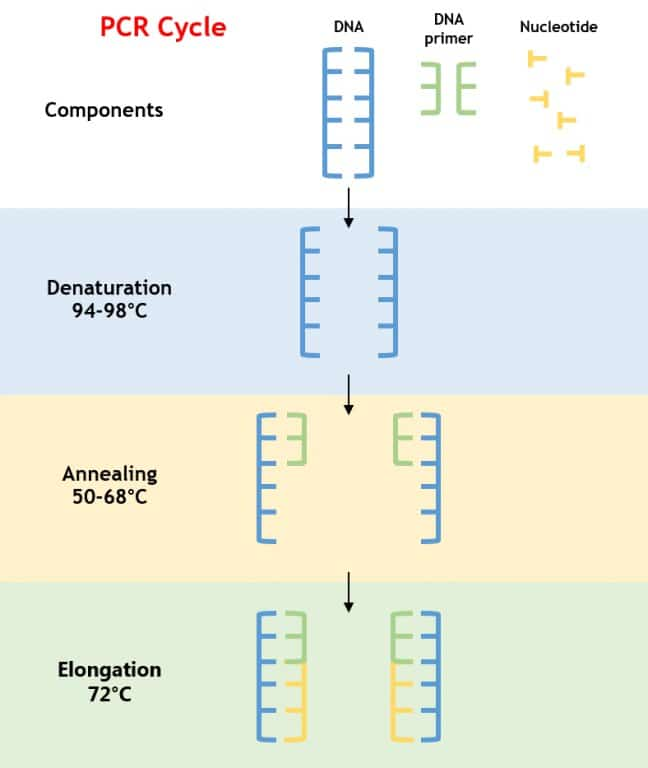
In PCR, there are three steps of replication. The first step is heating DNA to about 95℃ to denature the DNA and split it into two constituent strands. Next, during the annealing step, the temperature is lowered so that primers—the initial nucleic acid sequences in a strand of DNA—can attach to the separated DNA strands and start replicating the sequences of DNA, called nitrogenous base sequences. Finally, there is an extension step, where the rest of the DNA strand is constructed as the primers move in a 5’ to 3’ sequence from the DNA strand’s phosphate group to the hydroxyl group-2 molecular structures in DNA that serve as guides for the primers (4). This process exponentially increases DNA amounts over multiple cycles, making it an effective method to replicate specific structures in the DNA.
Before PCR was developed, DNA replication was very inefficient. During the denaturation process of DNA replication, the DNA polymerase enzymes used to execute this process would lose their shape and ability to build the new strand of DNA. As a result, scientists had to add new polymerase to the sequence after every cycle of replication. Thus, the technique required long amounts of time and effort to effectively execute. In 1988, however, Kary Mullis found the Taq enzyme—an enzyme that could serve as DNA polymerase without denaturing upon experiencing heat (5). Later, in 1993, his influential role in discovering Taq contributed to his earning of the Nobel Prize in Chemistry (6).
Despite the groundbreaking nature of this discovery, the Taq enzyme came with drawbacks. It could make errors in the strand replication phase—potentially incorporating the wrong DNA piece or incorrectly copying the desired strand. Because PCR creates DNA at an exponential rate, even a single error early on could lead to mutations in large quantities of DNA and result in incorrect data. Additionally, rounds of PCR can wear the Taq enzyme down, meaning that the enzyme would still have to be replaced—just not as often as before (7).
New enzymes such as Pfu (1990) and Physion DNA Polymerase (2003) were developed as stronger alternative enzymes that could be used without the issues associated with the Taq enzyme. In particular, Physion DNA Polymerase possesses exceptional proofreading abilities and good connections to a variety of different DNA replication templates (7). These enzymes significantly advanced the process of PCR, making it even more efficient and simple for researchers.
The discovery of PCR has contributed significantly to massive medical breakthroughs in scientific research. During the COVID-19 pandemic, PCR was essential to detect SARS-CoV-2 in patients around the world. After the identification of SARS-CoV-2 as the cause for the pandemic, the virus’ chromosomes were sequenced to find the correct sequence of RNA required for diagnosis. Scientists used reverse transcription-Polymerase Chain Reaction (RT-PCR) to convert the RNA into DNA and then replicate it, allowing scientists to detect whether people had the virus and see whether treatments were working (8).
Ultimately, while PCR has its shortcomings, it provides immense potential to enhance research and solve current and future medical and genetic problems affecting our world.
Bibliography
- National Institute of Health. (August 24, 2020), Deoxyribonucleic Acid (DNA) Fact Sheet, Retrieved from https://www.genome.gov/about-genomics/fact-sheets/Deoxyribonucleic-Acid-Fact-Sheet
- Mark Loch. (July 25, 2019), The astronomical length of DNA, Retrieved from https://mark-lorch.medium.com/the-astronomical-length-of-dna-2f93a0c61f65
- Nimrat Khehra, Inderbir S. Padda, and Muhammad Zubair. (July 7, 2025), Polymerase Chain Reaction (PCR), Retrieved from https://www.ncbi.nlm.nih.gov/books/NBK589663/
- Thermo Fisher Scientific. (August 21, 2019), PCR Basics, Retrieved from https://www.thermofisher.com/us/en/home/life-science/cloning/cloning-learning-center/invitrogen-school-of-molecular-biology/pcr-education/pcr-reagents-enzymes/pcr-basics.html
- Leslie A. Pray. (October 18, 2008), Discovery of DNA Structure and Function: Watson and Crick, Retrieved from https://www.nature.com/scitable/topicpage/discovery-of-dna-structure-and-function-watson-397/
- Colby McDonald. (December 12, 2019), Intolerable Genius: Berkeley’s Most Controversial Nobel Laureate, Retrieved from https://alumni.berkeley.edu/california-magazine/winter-2019/intolerable-genius-berkeleys-most-controversial-nobel-laureate/
- Thermo Fisher Scientific. (October 13, 2015), The History of PCR, Retrieved from https://www.thermofisher.com/us/en/home/brands/thermo-scientific/molecular-biology/molecular-biology-learning-center/molecular-biology-resource-library/spotlight-articles/history-pcr.html
- Pravin Pokhrel, Changpeng Hu, and Hanbin Mao. (July 5, 2020), Detecting the Coronavirus (COVID-19), Retrieved from https://pubs.acs.org/doi/10.1021/acssensors.0c01153
- Biochain. (2025), The Polymerase Chain Reaction – What it is and How it Works, Retrieved from https://www.biochain.com/blog/the-polymerase-chain-reaction-what-it-is-and-how-it-works/


Comments are closed.