
Snowflakes and the reason behind their uniqueness
The late-January snowstorm, one that provided a warmly welcomed snow day, has swept across Massachusetts, burying sidewalks, cars, and school grounds beneath layers of snow. As the storm continues, have you ever wondered about the origin behind the intricate structure visible in every snowflake under a microscope? This winter sight often revives a long-standing scientific claim: no two snowflakes are exactly alike. While the idea has become popularized, the science of it offers a more precise explanation for why each flake is unique.
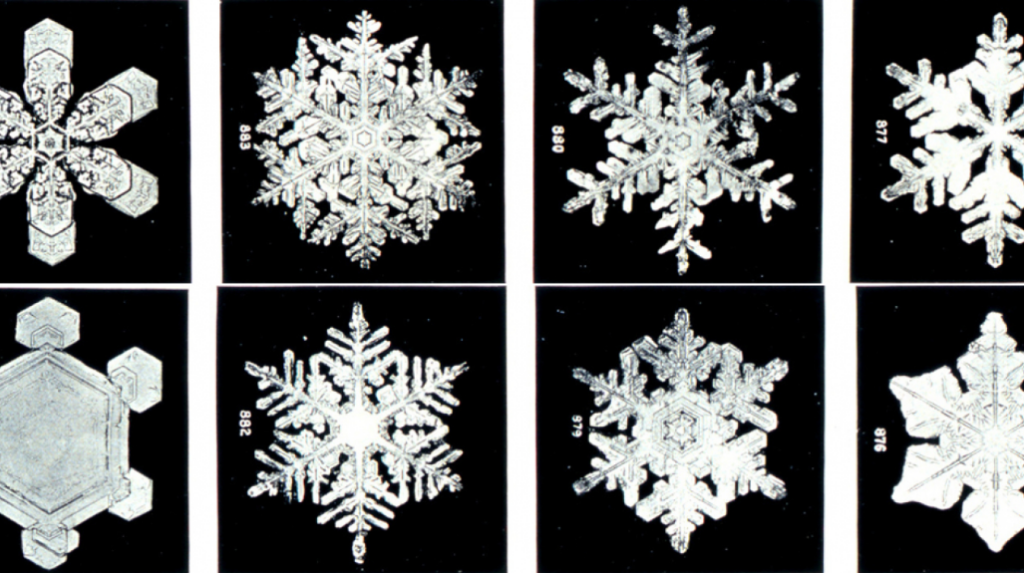
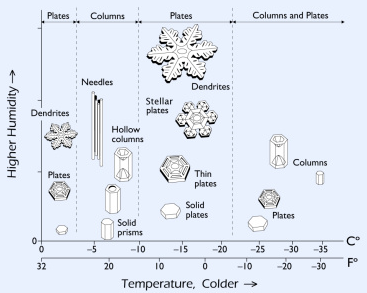
Snowflakes begin forming high in the atmosphere when water vapor freezes onto tiny particles such as dust or pollen. These particles act as the nuclei for each flake, allowing ice crystals to begin growing outward from their surfaces. Unlike raindrops, which remain liquid as they fall, snowflakes grow entirely as ice. As an ice crystal falls through the clouds, it encounters varying temperatures and humidity levels. Water vapor continues to freeze onto the crystal in different ways depending on these conditions, allowing it to branch and expand into geometric shapes. This process may take minutes or even hours, with the snowflake constantly changing as it travels toward the ground (1).
The structure of a snowflake is shaped by its precise path through the clouds. Slight differences in temperature, moisture, or wind can alter how ice molecules attach to the growing crystal. Since no two flakes experience the exact same sequence of conditions as they fall, their final structures are extremely unlikely to be identical (3). In other words, the physics around the crystal growth of a flake makes exact duplications next to impossible, as ice molecules form and branch differently in response to even the slightest environmental fluctuations.
Another factor contributing to snowflakes’ uniqueness is the sheer number of snowflakes that fall each winter. Estimates show that around one septillion flakes fall annually. That’s 1 followed by 24 zeros. Such an enormous number means the probability of finding two snowflakes with perfectly matching structures is extraordinarily small. Some scientists also note that while snowflakes may look similar, especially when viewed under low magnification, the microscopic details of their branches and crystal patterns still differ.
Scientists are careful not to describe the uniqueness of snowflakes as an absolute fact. Proving that no two snowflakes have ever been identical would require comparing every snowflake that has ever fallen throughout history, which is impossible. Because of this, the claim of uniqueness in the pattern of flake crystals can only be described as highly likely, rather than proven beyond all doubt. Snowflakes follow the same physical laws, so similar conditions can produce similar shapes, but exact structural matches remain vastly improbable in the natural world (2).
In the end, the mystery of two identical snowflakes can never truly be solved, though science supports the idea that the probability of duplicates is astronomically small. The snowflakes you see falling through the sky might actually signify the creation of history. A snow storm is a result of a near-infinite variety of intricate ice crystals, each one never before seen. As snow continues to fall this winter, it’s worth remembering that each flake is a one-of-a-kind record of the conditions it passed through on its journey to the ground.
Bibliography:
- How Do Snowflakes Form? (2025). National Environmental Satellite, Data, and Information Service. https://www.nesdis.noaa.gov/about/k-12-education/ice-snow/how-do-snowflakes-form
- Myth buster: No two snowflakes are alike? Very likely, but it’s hard to prove. (2026). Accelerator. https://www.reconnectwithnature.org/news-events/the-buzz/myth-buster-no-two-snowflakes-are-alike/
- Boyle, R. (2019, December 22). The Science Behind Why No Two Snowflakes Are Alike. WIRED. https://www.wired.com/story/the-science-behind-why-no-two-snowflakes-are-alike/
Images:
- How do snowflakes form? Get the science behind snow. (2016, December 19). Noaa.gov. https://www.noaa.gov/stories/how-do-snowflakes-form-science-behind-snow
- Guide to Snowflakes – SnowCrystals.com. (2026). Snowcrystals.com. https://www.snowcrystals.com/morphology/morphology.html






Comments are closed.