
The Truth Behind a Daily Phenomenon
The tides change twice a day, but have you ever wondered why? About every twelve hours, the oceans go from low tide to high tide on beaches all around the world (1).
Many know that gravity causes the Earth to orbit around the sun because the sun has more gravity than the Earth. Similarly, the moon orbits around the Earth due to the Earth’s gravitational field. However, this does not mean that the moon has no gravitational pull on the Earth. When the moon’s gravity pulls the Earth, it slightly distorts its shape into that of a football: the equator is stretched, and the poles are shortened (1). As the Moon pulls the Earth toward itself, it also pulls the water in Earth’s oceans toward itself. When the oceans are being pulled towards the moon, it results in high tide. In contrast, the pull’s absence creates a low tide (2).
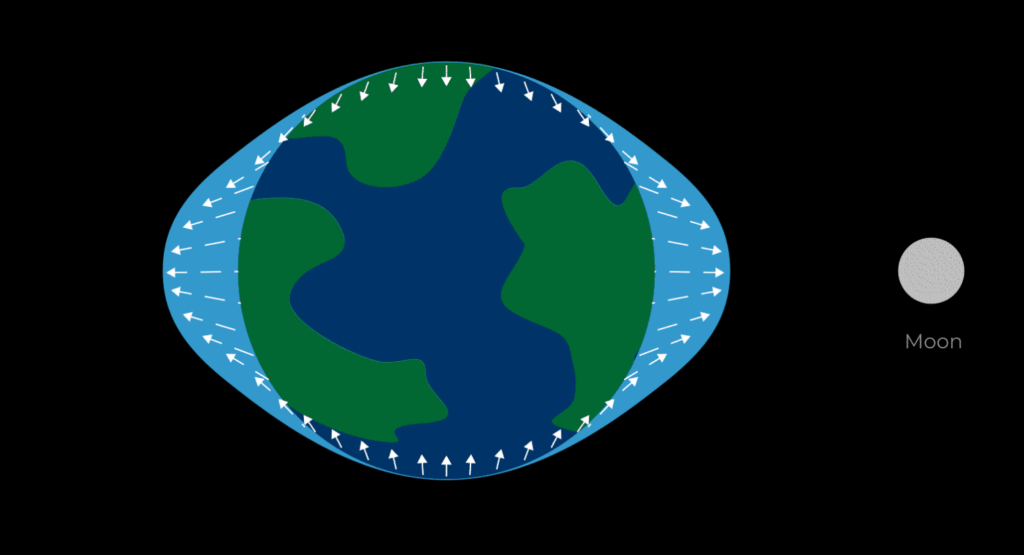
However, if the entire equator of the Earth is being stretched, how is the Moon influencing the Earth on the side farthest from it? While many are aware that the moon affects the tides, most do not know that the sun does as well (2). The sun has much more gravitational pull than the moon, but it is also much farther away from the Earth. As a result, the sun affects the Earth’s tides less than half as much as the moon does. Twice a month, when the sun and moon are aligned, the combined gravitational pulls make the high tides much stronger, creating spring tides. The moon and the sun pull the tides in opposite directions. This causes a net zero gravitational pull, resulting in no significant change in the tides about a week after spring tides occur (1). This happens when the sun and moon are tilted 90 degrees with respect to Earth (3).
Tidal cycles can change depending on where you are on Earth. For much of the Pacific coast, two high tides and two low tides occur within 24 hours. However, in Antarctica, only one high tide and one low tide occur. If the Earth did not have continents and were a perfect sphere, it would have consistent high and low tides. The continents block a vast amount of water in the ocean from being pulled toward the sun or the moon, making tidal patterns different around the world (4).
Overall, although it is well known that the moon controls the tides, the sun also influences them and pulls in the opposite direction from the moon. Due to the moon’s closeness to Earth, its gravitational pull is much stronger than the sun’s. Every day, the moon, sun, and continents stretch the Earth horizontally, creating the tides.
Bibliography
- Vogel, T., NASA, Team, N. M., Barry, C., & Nguyen, V. (2023, June 6). Tides. NASA Science. https://science.nasa.gov/moon/tides/
- ABC Education. (2022, June 29). How does the Moon affect the tides on Earth? ABC Education. https://www.abc.net.au/education/how-the-moon-affects-the-tides-on-earth/13920350
- Coastal Processes—Tides (U.S. National Park Service). (2019). Nps.gov. https://www.nps.gov/articles/coastal-processes-tides.htm
- Education – NOAA Tides & Currents. (2026). Noaa.gov. https://tidesandcurrents.noaa.gov/education.html
Images





Comments are closed.