
What is eugenics and how has it been practiced?
Eugenics is widely regarded as one of the most consequential pseudosciences in history, with devastating global repercussions. A pseudoscience is a set of beliefs or practices that are presented as scientific but lack sufficient evidence or proof. Eugenics is a scientifically inaccurate theory that claims humans can be improved through selective breeding and inheritance. Eugenics movements often use this false theory to argue for the superiority of a specific race or group of people (1).
The concept of eugenics was derived from the theory of natural selection proposed by British naturalist Charles Darwin in 1858. Darwin’s theory described how, through constant struggle between animals competing for resources, the weak die out as they do not possess favorable traits (2). British philosopher and scientist Herbert Spencer proposed the idea that humans were also subject to the same laws of natural selection as animals. He argued that certain human traits, for instance, intelligence, physical ability, and personality, were more “fit” for success. However, Darwin himself did not openly support this theory. Spencer named this idea Social Darwinism, which laid the foundation for beliefs of “creating the perfect human” through breeding and exclusion (3, 1).
One of the most well-known and extreme cases of eugenics was the euthanasia movement in Nazi Germany during the Holocaust. The term euthanasia, meaning a “good death,” typically describes ending the suffering of a terminally ill patient. In 1930s Germany, however, it was used as a slogan for a medicalized mass-murder program. This movement targeted people with disabilities, mental illnesses, and, most notably, the Jewish population. The purpose of the movement was to create the “perfect” German population and so-called master race to establish Germany as an unstoppable country. To achieve this goal, on July 14, 1933, the “Law for the Prevention of Genetically Diseased Offspring” was passed, authorizing the involuntary sterilization of individuals labeled as having “hereditary flaws.” The idea for the law was influenced by Karl Brandt, when he petitioned for the death of his own son, who was born with blindness and brain malformations. At the time, Brandt was Hitler’s personal physician. This situation motivated Hitler to expand the program infanticide, defending it as the most “natural” process of sterilization.
When news of these exterminations became public, the initiative gained popularity instead of facing backlash. The program was expanded to adults in mental institutions and later to anyone deemed “unfit” for society. This classification ranged from people with autism to those suffering from severe alcoholism. Ultimately, this application of eugenics resulted in the forced sterilization of 370,000 people, and the deaths of over 300,000 individuals, many of whom were children under the age of four. These actions demonstrate the devastating consequences of eugenic ideology in practice (4).
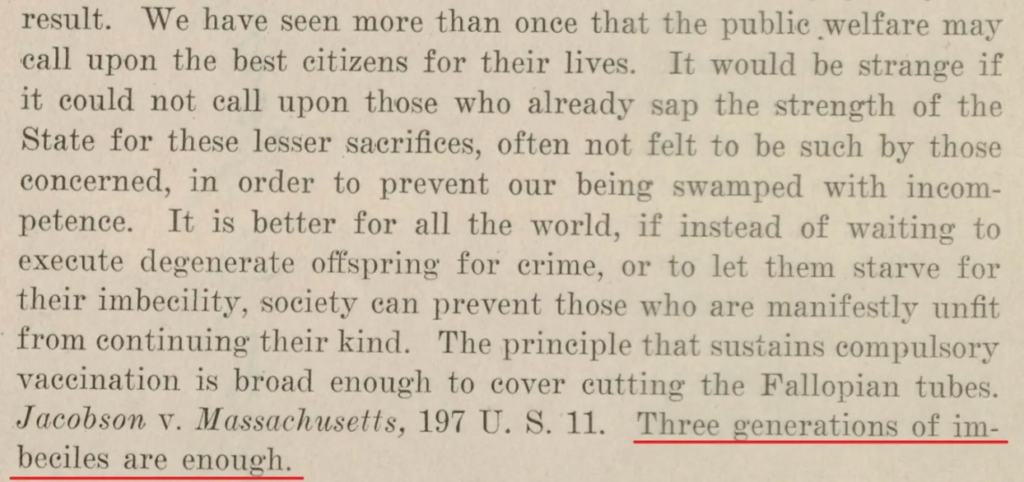
However, eugenics movements are not limited to German history. A prominent example is the United States Supreme Court case Buck v. Bell in 1927. The case involved a dispute over whether Carrie Buck should be sterilized against her will after her foster parents labeled her as “feeble-minded.” Buck’s biological family had a history of intellectual disabilities spanning three generations, and the state of Virginia wanted to prevent Buck from having more children. In the end, the court upheld the state’s right to sterilize Buck. The case was presided over by Supreme Court Justice Oliver Wendell Holmes, who stated, “Three generations of imbeciles are enough” (5). The ruling established a key legal precedent for forced sterilization across the United States for decades.
Eugenics appears not only in history but also in contemporary pop culture. A key example of this was a recent collaboration between model and actress, Sydney Sweeney and clothing company American Eagle. The campaign promoted American Eagle jeans with the slogan “Sydney Sweeney Has Great Jeans” appearing in all of its advertisements. Many people thought of the phrase as a clever play on words, but others condemned its message. The advertisement begins with Sweeney saying, “Genes are passed down from parents to offspring, often determining traits like hair color, personality, and even eye color.” The camera then zooms into her eyes, and she says, “My jeans are blue.” Her statements caused widespread commotion across the media, as many viewers interpreted the advertisement as implying that Sweeney’s blonde hair and blue eyes made her the “ideal person.” The slogan of the campaign makes an obvious reference to Sweeney’s looks and seemingly concentrates on white beauty standards. Critics argue that the wordplay of using “jeans” and “genes” interchangeably ignores the violent history of eugenics, given its practice in the United States and Nazi Germany. This controversy shows how, even today, eugenics continues to resurface in mainstream media through seemingly harmless references (6).

Bibliography:
- Human Genome Research Institute. (2022, May 18). Eugenics and Scientific Racism, National Human Genome Research Institute, National Institutes of Health. https://www.genome.gov/about-genomics/fact-sheets/Eugenics-and-Scientific-Racism
- Desmond, A. (2025, December 30). Charles Darwin, Britannica. https://www.britannica.com/biography/Charles-Darwin
- Britannica. (2025, December 9). Social Darwinism, Britannica. https://www.britannica.com/topic/social-Darwinism
- Grodin, M., Miller, E., Kelly, J. (2018, January). The Nazi Physicians as Leaders in Eugenics and “Euthanasia”: Lessons for Today, American Journal of Public Health. https://pmc.ncbi.nlm.nih.gov/articles/PMC5719686/
- Czarr. (2017, May 2). “Three Generations of Imbeciles are Enough” — The Case of Buck v. Bell, National Archives. https://education.blogs.archives.gov/2017/05/02/buck-v-bell/
- Ziegler, H. (2025, September 5). American Eagle Sales Fall Slightly After Sydney Sweeney Ad, The New York Times. https://www.nytimes.com/2025/09/05/business/american-eagle-sydney-sweeney-ad-earnings.html?searchResultPosition=1
Images:
https://research.calvin.edu/german-propaganda-archive/volkundrasse1936-8.htm
https://education.blogs.archives.gov/2017/05/02/buck-v-bell/





Comments are closed.