
What is this new discovery, and how does it redefine DNA structure?
For decades, biology textbooks and curricula have taught students to focus on DNA’s genetic code, the sequence of letters that instructs cells how to function and determines who you are. What if I told you research suggests that the way DNA’s physical structure is organized inside the cell may be just as important as the code itself? This discovery is completely changing how scientists understand genetics and its effect on human biology. Even though nearly every cell in your body contains the same DNA, brain cells, muscle cells, and skin cells all behave in their own unique way. The difference is not in the code itself, but in how that code is folded and accessed within the cell.
Recently, scientists at Northwestern University working on the 4D Nucleome Project produced the most detailed maps to date of the human genome structure and how that organization changes over time (1). Using these maps, scientists discovered that DNA’s three-dimensional organization inside the nucleus helps determine how gene activity is regulated, indicating when they are turned on, which stay silent, and how cells ultimately behave (2).
Geneva, U. of. (2015, November 5). Why some genes are highly expressed. Phys.org. https://phys.org/news/2015-11-genes-highly.html
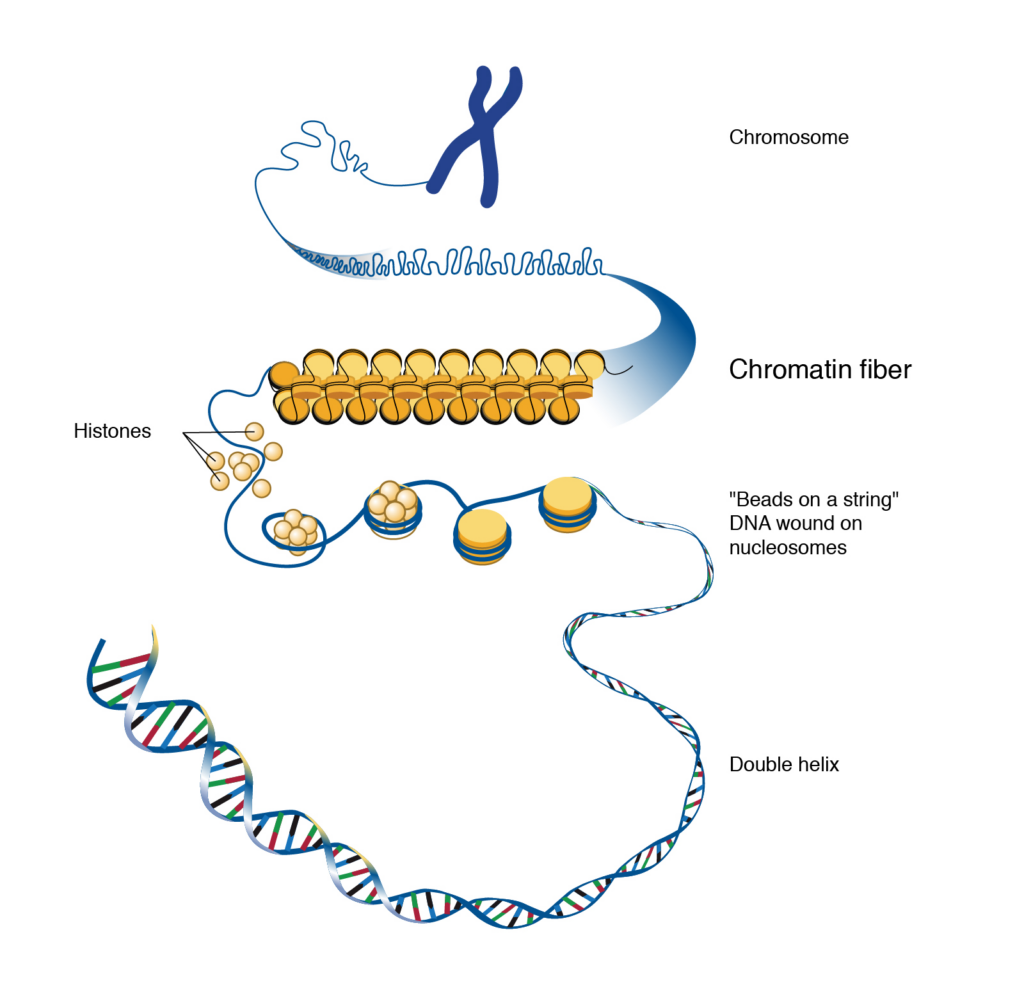
Inside the nucleus of each cell, about six feet of DNA must fit into a space one-tenth the width of a human hair strand. As a result, DNA can’t just freely float around. Instead, it coils around proteins, specifically histone proteins, to form nucleosomes (3). These nucleosomes individually connect together like beads on a string, creating a long strand that folds into chromatin fibers (3). These chromatin fibers then need to be folded even more compactly in order to fit inside the nucleus. These folds form loops, domains, and compartments that are very specific when tucked into the cell.
Research from Northwestern University and other institutions has helped reveal that this 3D structure of loops and structures is not random. In fact, DNA’s folding pattern helps control which genes are turned on and which are turned off, influencing everything from development to cell identity and disease (2). This effort led to the identification of over 140,000 chromatin loops per cell and revealed how different types of loops contribute differently to gene regulation (1). Scientists have also created high-resolution 3D models of entire genomes, which are arranged relative to nearby genes (1, 2). These models demonstrate how the genome is organized into large structural units, called domains. DNA sequences with the same domains are organized near each other, allowing them to interact more frequently with each other than with regions outside the domain. These domains help keep gene regulation organized, which ensures that the correct genes are turned on, rather than the wrong ones (1).
Geneva, U. of. (2015, November 5). Why some genes are highly expressed. Phys.org. https://phys.org/news/2015-11-genes-highly.html
Scientists believe genes that control cell growth can be misregulated and that some genetic disorders may not be caused by changes in the DNA sequence, but maybe by changes in how the DNA is folded (4). In the future, scientists at Northwestern University hope to eventually use these discoveries and tools to decode how genome misfolding contributes to cancers and developmental disorders (2).
Bibliography:
- A hidden world inside DNA is finally revealed. (2026). ScienceDaily. https://www.sciencedaily.com/releases/2026/01/260107225541.htm#:~:text=DNA%20inside%20the%20cell%20does,and%20the%20risk%20of%20disease.
- Scientists map the human genome in 4D. (2026). Northwestern.edu; Northwestern Now. https://news.northwestern.edu/stories/2025/12/scientists-map-the-human-genome-in-4d
- Hughes, H. (2025, December 4). Microscopic Droplets Reveal DNA’s Secret Architecture. SciTechDaily. https://scitechdaily.com/microscopic-droplets-reveal-dnas-secret-architecture/
- How Does a Glitch in Genome Folding Lead to Disease? (2017). New York Stem Cell Foundation. https://nyscf.org/resources/how-does-a-glitch-in-genome-folding-lead-to-disease/#:~:text=The%20sequence%20of%20bases%20(As,other%20will%20start%20to%20interact.
- Dalton, L., & Young, R. (2024). DNA, Chromosomes, and the Interphase Nucleus. Fundamentals of Cell Biology; Oregon State University. https://open.oregonstate.education/cellbiology/chapter/dna-chromosomes-interphase-nucleus/


Comments are closed.