
What are fractals, and how did they change math and science?
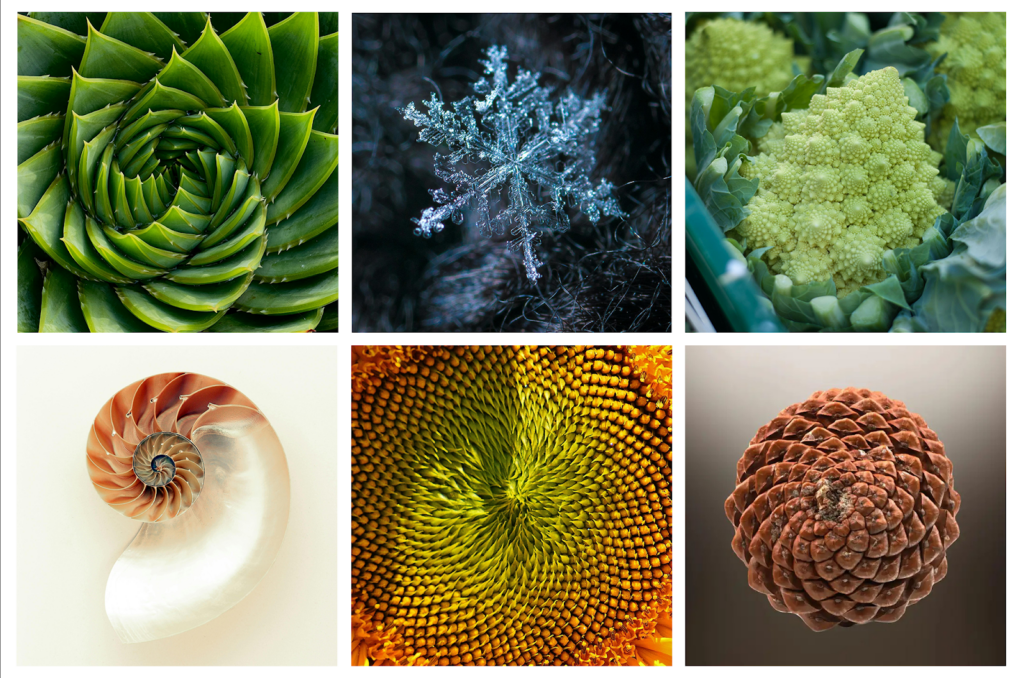
What do galaxies, clouds, cauliflower, mountains, and ferns all have in common? They all follow fractal structures—never-ending, infinitely complex patterns in which the same shape successively repeats itself at smaller and smaller scales (1). To put this into perspective, imagine a tree. It has a trunk that splits into branches. Those branches diverge into even smaller branches, which eventually separate into twigs and twiglets. At first glance, it may seem like the tree’s structure is disorganized. In reality, there is a self-similar pattern—each branch is a similar version of the tree itself.
Although scientists and mathematicians have long studied these self-repeating patterns, the term was first coined by Benoit Mandelbrot in 1975 (1). After studying in both the United States and France, he worked at the largest industrial research organization in the world: the International Business Machine Corporation, or IBM. There, he observed that the extraneous noise of IBM’s circuits contained a natural, repeating shape and structure (3). In 1980, using IBM’s computers, he was one of the first to use computer graphics to create fractal geometric images.
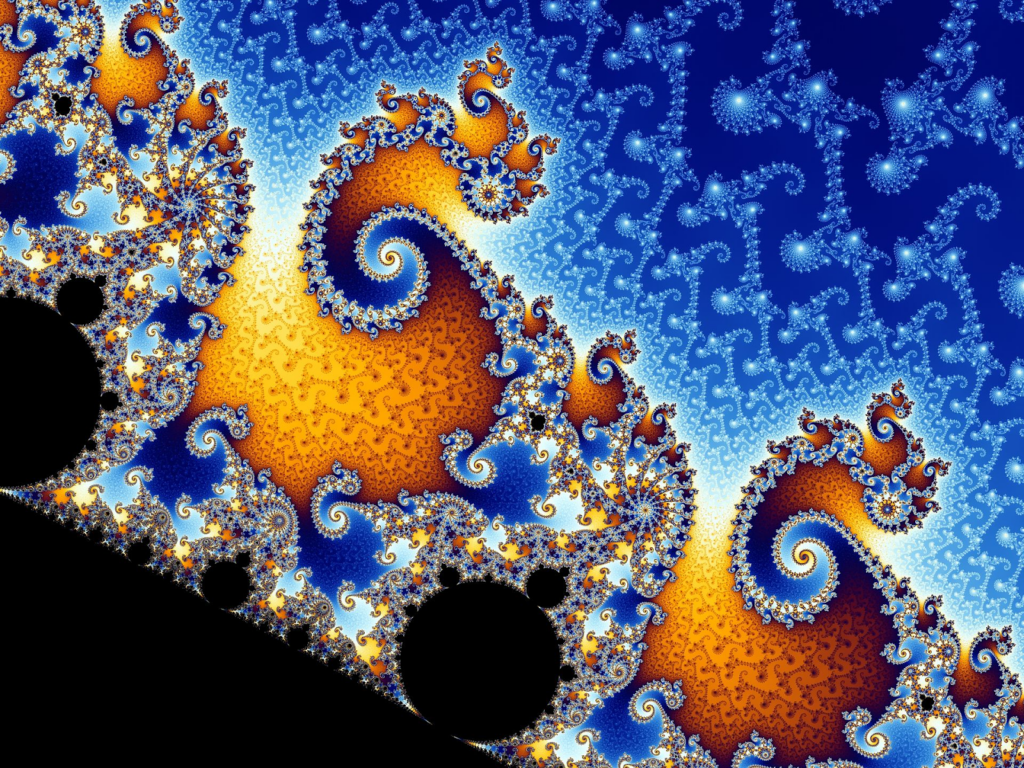
Mandelbrot’s work sparked the rise of fractal geometry, which built upon earlier mathematical concepts of self-similar shapes (4). Though classical geometry focuses on clean forms such as lines, circles, and polygons, fractal geometry opens the door to describing irregular and complex shapes. For instance, if a scientist wanted to measure a coastline’s distance, they could use a map and get a close estimate using its perimeter. Still, they would need to account for every rock, boulder, and eventually each grain of sand to measure its true length. Therefore, the coastline would get infinitely longer (5).
Additionally, fractals defy the usual idea of dimension, which is the smallest number of coordinates needed to specify any point within a shape. By this definition, a line is one dimension, a plane is two dimensions, and a cube is three dimensions. Unlike these clean forms, fractals display the roughness of a shape (1). The Sierpinski triangle, another fractal, is formed by recursively removing the central triangle from an equilateral triangle. It has approximately 1.585 fractal dimensions because the resulting shape is more complex than a line but doesn’t fill a plane; therefore, it is neither one-dimensional nor two-dimensional (5).
Not only are fractals a subfield of math, but they have also revolutionized other sciences. Fractals can be used to study anything. For instance, to identify if a place in the past experienced “positive shock” (warming) or “negative shock” (cooling), researchers can evaluate the fractal dimension of climate data to indicate shifting patterns (6). It can also be used to examine the trajectory of meteorites or even the growth of mutated cells (2). They can also model bodily systems like blood vessels and lungs (2). Its influence even extends beyond science. Fractals have helped improve visual-effects in movies and inspired wireless cell phone antennas, as a fractal pattern can help to pick up a wider range of signals (1).
Benoit once stated that things typically considered to be “rough”, a “mess,” or “chaotic” actually had a “degree of order” (6). He proved his point as fractals continue to help scientists expand our understanding of the natural world and the hidden patterns that shape it.
Bibliography
- Ornes, S. (2025, December 18). Fractals describe patterns hidden all around us. Science News Explores. https://www.snexplores.org/article/fractals-patterns-all-around
- Challoner, J. (2010, October 18). How Mandelbrot’s fractals changed the world. BBC News. https://www.bbc.com/news/magazine-11564766
- Benoît Mandelbrot | IBM. (2025). Ibm.com. https://www.ibm.com/history/benoit-mandelbrot
- Robb, D. (2025, August 17). Fifty Years of Fractals – JSTOR Daily. JSTOR Daily. https://daily.jstor.org/fifty-years-of-fractals/Haggit, C., & Yara Simón. (2023, October 31).
- Article 132: The Holographic Universe – Part 1 – Fractals & Holography – Cosmic Core. (2019, April 30). Cosmic Core. https://www.cosmic-core.org/free/article-132-the-holographic-universe-part-1-fractals-holography/
- Esfahani,. (2010). The fractal nature of climate change – 2000 years in retrospect. AGU Fall Meeting Abstracts, 2010, H21G1126. https://ui.adsabs.harvard.edu/abs/2010AGUFM.H21G1126E/abstract

Comments are closed.