
How the worst nuclear accident in the world unfolded
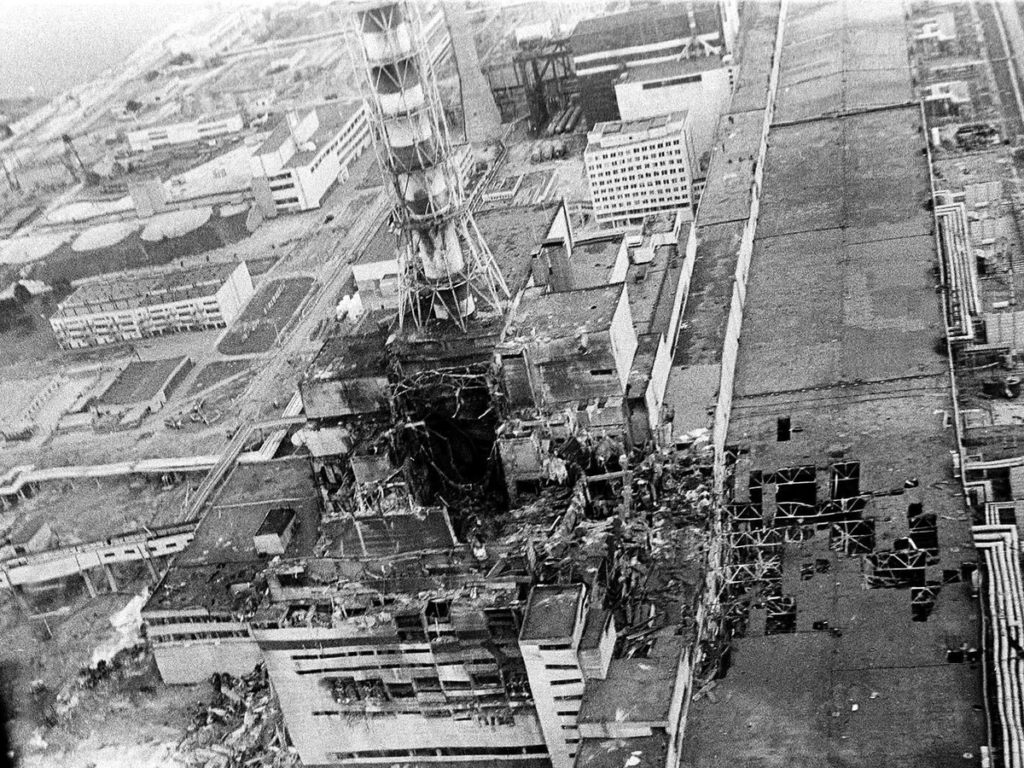
Who hasn’t heard about Chernobyl? One of the most famous events in nuclear energy, the Chernobyl disaster was one of the worst nuclear accidents in history. By releasing around five percent of its 192-ton radioactive core, Chernobyl caused the evacuation of over 350,000 people, polluted the air, soil, and water, and increased cancer rates across Europe. Now, more than 35 years later, Chernobyl still impacts millions of lives. This is especially true as the Russo-Ukrainian War threatens its modern-day protective shielding, which was installed after the disaster to prevent further pollution. So, how did this nuclear plant fail so spectacularly? Ironically, it began with a safety test (1).
Originally scheduled for midday on April 25, 1986, the safety test would allow operators at Chernobyl to take advantage of required maintenance on the reactor (2,3). The test aimed to determine whether energy from a slowing reactor could still power safety equipment for a short period of time, which would be enough for backup generators to turn on (2,4). For the test to occur, the reactor needed to go into near-shutdown and generate very little energy (2). However, energy demand was higher than usual, and the test was postponed to midnight, when it would be conducted by an inexperienced night crew (2,5).
When the power grid controller finally allowed the test to run around midnight, the operating crew immediately made an error in the procedure (2). While the test was supposed to be run at about 700 to 1000 MWt of energy production, it fell to just 30 MWt (2,5). At these reaction levels, the element xenon built up in the reactor, making it difficult to increase the power again (5). To combat this, the operators raised almost all of the control rods in the reactor, violating multiple safety regulations. When power eventually stabilized at 200 MWt, well below the required 700 MWt, operators decided to conduct the test, once again bypassing automatic safety measures controlled by computers (2,5).
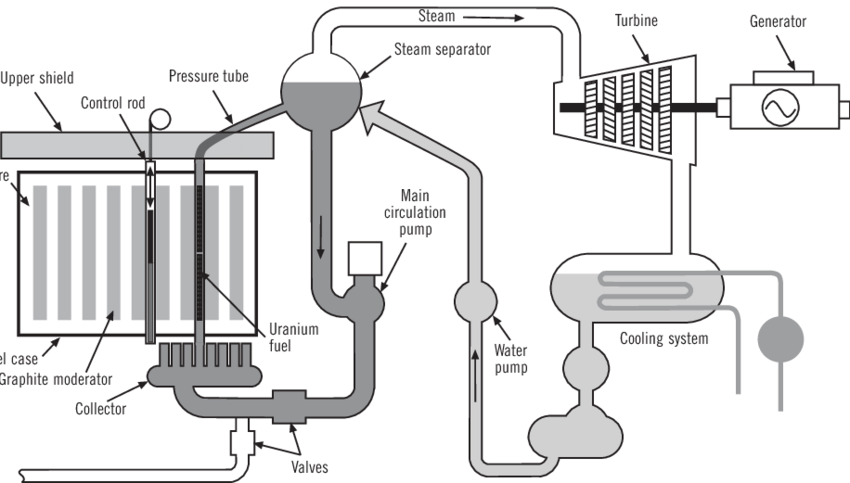
As coolant pumps went offline for the test, the amount of water in the reactor rapidly turned into steam, no longer being replaced by fresh water (2). The poor design of the Chernobyl reactor allowed the boiling coolant water to create a positive feedback loop; the boiling water no longer slowed down the reaction and created more and more power. This rapid increase in power then boiled more water, in a loop known as a “positive void coefficient” (2,6). When operators saw the power rapidly increase to almost 100 times the expected production, they immediately tried to abort the test by lowering all control rods (4,6). However, another design flaw in the Chernobyl reactor meant that the graphite-tipped rods actually momentarily increased reactivity as they were inserted (6). Combined with the rapid burning away of reaction-limiting xenon, the positive void coefficient, and the AZ-5 design flaw, the reactor generated too much steam. The core’s lid blew off at 1:23 a.m. on April 26th, 1986 (2,4,5,6). The remaining steam energy melted the core, turning it into a sludge of radioactive material that increased rates of thyroid cancer, polluted topsoil, and displaced thousands of people throughout Europe (1).
While the explosion at Chernobyl is often blamed on operator error, factors such as inadequate training and poor safety culture were the root causes of the catastrophe. As nuclear energy continues to grow globally, understanding how the Chernobyl disaster occurred is important not only for scientists building safer reactors, but also to highlight the necessity of rigorous procedures, safety measures, and communication in daily life—no one wants a meltdown!
Bibliography:
- Chernobyl Accident 1986 – World Nuclear Association. (2025). World-Nuclear.org. https://world-nuclear.org/information-library/safety-and-security/safety-of-plants/chernobyl-accident
- Chernobyl: Chapter I. The site and accident sequence. (2025). Nuclear Energy Agency (NEA). https://www.oecd-nea.org/jcms/pl_28271/chernobyl-chapter-i-the-site-and-accident-sequence
- A reactor physicist explains Chernobyl. (2026). Ans.org. https://www.ans.org/news/article-3913/a-reactor-physicist-explains-chernobyl/
- What caused the disaster | The Chernobyl Gallery. (2013, February 15). The Chernobyl Gallery. https://www.chernobylgallery.com/chernobyl-disaster/cause/
- Sequence of Events – Chernobyl Accident Appendix 1 – World Nuclear Association. (2025). World-Nuclear.org. https://world-nuclear.org/information-library/appendices/chernobyl-accident-appendix-1-sequence-of-events
- RBMK Reactors – Appendix to Nuclear Power Reactors – World Nuclear Association. (2026). World-Nuclear.org. https://world-nuclear.org/information-library/appendices/rbmk-reactors
Images

Comments are closed.