
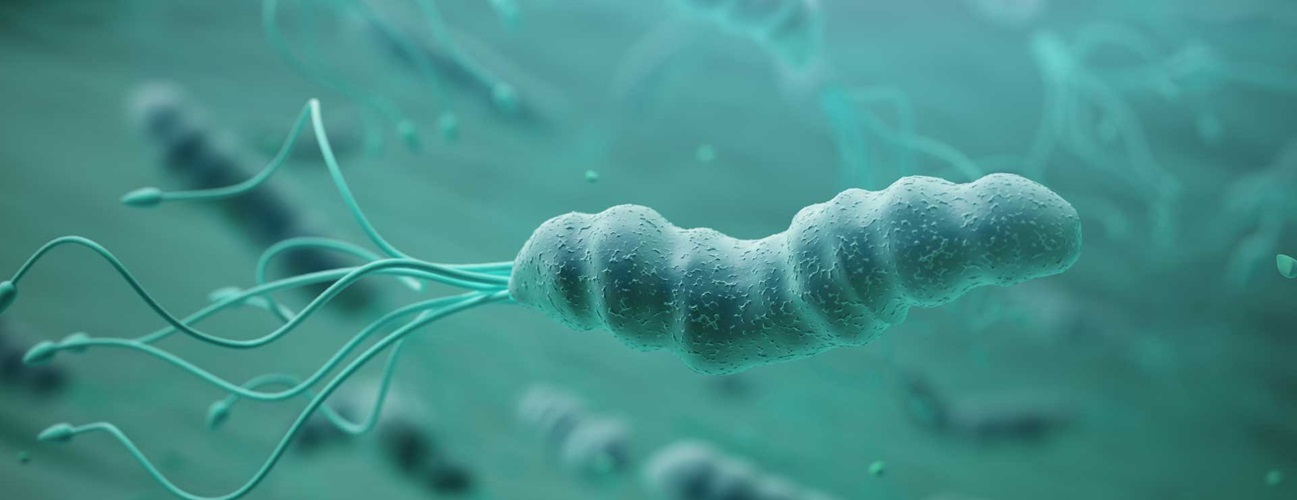
The bacteria behind gastric ulcers, and how Barry Marshall proved it was a pathogen
Doctors knew of stomach ulcers before the 16th century, noting symptoms like gastritis and pain during meals. Until the mid-1980s, scientists theorized that these symptoms stemmed from psychological conditions such as stress and anxiety. The condition was often treated, unsuccessfully, with antidepressants or basic antacids. However, in the 1980s, scientists discovered that a bacterial infection caused stomach ulcers, revolutionizing treatment (1).
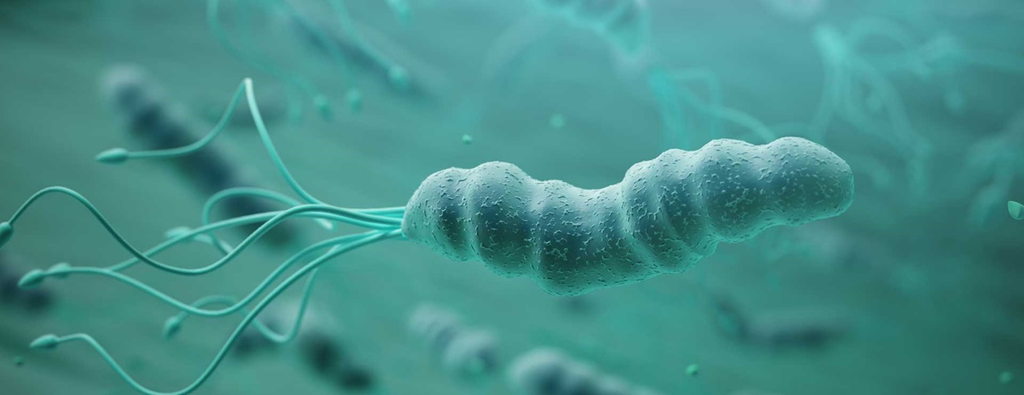
Doctor Barry Marshall, credited with discovering the bacterium that causes stomach ulcers, was not the first to notice it. Scientists first observed Helicobacter Pylori, a curved bacterium, in the late 19th century in biopsies of the stomach lining. Scientists then hypothesized that stomach bacteria might cause gastric ulcers; however, they didn’t know how to culture and breed this species. For that reason, they didn’t treat patients with antibiotics; instead, they continued using decades-old treatment methods (2).
But Dr. Marshall, a native of Perth, Australia, discovered the bacteria while treating a patient with acute gastritis. The patient was falsely diagnosed with a psychosomatic illness and referred to a psychiatrist. However, Dr. Marshall began researching the bacteria, which resembled agents of foodborne illness. He noted that H. Pylori had been interpreted as a bacillus that fed on inflamed and dying stomach tissue rather than causing infection. Working with Dr. Martin Skirrow, a gastroenterologist at the Worcester Infirmary in England, Marshall identified the bacteria in several other patients and eventually isolated it (3). Marshall’s hypothesis, lacking an animal model, drew skepticism from those who didn’t believe H. Pylori was a pathogen. Desperate to prove his theory, Marshall cultured the bacteria and drank it himself; he experienced symptoms of extreme gastritis soon after and underwent treatment with antibiotics and bismuth. Impressively, he made a full recovery a few days later, proving that H. Pylori is responsible for stomach ulcers and gastritis (4).
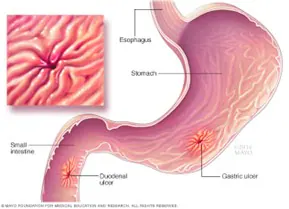
H. Pylori, a curved bacillus, lives in the stomachs of many people, where it dwells for decades without creating symptoms. When the bacteria enters the stomach of someone who wasn’t infected, it produces an enzyme called urease. Urease catalyzes the hydrolysis of urea in a person’s stomach into CO2 and ammonia, the latter of which is toxic to stomach cells. It also neutralizes stomach acid, meaning that when acidic or spicy food enters the stomach, the acid kills stomach cells. Both kill stomach cells and wear out the stomach lining, inducing gastritis and ulcers (5). Untreated H. Pylori can cause stomach cancer, or else eventually perforate the stomach lining and kill a patient (6).
Had Dr. Marshall never recognized H. Pylori as a pathogen, and been brave enough to infect himself, millions of people would be forced to live with chronic pain, or be killed by complications of gastritis. Dr. Marshall and his mentor, Dr. Robin Warren, were rightfully awarded a Nobel Prize in 2005 for the discovery. Treatments devised specifically to eradicate H. Pylori are still used today (1).
Bibliography:
- Radomski, B. M., Šešelja, D., & Naumann, K. (2021). Rethinking the history of peptic ulcer disease and its relevance for network epistemology. History and Philosophy of the Life Sciences, 43(4). https://doi.org/10.1007/s40656-021-00466-8
- Kyle, R. A., Steensma, D. P., & Shampo, M. A. (2016). Barry James Marshall—Discovery of Helicobacter pylori as a Cause of Peptic Ulcer. Mayo Clinic Proceedings, 91(5), e67–e68. https://doi.org/10.1016/j.mayocp.2016.01.025
- Marshall, B., & Adams, P. C. (2008). Helicobacter Pylori: A Nobel Pursuit? Canadian Journal of Gastroenterology, 22(11), 895–896. https://doi.org/10.1155/2008/459810
- Watts, G. (2005). Nobel prize is awarded to doctors who discovered H pylori. BMJ, 331(7520), 795.1. https://doi.org/10.1136/bmj.331.7520.795
- Mobley, H. L., Hu, L. T., & Foxal, P. A. (1991). Helicobacter pylori urease: properties and role in pathogenesis. Scandinavian journal of gastroenterology. Supplement, 187, 39–46. https://pubmed.ncbi.nlm.nih.gov/1775923/
- (2026, February 23). Helicobacter Pylori. Hopkins Medicine. https://www.hopkinsmedicine.org/health/conditions-and-diseases/helicobacter-pylori
Image Citations:



Comments are closed.