
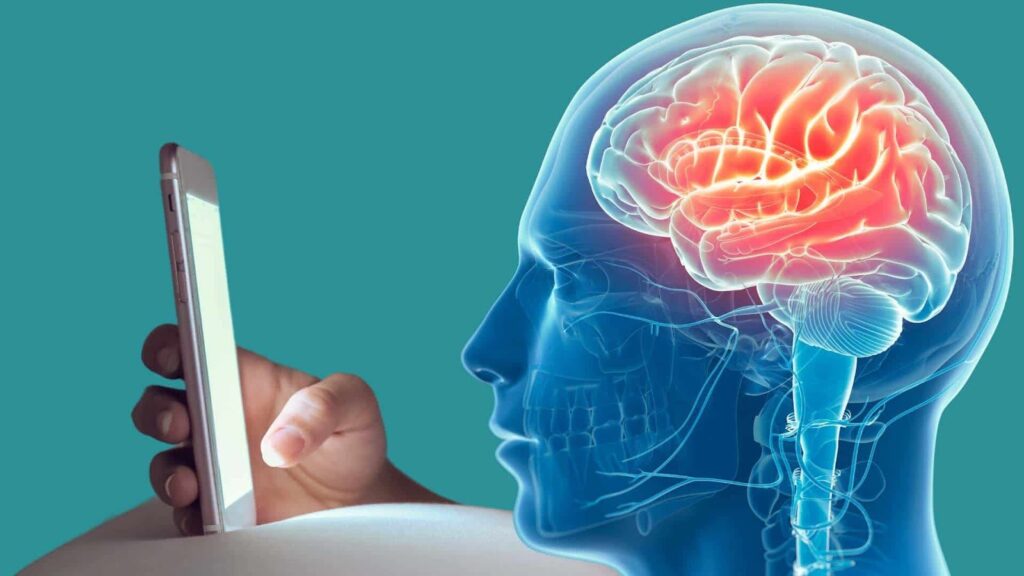
The effect that scrolling on social media has on the brain.
About 5.17 billion people around the world use social media, with an average daily use of more than two hours (1). In addition, approximately 20% of adults are online 40 or more hours per week (2). Social media has quickly become a central part of human life, with many users spending large amounts of time online, scrolling through endless reels and videos. Time spent on social media leads to unhappiness and restlessness, two examples of the effects scrolling has on a neurological level.
Social media apps are designed to draw people in, with personalized “for you” pages and feeds that adapt to each user’s specific interests. However, they are also addictive in a different way, similar to sugar, alcohol, and even drugs. Scrolling on social media triggers a dopamine release to reward pathways in the brain (3). Dopamine, often called the “pleasure hormone,” is a chemical messenger that is released every time people do something enjoyable (4). The feeling is temporary, so the body tells a person to do any activity or action that releases dopamine over and over again in order to get another dose (4). Therefore, humans want to stay online for extended periods of time. After closing social media, the brain goes into a dopamine deficit, so while scrolling can feel rewarding, it often leads to a decline in mood afterward (3). One study even coined the term “dopamine-scrolling” to describe the action of spending large amounts of time, often across various apps, seeking out endless entertainment online (5).

Similar to dopamine-scrolling, “doomscrolling” describes when people spend time endlessly scrolling online but through negative content that makes them feel bad (6). Doomscrolling is a more specific term than dopamine-scrolling, which is any kind of scrolling that releases dopamine—negative or positive content. Doomscrolling makes us feel stressed, as it causes the amygdala—the part of the brain that processes emotions like fear and anxiety—to start working excessively and release stress hormones like cortisol and adrenaline (7, 8). Ultimately, the emotional crash people experience after spending time on social media isn’t just disappointment about wasted time; it’s the brain’s neurological response to the hormones social media releases.
Scrolling before bed can be especially harmful to the body and sleep schedule. In short, it overstimulates the brain, which makes it harder to relax afterward, especially if scrolling occurs right before sleep (9). Additionally, devices like smartphones release blue light, which disrupts the production of melatonin. Melatonin helps regulate the body’s sleep schedule; it makes people feel tired at night and helps them wake up in the morning (10, 11). Therefore, not only does social media’s addictiveness cause people to scroll late into the night, but it also has prolonged effects on sleep and restfulness.
While the effects of social media sound disheartening, there are ways to combat its harmful and addictive properties. Taking a break from scrolling is a great way to clear reward pathways, as well as significantly reduce time wasted in general (3). Simply not opening social media can be difficult, so strategies such as setting screen time limits, downloading apps to help restrict time, and even deleting social media for a while can be helpful. While it may feel like not using social media would lead to a lower mood, science proves that a reset benefits the body and mind.
Bibliography:
- Lee, R. A. (2026, January 30). Social Media Statistics 2025:Platforms, Users, and Behaviors. SQ Magazine. https://sqmagazine.co.uk/social-media-statistics/
- Korte M. (2020). The impact of the digital revolution on human brain and behavior: where do we stand? . Dialogues in clinical neuroscience, 22(2), 101–111. https://doi.org/10.31887/DCNS.2020.22.2/mkorte
- Addictive potential of social media, explained. (2021). News Center. https://med.stanford.edu/news/insights/2021/10/addictive-potential-of-social-media-explained.html
- Dopamine and Serotonin: Our Own Happy Chemicals. (2023). Nationwidechildrens.org. https://www.nationwidechildrens.org/family-resources-education/700childrens/2023/02/dopamine-and-serotonin
- Sharpe, B. T., & Spooner, R. A. (2025). Dopamine-scrolling: a modern public health challenge requiring urgent attention. Perspectives in public health, 145(4), 190–191. https://doi.org/10.1177/17579139251331914
- Sharpe, B. T., & Spooner, R. A. (2025). Dopamine-scrolling: a modern public health challenge requiring urgent attention. Perspectives in public health, 145(4), 190–191. https://doi.org/10.1177/17579139251331914
- This Is What Doomscrolling Does to Your Brain | Hartford HealthCare | CT. (2025). Hartfordhealthcare.org. https://hartfordhealthcare.org/about-us/news-press/news-detail?articleId=67943#:~:text=2.,ve%20put%20your%20phone%20down
- Clinic, C. (2023, April 12). Amygdala: What It Is and What It Controls. Cleveland Clinic. https://my.clevelandclinic.org/health/body/24894-amygdala
- University Hospitals. (2024, July 9). Doomscrolling: Breaking the Habit. Uhhospitals.org. https://www.uhhospitals.org/blog/articles/2024/07/doomscrolling-breaking-the-habit
- Screen Time and the Brain. (2025). Harvard.edu. https://hms.harvard.edu/news-events/publications-archive/brain/screen-time-brain
- Clinic, C. (2023, September 6). Melatonin: What It Is, What It Does & How It Works. Cleveland Clinic. https://my.clevelandclinic.org/health/articles/23411-melatonin
Images:





Comments are closed.