
What’s up with sunscreen and the sun?
You may have heard that sunscreen causes cancer, or that sunscreens are unhealthy, or that people of certain skin tones do not need sunscreen. Though they might contain a hint of truth, they are all debunked myths.
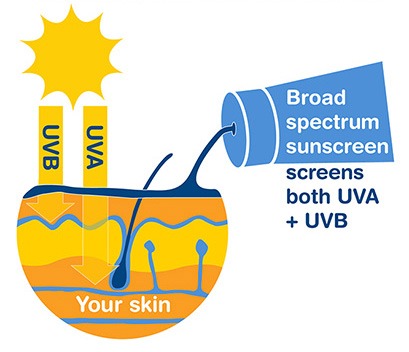
Ultraviolet (UV) light, a type of solar radiation that harms our skin, consists of UVA, UVB, or UVC rays—depending on its wavelength. UVA rays penetrate deep into the skin, causing oxidative stress—an imbalance between free radicals and antioxidants—and inflammation that indirectly damages DNA and escalates skin aging (3, 4). Conversely, UVB rays affect the skin’s surface, causing direct damage to its DNA, leading to tanning, sunburns, or skin cancer (2, 4). UVC, the highest-energy UV light, is the most lethal to living organisms; however, it does not reach Earth’s surface because the ozone layer, which also partially protects against UVB, breaks apart the UVC proton (2).
There are two types of sunscreen. Chemical sunscreens, also known as organic filters, primarily absorb UV rays in the skin and convert them into harmless heat (1, 3). On the other hand, mineral sunscreens, or physical filters, absorb UV radiation but also reflect their rays (2).
Sun protection factor (SPF) quantifies a sunscreen’s sunburn protection. A SPF 15 sunscreen protects against 96% of UVB rays. An SPF 30 sunscreen is not twice as protective as an SPF 15 sunscreen; instead, it protects the skin against 97% of UVB rays (1, 3). While SPF only includes protection against UVB rays, most sunscreens are broad-spectrum, meaning they protect against UVA as well.

The science is clear that UV radiation from the sun damages our skin’s DNA. Sunscreen is a well-studied tool to prevent these damages. Despite concerns about sunscreen, doctors recommend using a broad-spectrium of it, SPF 15 or more, daily rather than stressing over specifics like its type. Dermatologist Dr. Joyce Teng emphasizes that “the best sunscreen is the one you’ll use regularly” (4).
Citations:
- Slevin, T. (2018, January 19). How does sunscreen work? Cancer Council NSW. https://www.cancercouncil.com.au/news/how-does-sunscreen-work/
- (2006, September). The Burning Facts, United States Environmental Protection Agency. https://www.epa.gov/sites/default/files/documents/sunscreen.pdf
- Presow, S. (2024). Taming the sun – the science of sunscreen, Environmental Protection Authority. https://www.epa.govt.nz/community-involvement/science-at-work/science-of-sunscreen/
- Williams, S. (2025, June 23). Sunscreen fact and fiction: What the science says, Stanford Medicine. https://med.stanford.edu/news/insights/2025/06/sunscreen-science.html
Images:





Comments are closed.