
How Rosalind Franklin’s photo 51 changed the course of humanity
“The Nobel Prize in Physiology or Medicine 1962 is awarded jointly to Francis Harry Compton Crick, James Dewey Watson, and Maurice Hugh Frederick Wilkins for their discoveries concerning the molecular structure of nucleic acids and its significance for information transfer in living material.” – The Nobel Prize Committee (1)
In nearly every biology class, students learn about the importance of deoxyribonucleic acid (DNA) through a myriad of ways: cell replication, genetics, and heredity. It is the basis of every living organism and differentiates everyone from each other. For a long time, however, DNA was an obscure figment of a scientist’s imagination. Many thought that proteins were the primary carriers of genetic information because early X-ray images of DNA appeared to be nothing more than a blurry mess (2). The Nobel Prize Committee recognized Watson, Crick, and Wilkins for their discovery of the molecular structure of DNA and catalyzed a series of famous research, like the Hershey-Chase experiment; however, all of this information is ultimately a lie.
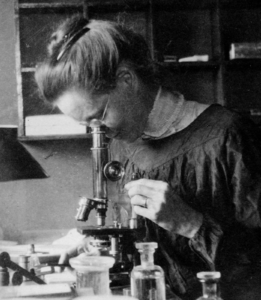
Rosalind Franklin was a British chemist, X-ray crystallographer, and the true discoverer of the DNA structure. From a young age, peers would describe her as “alarmingly clever” for her exceptional aptitude in STEM and the language arts. When she was 15, Franklin knew she was destined for science. She attended the University of Cambridge and studied physical chemistry (3). However, in the midst of World War II, Franklin was forced to give up a fellowship to research coal and carbon for the war effort. In 1951, Rosalind joined a laboratory at King’s College to study DNA. Applying her research done during World War II, she soon discovered the density of DNA and established that the molecule had a helical structure (4).
Franklin and her assistant, Raymond Gosling, had been taking a series of photos to understand the structure of DNA. They were able to do this using X-ray diffraction, a technique involving shooting X-rays at crytallized DNA fibers (5). Rosalind had independently designed a microcamera to focus on these fibers. On May 2nd, 1952, their research would pay off. Gosling took the 51st photo for their research, which was a 62-hour-long process. A few days later, when the photo had developed, the film revealed a distinctive helical cross-shape (3).
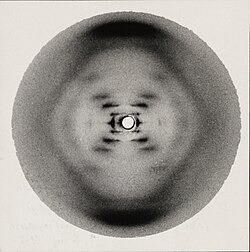
When Rosalind Franklin was in the process of transitioning to a new position at King’s College, her research rival, Maurice Wilkins, found Photo 51 and showed it to Harry Crick and James Watson. The two had long been researching DNA structure as well, though their research was far less valuable (6). The two hypothesized that DNA was built from three helical strands instead of two, and that its phosphate backbone was on the inside. Franklin famously critiqued this model, noting that it would fall apart because the negatively charged phosphates would repel each other (2). Regardless, this photo enabled Watson and Crick to establish that DNA was a double helix.

Rosalind Franklin died in 1958, likely because of overexposure to X-ray radiation, while Watson, Crick, and Wilkins were recognized in 1962 for her discovery. Her research, however, has been and continues to be invaluable. It lives on in biology class, plants, animals, and our bodies as the fundamental principle of life. While the Nobel Prize Committee has yet to credit her, Rosalind’s name lives on.
Citations:
- The Nobel Prize. (1962). Nobel Prize in Physiology or Medicine 1962. The Nobel Prize Committee. Retrieved from: https://www.nobelprize.org/prizes/medicine/1962/summary/
- Kaplan, Judith. (2025). Francis Crick, Rosalind Franklin, James Watson, and Maurice Wilkins. Science History Institute Museum & Library. Retrieved from: https://www.sciencehistory.org/education/scientific-biographies/francis-crick-rosalind-franklin-james-watson-and-maurice-wilkins/#:~:text=DNA%2C%20the%20%E2%80%9CTransforming%20Principle%E2%80%9D,material%20of%20genes%20and%20viruses
- Dr. Rosalind Franklin Centennial. (n.d.). A Scholar in the Making. Rosalind Franklin University. Retrieved from: https://www.rosalindfranklin.edu/rf100/scholar.html
- Britannica Editors. (2026). Rosalind Franklin. Britannica. Retrieved from: https://www.britannica.com/biography/Rosalind-Franklin
- King’s College London. (2016). The Structure of DNA: How Dr. Rosalind Franklin Contributed to the Story of Life. King’s College. Retrieved from: https://www.kcl.ac.uk/the-structure-of-dna-how-dr-rosalind-franklin-contributed-to-the-story-of-life-2
- Cobb, Matthew. (20150. Sexism in science: Did Watson and Crick really steal Rosalind Franklin’s data? The Guardian. Retrieved from: https://www.theguardian.com/science/2015/jun/23/sexism-in-science-did-watson-and-crick-really-steal-rosalind-franklins-data#:~:text=At%20the%20end%20of%20January,abandon%20her%20work%20on%20DNA.
Images:


Comments are closed.