
Research reveals which music improves concentration and which types reduce efficiency.
With the high stress and heavy workload at BB&N, many students rely on music to get themselves through the long nights of challenging homework. As it turns out, they are not alone: the global average listening time has reached an all-time high of 18 hours per week (1). While music was once primarily experienced live and enjoyed during free time, it is now so accessible that it has become part of the background of daily life, with 58% of Gen Z reporting that they regularly listen to music while studying (2). Not only does it have positive impacts on mood, but 89% of people believe that they work more productively while listening to music (2). But does science actually show that music benefits intellectual performance?
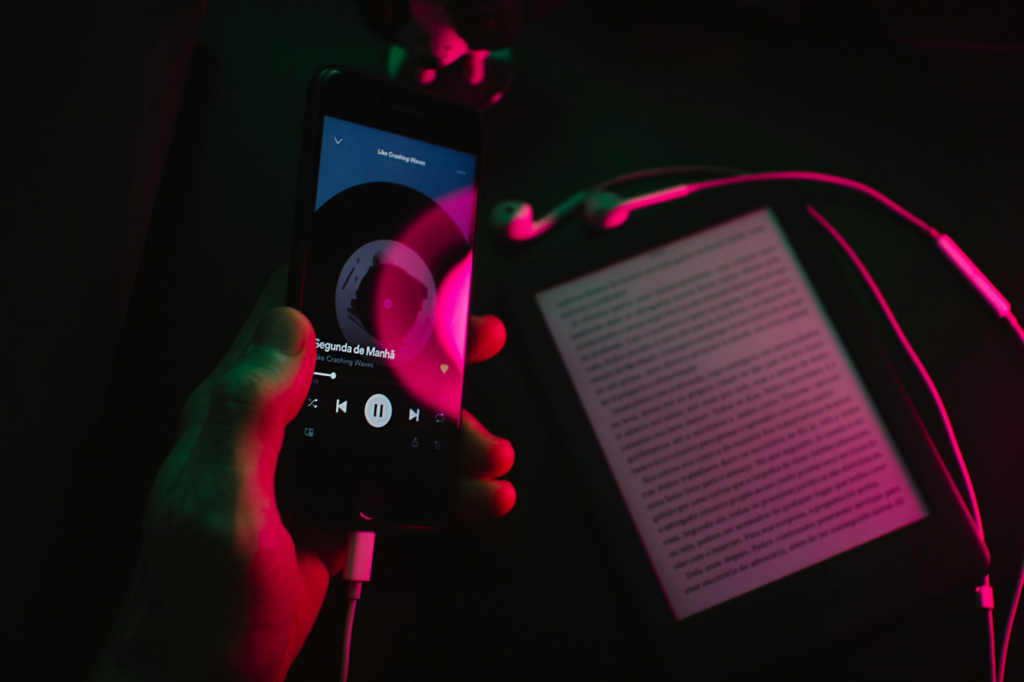
The answer depends on the type of task and the genre of music. Some of the more well-understood advantages of listening include improved mood and motivation, as well as lower stress levels; however, loud and unpredictable music can easily become a distraction (3). Research shows that music with lyrics impairs visual memory, verbal memory, and reading comprehension (4).
Many streaming platforms like Spotify advertise certain types of music specifically for work. One recent study aimed to discover whether these tailored playlists actually benefit productivity. The researchers compared background office noise, popular hit music, “Deep Focus,” or calm instrumental music from the Spotify playlist “Lofi Beats,” and “Work Flow,” a more energizing instrumental playlist (5). They evaluated the participants’ mood using self-reports and measured their performance using the flanker test, a demanding psychological test that assesses focused attention and cognitive control (6).

The study found that although “Work Flow” and “Deep Focus” music were both advertised for work, only “Work Flow” music had a positive effect on psychological performance, with participants demonstrating reduced reaction times whilst maintaining similar accuracy (7). In addition, the researchers surprisingly found that lo-fi music did not improve participants’ mood, and that office noise had no significant negative effect on performance (6).
Music is influential in part because it directly affects the limbic system, a part of the brain that helps regulate our emotions (8). This is why, although lyrics can compete with reading and thinking, steady music can reduce stress and thus improve concentration, and energizing music can enhance motivation and focus during repetitive tasks (9).
Therefore, certain kinds of music can improve mood and intellectual efficiency, as long as they are chosen carefully. However, not all music that is advertised for work is actually beneficial, and music with lyrics can actually inhibit performance on reading comprehension and memory. Although many people associate music with increased cognitive performance, in reality, they may actually be attributing improved mood to higher productivity. Therefore, in order to maximize performance, be sure to use research-backed music to increase productivity.
Bibliography:
- Sanfilippo, K. R. M., Spiro, N., Molina-Solana, M., & Lamont, A. (2020). Do the shuffle: Exploring reasons for music listening through shuffled play. PLOS ONE, 15(2), e0228457. https://doi.org/10.1371/journal.pone.0228457
- Steinberg, B. (2022). Students who listen to music while studying have a higher GPA: Poll. New York Post. https://nypost.com/2022/08/18/students-who-listen-to-music-while-studying-have-a-higher-gpa-poll/
- Kiss, L., & Linnell, K. J. (2020). The Effect of Preferred Background Music on task-focus in Sustained Attention. Psychological Research, 85(6). https://doi.org/10.1007/s00426-020-01400-6
- Raypole, C. (2020, July 29). Does Music Help You Study or Concentrate on Work? Healthline. https://www.healthline.com/health/does-music-help-you-study#negative-effects
- Souza, A. S., & Barbosa, L. C. L. (2023). Should We Turn off the Music? Music with Lyrics Interferes with Cognitive Tasks. Journal of Cognition, 6(1), 24–24. https://doi.org/10.5334/joc.273
- Lane, R. (2025, April 29). This Type of Music Can Increase Your Concentration and Productivity. Georgetown University. https://www.georgetown.edu/news/discovery-and-impact-music-can-increase-your-concentration-and-productivity/
- Baghdadi, G. (2021). Eriksen Flanker Task – an overview | ScienceDirect Topics. Www.sciencedirect.com. https://www.sciencedirect.com/topics/neuroscience/eriksen-flanker-task
- Orpella, J., Bowling, D. L., Tomaino, C., & Ripollés, P. (2025). Effects of music advertised to support focus on mood and processing speed. PLoS ONE, 20(2), e0316047–e0316047. https://doi.org/10.1371/journal.pone.0316047
- (2018, April 16). The Mind on Music – Georgetown Today. Georgetown Today. https://today.advancement.georgetown.edu/health-magazine/2018/the-mind-on-music/
- How Music Can Help With Difficult Tasks | Psychology Today. (n.d.). Www.psychologytoday.com. https://www.psychologytoday.com/us/blog/music-on-my-mind/202307/how-music-can-help-with-difficult-tasks
Images:





Comments are closed.