
The Big Bang’s Aftertaste
The “Big Bang” is attributed to the moment our universe was created, but how do scientists truly know it happened? Where is the evidence? Well, when you throw a stone into a pond, it’s initially obvious that someone disturbed the surface, but after a moment, only imperceptible ripples remain. The Cosmic Microwave Background (CMB) holds a similar relationship to the Big Bang.
It took around 300,000 years for the universe to cool down from its initial state to about 3,000 C˚, allowing atoms to form, and the remnant of that first stage of the universe is the CMB (1). This moment when atoms could form is called “recombination,” which gave off a particular kind of light, and it made the universe’s matter the transparent emptiness of space as it is now. Since recombination happened everywhere, we feel its light from all sides as radiation; thus, Cosmic Microwave Background Radiation is the full name of the term CMB.
The assertion earlier in the article that the CMB is evidence of the Big Bang is not quite true—in fact, it would be more accurate to say that the Big Bang is the evidence of the CMB. As the European Space Agency says, “The Big Bang model is still the only model that can convincingly explain the existence of the CMB” (1). So, because of the CMB’s discovery, the Big Bang is currently the only theory that makes sense.
So what else do we gain from the idea of the CMB besides evidence toward a popular theory? Well, we learn details about our universe’s existence. For example, in the picture above, taken by the Wilkinson Microwave Anisotropy Probe (WMAP), the map of the CMB is shown. The WMAP system works by measuring the difference in temperature between two points in the sky rather than the absolute temperature, which other, less effective probes have used. The WMAP even found the age of the universe to be 13.77 billion years old (and counting) within half a percent, along with a plethora of other cosmic discoveries (3).
The tiny irregularities in the WMAP images are minuscule density fluctuations from the Big Bang that made galaxies exist. If the fluctuations had not existed, or had been significantly larger, galaxies would have never formed, and we wouldn’t be around to study them, or anything for that matter (2). The fluctuations’ tiny difference in density and thus mass caused them to pull in more matter, which made them even more dense: fast forward billions of years, and you get galaxies. The CMB has taught us a lot about how our universe came to be. Just like when scientists cut a tree’s trunk and analyze the rings of the wood to understand environmental data from centuries earlier, the CMB acts as a window into our universe’s past.
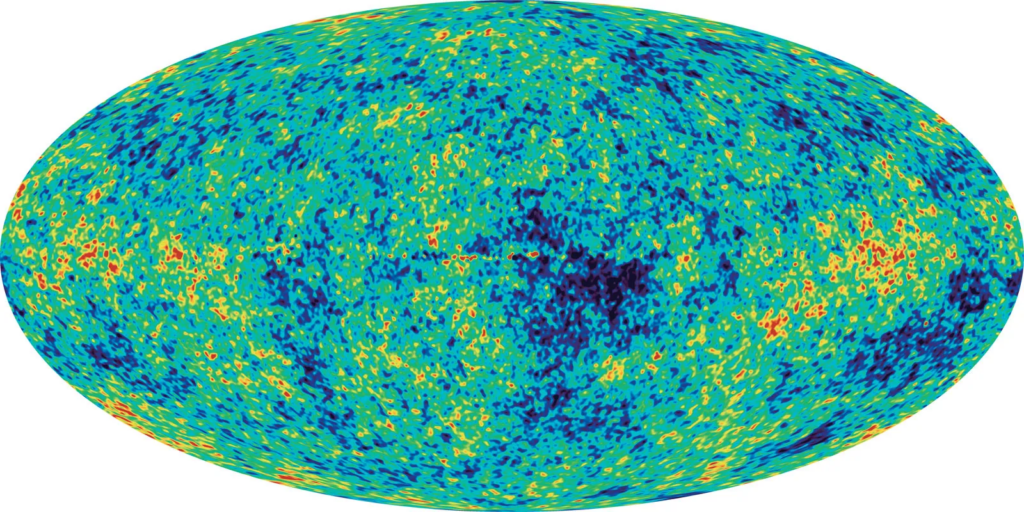
Sky map of CMB via Wilkinson Microwave Anisotropy Probe (WMAP)
https://www.britannica.com/science/cosmic-microwave-background

Image of Wilkinson Microwave Anisotropy Probe (WMAP)
Sources:
- European Space Agency. (n.d.). Cosmic Microwave Background (CMB) radiation. ESA – Science & Exploration. Retrieved January 18, 2026, from https://www.esa.int/Science_Exploration/Space_Science/Cosmic_Microwave_Background_CMB_radiation
- Center for Astrophysics | Harvard & Smithsonian. (n.d.). Cosmic Microwave Background. Harvard & Smithsonian. Retrieved January 18, 2026, from https://www.cfa.harvard.edu/research/topic/cosmic-microwave-background
- NASA. (2025, approx.). WMAP overview. NASA Science. Retrieved January 18, 2026, from https://science.nasa.gov/mission/wmap/wmap-overview/



Comments are closed.