
How the world’s most famous supersonic transport plane crashed
Following a joint Anglo-French development agreement in 1962, work began on the first supersonic passenger plane (1). After seven years of development, the French prototype, Concorde 001, completed its maiden flight on March 2nd, 1969 (1). The plane entered commercial service on January 21, 1976, with British Airways, flying from Heathrow to Bahrain (1). Soon after, Air France opened their own route from Charles de Gaulle to Rio de Janeiro via Dakar (1).
However, the Concorde was cursed before it even entered service: the 1973-74 Oil Crisis caused oil prices to skyrocket worldwide, making the Concorde, with its four massive fuel-hungry engines, economically unavailable (2). In addition, America banned supersonic travel over its airspace in 1973, and the two American companies that had previously ordered the plane cancelled their orders in the same year (3). Throughout its operational life, the Concorde also suffered from severe maintenance problems, requiring an average of 57 hours of maintenance to fly one hour, a significant increase from the average of 10-15 hours required by most contemporary planes (4, 5).
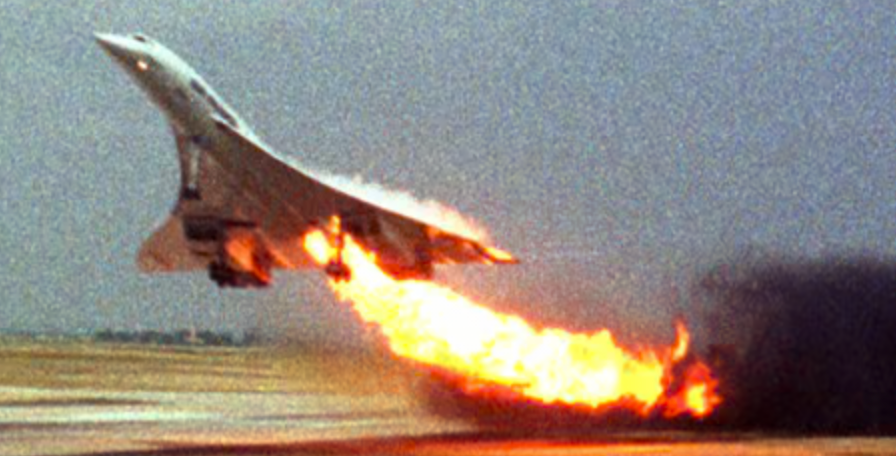
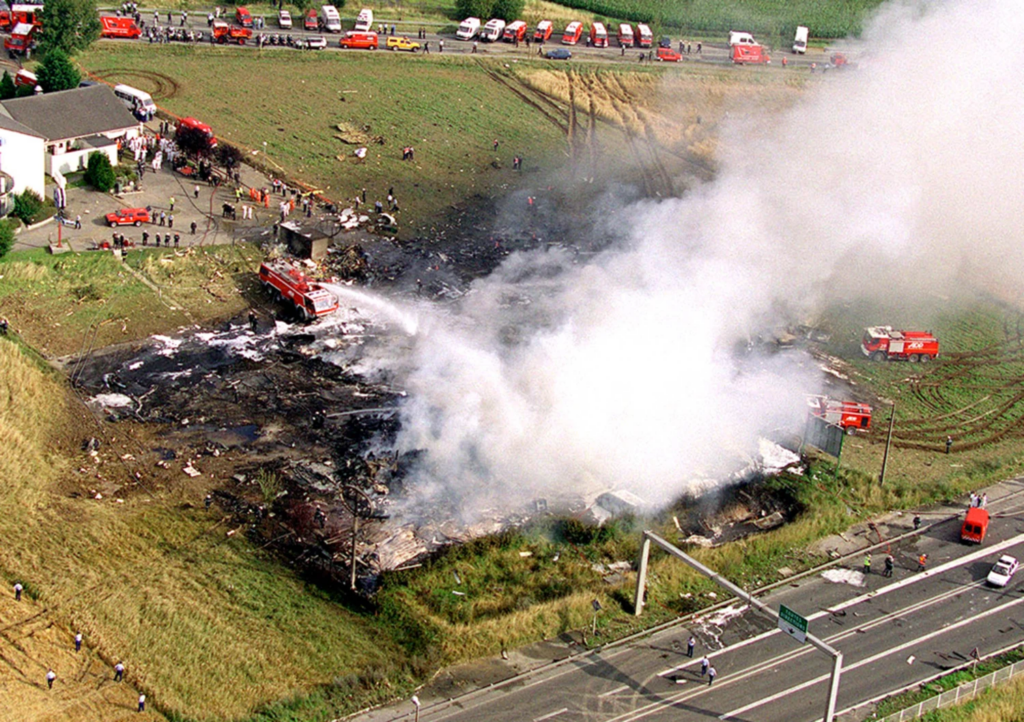
It was under these circumstances that Captain Christian Marty initiated the takeoff procedure for his Concorde (Air France Flight 4590) in Charles de Gaulle Airport on June 25, 2000 (6). Unbeknownst to Captain Marty, First Officer Jean Marcot, and Engineer Gilles Jaurdinaud, there was a piece of metal on the airstrip that had fallen off of a DC-10 aircraft just five minutes earlier (6). As the massive Concorde accelerated down the airstrip, its leftmost tire (Left Tire No. 2) struck the debris, resulting in the tire blowing apart (6). This time, unlike the multiple other times when a Concorde had taken off with a damaged or punctured tire, the rapid destruction of the tire caused a large piece of the tire debris to slam into fuel tank No. 5 (6). Since the fuel tanks were all full, the indent caused by the impact resulted in an adjacent bulge in the fuel tank as the force of the impact rebounded into the aluminum airframe (6). This blew out a piece of the airframe on the underside of the fuel tank, resulting in a catastrophic fuel leak (6). Although the aircraft climbed to 200 feet, the fire from the fuel leak forced the crew to shut down engines No. 1 and No. 2. Due to the resulting compromised control, the plane slammed into a nearby hotel, killing all crew on board, all 109 passengers on board, and four people on the ground instantly (6).
The immediate investigation that followed analyzed the surviving cockpit instruments and images of the fuel leak to determine the rate of leak (6). Using that rate, the investigators were able to identify a piece of debris on the airstrip as the piece of the fuel tank that had blown out (6). Then, after finding the metal strip from the DC-10, the investigators were finally able to fully reconstruct the sequence of events (6). Even with subsequent adjustments made to reinforce the fuel tanks and stricter airstrip inspection, the infamous Concorde was retired in 2003 (2).
Now, as multiple companies such as Virgin Galactic develop supersonic commercial aircrafts again, we must take the lessons from the Concorde into account, and hopefully, within our lifetimes, a supersonic passenger aircraft may yet again grace our skies.
Sources
- Britannica Editors (2008, December 2). Concorde | Summary, History, & Facts | Britannica, Encyclopædia Britannica
www.britannica.com/technology/Concorde.
- Hayward, Justin (2021, February 18). The Rise & Fall of Concorde, Simple Flying https://simpleflying.com/concorde-rise-and-fall/#:~:text=Table_title:%20Orders%20from%2018%20airlines%20Table_content:%20header:,Date%20Cancelled:%20February%20/%20June%201973%20%7C
- Banke, Jim (2023, April 27). NASA’s Quest: Reassessing a 50-Year Supersonic Speed Limit – NASA, NASA https://www.nasa.gov/centers-and-facilities/armstrong/nasas-quesst-reassessing-a-50-year-supersonic-speed-limit/
- Tagliabue, John (2000, August 5). INTERNATIONAL BUSINESS; a Role for the Concorde, Even with Its High Costs. The New York Times https://www.nytimes.com/2000/08/05/business/international-business-a-role-for-the-concorde-even-with-its-high-costs.html#:~:text=Yet%20almost%20alone%20among%20commercial,times%20that%20of%20the%20Concorde.
- Ard, Enw, and J Ronow1cz. Analysis of Relationship between Financial Health and Maintenance Cost Structure of U.S. Airline Industry. https://onlinepubs.trb.org/Onlinepubs/trr/1991/1298/1298-005.pdf
- Federal Aviation Administration (2022, December 19) Concorde | Federal Aviation Administration, FAA. www.faa.gov/lessons_learned/transport_airplane/accidents/F-BTSC
Image:




Comments are closed.