
Extremely dense collapsed cores of stars shoot radiation in perfect intervals
An invisible radio wave sweeps across the Milky Way, arriving at Earth at intervals so precise that they may be more accurate than our clocks. Jocelyn Bell Burnell first discovered these waves when, using her station’s radio telescope, she stumbled upon a repeating radio signal coming from the same location in the sky each night. The signal repeated so precisely every 1.33 seconds researchers initially called it LGM, short for “little green men,” jokingly referring to aliens (1,2).
Pulsars are a type of neutron star—an ultradense collapsed core of a massive star, more than six to ten times more massive than the Sun—that are extremely magnetized and rotate quickly (1,2,3). Most pulsars rotate around once per second, but some can speed up to 650 times per second! Any pulsar with a rotational period shorter than 50 milliseconds is known as a millisecond pulsar (3).
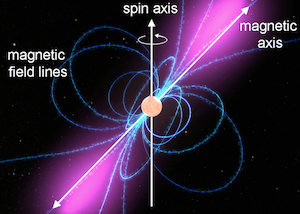
But how does a pulsar pulse? Similar to Earth, the magnetic poles generally do not line up with the axis of rotation on neutron stars. This leads to a beam of radiation that sweeps across space in circles from above and below the star. Over time, this release of energy slows the pulsar’s rotation, eventually causing it to become a regular neutron star (2).
Beyond what Dr. Bell Burnell originally discovered, there are actually multiple other subtypes of pulsars. One category is the X-ray pulsar, which emits X-rays and sometimes radio waves. These can be divided into High-mass X-ray binaries (HMXB) and Low-mass X-ray binaries (LMXB). HMXBs usually have a companion star that is five to thirty times as massive as the neutron star, and are powered by stellar winds that transfer matter to them (3). LMXBs usually have a smaller companion star which feeds the neutron star through mass transfer by Roche-lobe overflow, which is when excess mass from the Roche-lobe forms an accretion disk around the neutron star. Finally, there are the gamma-ray pulsars, which release gamma-rays and optic pulsars which emit visible light (3).
But why does this matter? Are pulsars dangerous? Approaching a pulsar would be extremely hazardous due to its powerful magnetic fields, waves of radiation, heat, or gravity (2). Only about 3,000 pulsars have been discovered, although discovery is difficult and the number could be much higher (1,2). Luckily the closest, PSR J0108-1431, is 424 light-years away (2).
Pulsars are cosmic lighthouses, and they show us some of the most intense conditions in the universe. They allow scientists to study the physical properties of ultradense matter, rapid rotations, and intense magnetic fields. Pulsars are not just the remnant of collapsing supergiants; they are essential tools for expanding our understanding of the cosmos.
Bibliography
- Pulsars as Cosmic Clocks. (n.d.). NANOGrav. Retrieved January 19, 2026, from https://nanograv.org/science/topics/pulsars-cosmic-clocks
- Sutter, P. (2022, May 24). What are pulsars? Livescience.com. https://www.livescience.com/what-are-pulsars
- Pulsar. (n.d.). Astronomy.swin.edu.au. Retrieved January 19, 2026, from https://astronomy.swin.edu.au/cosmos/P/Pulsar
Image






Comments are closed.