
A very popular kitchen appliance uses technology actually invented for entirely different reasons
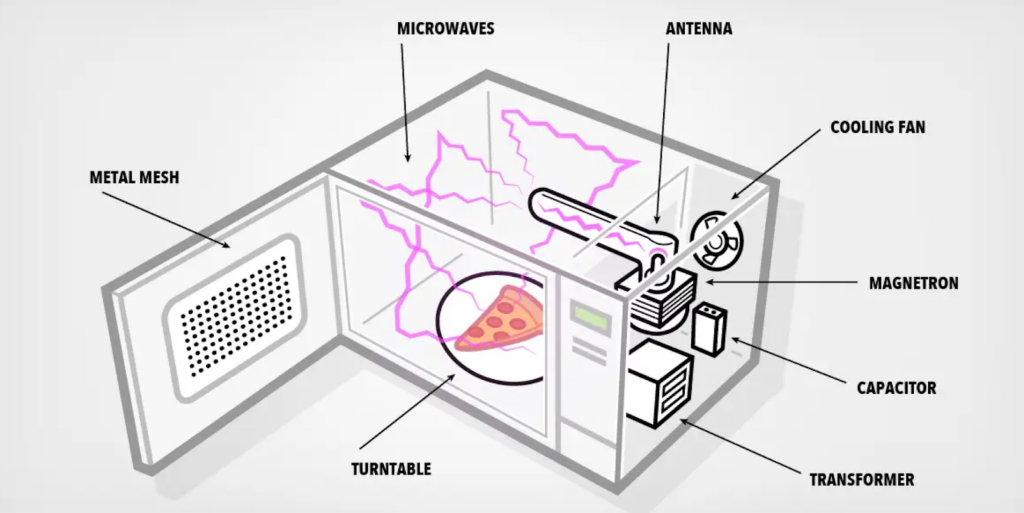
The microwave oven, commonly referred to as the “microwave,” has been a staple in modern kitchens across the globe for decades (1). It has evolved from being a 750-pound, 6-foot-tall box costing about $5,000 to a compact, inexpensive countertop appliance (1). According to the Bureau of Labor Statistics, around 90% of households across America own a microwave today—a significant increase from when the appliance first entered the market in 1946 (2). Because of its popularity and rich history, many people might assume that the research behind the microwave was intended to produce this best-selling kitchen appliance. However, like many other famous inventions, the discovery of the microwave was entirely accidental (1).
The research of electromagnetic waves, which heat the inside of the microwave, dates back to the 1860s, when James Clerk Maxwell discovered fundamental equations relating to electrical and magnetic fields (3). This inspired experiments by Heinrich Hertz and other scientists (4). Hertz used a spark-gap transmitter and receiver to prove that the waves demonstrated in Maxwell’s equations existed—his work was crucial for the groundbreaking discovery of the electromagnetic spectrum of waves (3). In 1867, Hertz concluded that electromagnetic waves bounced off of conductors of electricity such as metal surfaces (4). Because of his major contributions, the standard unit of frequency was named after him (hertz/Hz) in his honor (5). In subsequent years, he also showed that electromagnetic waves behaved like visible light—he proved they could be reflected, refracted, and polarized in a similar way (4).
This research on wave spectrums was first implemented in the real world in the United Kingdom in 1915, when meteorologist Robert Watson Watt tracked thunderstorms using radio signals from lightning strikes. During the 1930s, it was a common belief in the UK that war within Europe was inevitable—thus, a plan to continue research on electromagnetic waves to create a device detecting enemy aircraft was arranged. After investigating this technology, the first radio detection system (Radio Detecting and Ranging, a.k.a. RADAR), known as the Chain Home Network, was installed by the UK in 1938. Heavy ground transmitters were built within the country, while smaller receivers were equipped on aircraft. However, this system soon proved to have a major limitation—smaller aircraft were not detected due to the use of long radio wavelengths (4).
This led to the breakthrough of cavity magnetron tubes, which provide shorter wavelength radiation compared to radio waves. These tubes are the core components of modern microwaves. These devices were invented at Birmingham University by physicists John Randall and Harry Boot in 1940 to solve the radar detection issue. This device continued to develop in England, but it also was brought to the United States; the Allies were able to gain a significant advantage in the war due to this research (4).
From that point onwards, a significant amount of research of the cavity magnetron tube was conducted by Raytheon, an American defense manufacturer (4). Raytheon engineers used the Radiation Lab at the Massachusetts Institute of Technology (MIT) to create new signalling devices for aircraft. One of those engineers was Percy Spencer. After being honorably discharged from World War I, he joined the engineering team at Raytheon and worked at the lab (6).
Being a huge fan of the “PAYDAY” peanut- and caramel-filled chocolate bars, Spencer brought a bar to work almost daily (6). After he experimented with a cavity magnetron tube one day, he realized that his chocolate bar started to melt whenever he came near a tube (7). In order to confirm his findings, he experimented by directing cavity magnetron tubes towards other food items such as uncooked popcorn and eggs – he was able to successfully heat them. This led to the first prototype of a microwave oven, which he named the Radarange (7).
The Radarange was a metal box with a cavity magnetron tube, and Spencer first patented it in 1945 (7). While initially only accessible to restaurants and diners, they became available to the public and started gaining in popularity in the 1970s (7). Unfortunately, Spencer passed away right before the appliance started to surge in popularity—he had only received the $2 bonus that was standard for Raytheon employees who patented an invention (8). Despite the intent for the cavity magnetron tube to be used during times of war, it has also proved to be significantly useful in the kitchens of households across the world. This goes to show how research can be interpreted and used in many different ways depending on the individual!
References
- KitchenAid. (2023, November 30). The Microwave Oven’s History. Kitchenaid.com; KitchenAid. https://www.kitchenaid.com/pinch-of-help/major-appliances/microwave-oven-history.html
- Liegey, P. (2001, October 16). Microwave Oven Regression Model : U.S. Bureau of Labor Statistics. Www.bls.gov. https://www.bls.gov/cpi/quality-adjustment/microwave-ovens.htm
- Clerk, J. (2026). Electromagnetic Theory. Clerkmaxwellfoundation.org. https://clerkmaxwellfoundation.org/html/electromagnetic_theory.html
- Wallace, R. (2022, May 19). Seeing in The Dark, Through Clouds, with Mosquitos Making Microwaves. The National WWII Museum | New Orleans. https://www.nationalww2museum.org/war/articles/seeing-dark-through-clouds-mosquitos-making-microwaves
- Britannica Editors. (1998, July 20). Hertz | Definition & Facts. Encyclopedia Britannica. https://www.britannica.com/science/hertz
- History.com Editors. (2024, October 3). First patent filed for the microwave | October 8, 1945 | HISTORY. HISTORY. https://www.history.com/this-day-in-history/October-8/microwave-oven-first-patent
- Whirlpool. (2023, May 18). History of the microwave oven. Whirlpool.com; Whirlpool. https://www.whirlpool.com/blog/kitchen/history-of-microwave.html
- Ponti, C. (2025, April 28). Who Invented the Microwave Oven? HISTORY. https://www.history.com/articles/microwave-oven-invention
Image Source:


Comments are closed.