
Is AI making humans think less—or think better?
If a chatbot can think for humans, will humans fail to think for themselves? As artificial intelligence finds its way into classrooms and workplaces, researchers and scientists are beginning to understand the deeper consequences of AI usage in learning.
But why is AI so appealing when downsides are so prevalent? Generative AI tools can write essays, summarize complex texts, and generate ideas at remarkable speeds. This efficiency is attractive not only to students but also professionals; however, the cognitive effort required to reach an end result can be achieved much faster with AI. This process is also known as cognitive offloading: the practice of relying on external tools to perform mental tasks.
While cognitive offloading has existed for decades (calculators and search engines), generative AI takes offloading further because it can reason, explain, and communicate. This leap AI takes in cognitive offloading comes with cognitive costs, as evidenced by a recent large-scale study involving 666 participants in the United Kingdom. Research found a strong negative relationship between AI usage and critical thinking skills, demonstrating that individuals who utilized AI more frequently tended to have poorer critical thinking skills.
In addition, the study revealed that AI usage had a strong positive correlation with cognitive offloading, meaning that frequent AI users are likely to delegate thinking tasks to machines rather than thinking through the topic independently. More importantly, cognitive offloading mediated the relationship between AI usage and critical thinking. The study suggests that AI’s negative impact on critical thinking occurred because of increased reliance on AI for reasoning tasks. This data shows that heavy reliance on AI encouraged a reduced mental engagement, helping to explain the drastic decline in critical thinking (1).

Another experiment involving 160 university students aged 18 to 35 focused on how college students use generative AI to support their analytical writing. Although the study did not yet provide their results (due to a study protocol), the study’s design reflects an increasing concern for how reliance on AI may reduce cognitive efforts during complex tasks. To capture cognitive effort with more precision than the previous experiment, researchers used multiple measurement techniques. Eye-tracking was used to monitor eye movements and pupil dilation, which are established indicators of mental workload. Furthermore, functional near-infrared spectroscopy (fNIRS) recorded changes in blood oxygenation in the brain, which allowed researchers to observe neural activity related to cognitive processing during writing. In addition, the participants also completed a survey to assess their perceptions of the writing task, and their reliance on generative AI. This was an important indicator for perceived difficulty or reliance on AI (2). Overall, this experiment measured participants’ cognitive abilities. Because the study harnessed behavioral, neurological, and self-report data, it addressed whether generative AI is a cognitive aid or cognitive substitute.
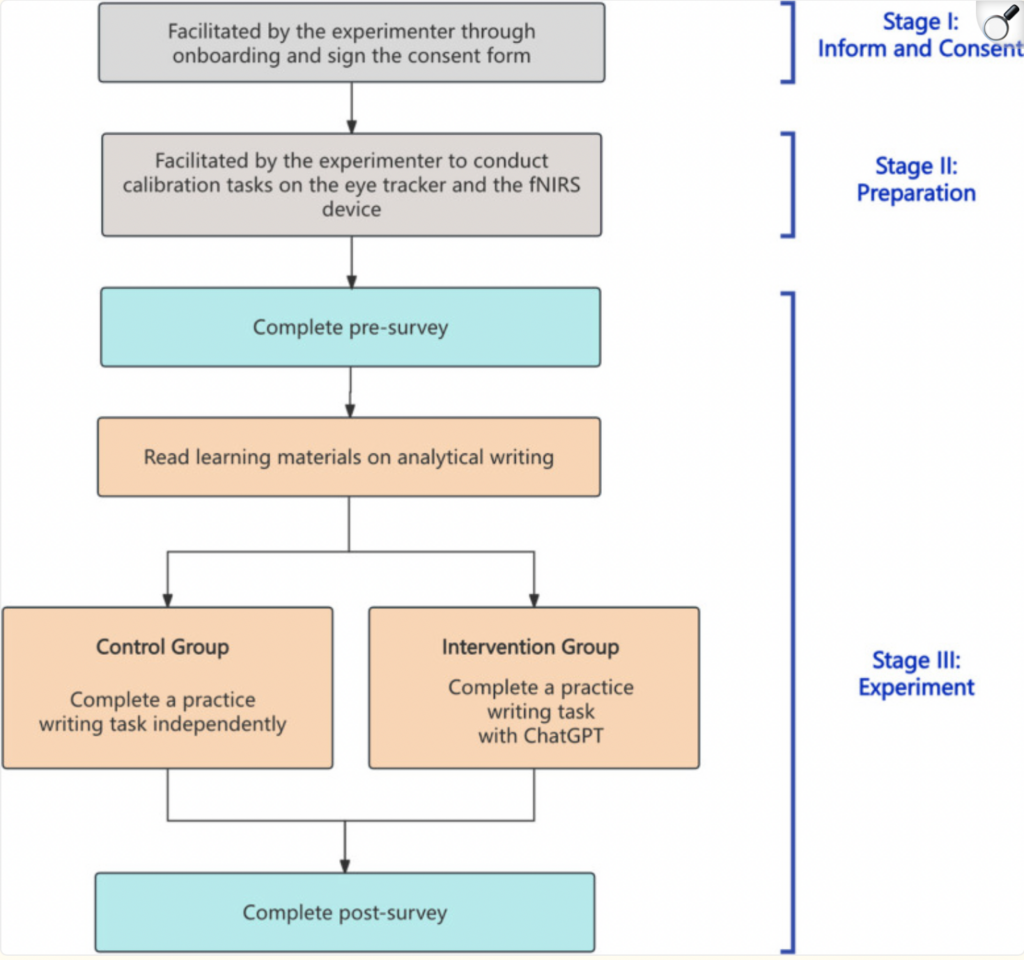
The central issue with AI is that it replaces thinking rather than supports it. Because of passive acceptance of the AI’s content, the human brain can weaken in terms of judgment and develop overconfidence, whereas active interaction (such as questioning and reflecting) preserves cognitive engagement.
As AI becomes more prevalent in modern society, it is essential to learn how to maintain cognitive effort with deliberate strategies; otherwise, AI may shift thinking from an active process to a passive one. It is equally important, however, to emphasize that researchers from both studies do not claim the inherent harm of AI. The challenge, therefore, is not to reject AI, but rather learn to use it wisely while preserving human cognition (3).
Images
- https://pmc.ncbi.nlm.nih.gov/articles/PMC12255134/
- https://pmc.ncbi.nlm.nih.gov/articles/PMC12255134/
Bibliography
- Chen, Y., Wang, Y., Wüstenberg, T., Kizilcec, R. F., Fan, Y., Li, Y., Lu, B., Yuan, M., Zhang, J., Zhang, Z., Geldsetzer, P., Chen, S., & Bärnighausen, T. (2025). Effects of generative artificial intelligence on cognitive effort and task performance: study protocol for a randomized controlled experiment among college students. Trials, 26(1). https://doi.org/10.1186/s13063-025-08950-3
- Gerlich, M. (2025). AI Tools in Society: Impacts on Cognitive Offloading and the Future of Critical Thinking. Societies, 15(1), 6. https://doi.org/10.3390/soc15010006
- Wang, M. (2025, August 13). Does AI Harm Critical Thinking – Duke Learning Innovation & Lifetime Education. Duke Learning Innovation & Lifetime Education. https://ctl.duke.edu/ai-ethics-learning-toolkit/does-ai-harm-critical-thinking/





Comments are closed.